9.3
8.536 reviews

English
EN


Central banks can use digital central bank money to gain total control over payment transactions. The technology makes it possible to track every transaction, unlike cash that passes from hand to hand unseen. This was said by Augustin Carstens, president of the Bank for International Settlements.
In January, the central banker held a speech about the future of money. In it, he said that the issuance of digital money should be reserved for central banks. Only they would be able to guarantee the security and stability of the digital money, according to Carstens. This video clip Carstens says that central bank digital money makes it possible to track all transactions. This gives central banks full control over money. From the video excerpt:
"We're trying to put down an equivalent of cash. And there's a big difference there, because with cash, for example, we don't know who is using a $100 bill or a 1,000-peso note today. The difference with central bank digital money is that the central bank has absolute control over the rules under which one can use this central bank money. We also have the technology to enforce that. Those two things are extremely important. That makes a big difference to what cash is."
All major central banks have been developing central bank digital money in recent years. In doing so, they are responding to the transition from cash to electronic payments. Central banks are also trying to offer an alternative to virtual currencies such as Bitcoin and Ethereum, which are becoming increasingly popular as an alternative to money. And that poses a threat to central banks, because they can't control virtual currencies.
Central banks are accelerating the development of central bank digital money because they want to prevent people from flocking to alternatives. The ECB aims to achieve a Digital euro while China is already experimenting with a Digital Yuan. The Federal Reserve, meanwhile, is working on a digital dollar, which will allow people to hold a balance directly with the central bank. The Bahamas launched last year with the 'Sand Dollar' is already a form of central bank digital money. So this development is going very fast.
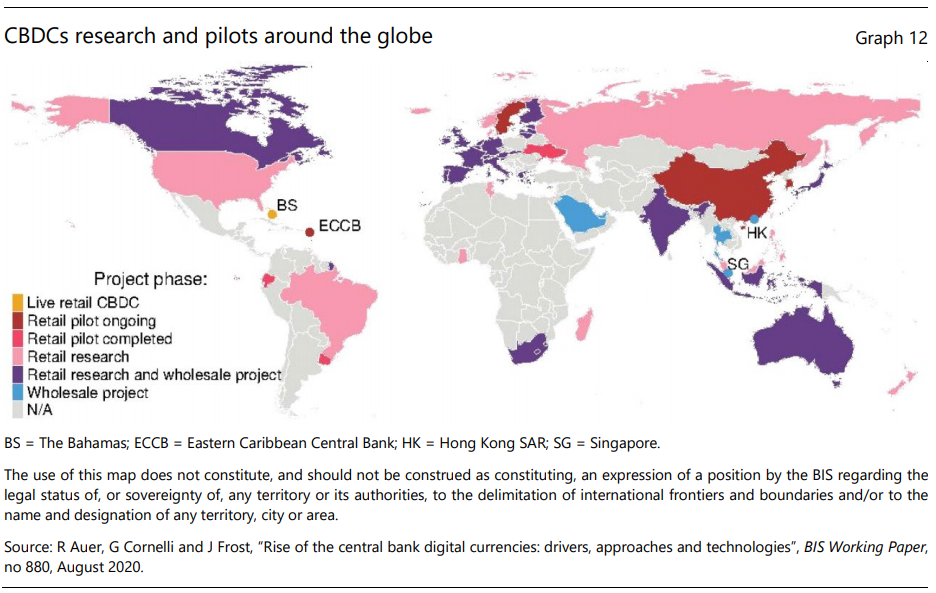
Central banks worldwide are preparing for the introduction of CBDC (Source: ENCORE)
The difference between central bank digital money and the money we currently use for electronic payments is the counterparty we do business with. In the first case, you have a balance with the central bank, in the second case with a commercial bank. For the end user, that may not be a big difference, but it does have implications for the future of our money. Central banks are responsible for issuing traditional coins and banknotes. With the advent of a digital successor, central banks may decide to withdraw cash from circulation in the long term.
Of course, this will not happen immediately, but it is in line with the long-term strategy of governments and central banks. They find cash difficult, because it gives them no insight into the money flows. It is also not possible to pass on negative interest rates on cash, whereas this is possible with central bank digital money. In fact, the ECB has already indicated that this is one of the policy tools it can apply with a digital euro. Central banks are therefore gaining more control with central bank digital money, which makes far-reaching financial repression possible.
Due to the extreme monetary policy of central banks, more and more savers and investors are looking for alternatives to the savings account. If they are not deterred by low interest rates, then by rising inflation. As a result, money loses purchasing power every year. It is therefore not surprising that the popularity of precious metals such as gold, silver and virtual currencies has increased considerably since the corona crisis. These forms of wealth exist outside the financial system and are therefore not dependent on (central) banks.
Disclaimer: Holland Gold does not provide investment advice and this article should not be considered as such. Past performance is no guarantee of future results.
This contribution was made from Geotrendlines


