English
EN



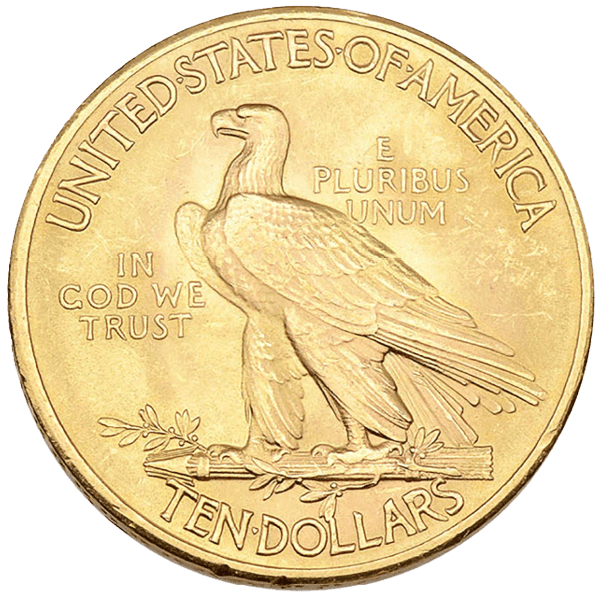
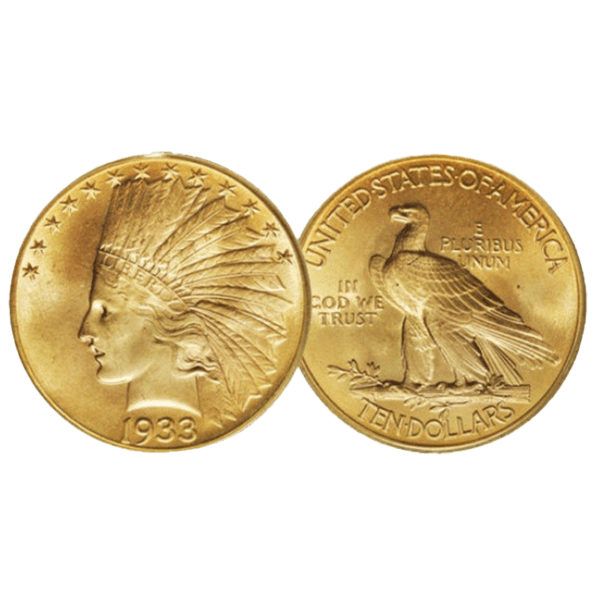
The 10 Dollar Indian Head Gold Eagle is one of the most distinctive historical gold coins from the United States. The coin is struck in 0.900 fine gold (21.6 carat) and contains 15.05 grams of pure gold, equivalent to approximately 0.484 troy ounce. This makes the coin an interesting historical alternative to modern half-ounce bullion coins.
The total weight is 16.72 grams. With a diameter of approximately 27 mm, the coin has a compact yet easily recognizable size. The 10 Dollar Indian Head Gold Eagle was issued as legal tender and was actively circulated between 1907 and 1933. The coins offered come from various years and may show signs of circulation.
The face value of the coin was 10 US dollars (USD), but its current value is naturally much higher due to its gold content and historical significance. The Indian Head Gold Eagle succeeded the Liberty Head (Coronet Head) Gold Eagle in the early 20th century. Both coins share the same gold content but differ greatly in design and appearance.
The 10 Dollar Indian Head Gold Eagle features an innovative design that differs significantly from earlier American coins. The obverse depicts Lady Liberty wearing a Native American headdress; despite the name, this is not a Native American portrait but a symbolic representation of Liberty. Above her head appears the word LIBERTY, with 13 stars along the rim representing the original states.
The reverse shows an American eagle holding arrows and an olive branch, surrounded by UNITED STATES OF AMERICA and TEN DOLLARS. The mottos IN GOD WE TRUST and E PLURIBUS UNUM are also included, the latter meaning “Out of many, one.”
The design was created by Augustus Saint-Gaudens and came about at the initiative of President Theodore Roosevelt, who sought to artistically renew American coinage following classical ideals.
In 1933, production and circulation of the 10 Dollar Indian Head Gold Eagle came to an abrupt end. That year, the US government under President Franklin D. Roosevelt banned private ownership of gold. Citizens and businesses were required to surrender or sell their gold coins, bars, and certificates to the government.
Franklin D. Roosevelt was a distant cousin of Theodore Roosevelt, who had earlier initiated the artistic renewal of American coinage. Both presidents came from different branches of the same Roosevelt family, which traces its origins to Dutch settlers in 17th-century New Netherland.
In exchange for surrendered gold, citizens received a fixed compensation of 20.67 US dollars per troy ounce, the official gold price at the time. Shortly thereafter, the gold price was raised to 35 dollars per troy ounce, effectively devaluing the dollar and significantly revaluing gold.
As a result of these measures, the vast majority of Indian Head Gold Eagles were withdrawn from circulation and melted down. Today, the coin is not only a historical gold coin but also a tangible and relatively scarce reminder of a pivotal moment in American monetary history.
Looking to sell your gold coins? Holland Gold offers a buyback guarantee for this coin. We also purchase coins that were not originally bought from us. On our website, under the section “sell to us,” you can view the current buyback price.
| Fine weight | 15,05 Gram |
| Total weight | 16,72 Gram |
| Dimensions | Ø 27 mm x 2 mm |
| Purity / Content | 900/1000 - 21.6 Carats |
| Year of issue | 1907-1933 |
| Condition | Previously circulated |
| Country of Origin | United States of America |
| Mint House | The United States Mint |
| Packaging | Soft plastic coin capsule |
| Safety features | No |
| Legal tender | Yes |
| Face value | 10 U.S. dollars |
| Tax (VAT) | Exempt from VAT |
| Insured shipment possible | Yes, at a location of your choice |
| Pick-up available | Yes, in Alkmaar or Rotterdam |
| Storage possible | Yes, in the Netherlands |