English
EN


A transaction takes place because the buyer values the euros less than the product, while the seller prefers the euros to the product. We express prices in euros, assuming that the euro is a fixed benchmark. But anyone who measures everything in euros cannot determine whether the euro itself is losing purchasing power. If we look at the same economy using a different benchmark, such as gold, a very different picture may emerge. What does that tell us about today's prices?
As mentioned earlier, a voluntary transaction takes place because people value goods differently. To the customer, a loaf of bread is worth more than the money paid for it, while the baker prefers the money to the bread.
In the days of hunters and gatherers, people mainly lived in small groups, were largely self-sufficient and produced for their own needs. Differences in skills led people to specialise increasingly in particular tasks. This enabled them to produce more efficiently, resulting in greater productivity and prosperity. At the same time, this created a greater need to trade with others.
Before money existed, this mainly took place through barter: goods were exchanged directly for other goods. This presented several problems. A car, for example, is worth much more than a refrigerator. How do you exchange a car for goods of lower value? You cannot divide a car into 10 parts. Moreover, both parties had to want exactly what the other was offering. A concert ticket may be very valuable to one person, while another would give nothing for it.
To overcome these problems, traders began using goods that were widely accepted and therefore easy to trade. Instead of bartering directly for the desired product, people first exchanged their goods for another good that served as a medium of exchange. This good was not acquired primarily for consumption or production, but to facilitate future transactions. As more and more people accepted a good as a medium of exchange, its saleability increased. In this way, the use of certain goods eventually evolved into money as we know it.
Money therefore facilitates more transactions, but it also has another important advantage. Expressing the value of goods in the same monetary unit makes economic calculation possible. If each good were priced in terms of other goods, this would result in a vast number of prices. Aldi has around 1,300 products. If each of these were priced in terms of every other product, this would result in 844,000 prices. This would obviously lead to chaos, so money becomes increasingly important as production increases in scale and scope. A good laptop, for example, costs 1 ounce of gold, while a car costs 12 ounces of gold. A car is therefore worth about 12 laptops. This makes it easy to compare values, and these common market prices allow entrepreneurs to determine whether they are making a profit or a loss and whether they are allocating their capital efficiently.
Money provides purchasing power. Like other products, it has a market. Greater demand for money increases its value, while a larger quantity of money reduces its value. When people want twice as much money, they do not mean more paper, but more purchasing power. Printing money to meet this additional demand does not help: although it gives people the money, it does not improve their purchasing power, because there are just as many products but twice as much money, which therefore halves purchasing power. With a stable form of money whose supply grows slowly, prices therefore often fall because the quantity of money increases more slowly than the production of goods and services. To illustrate: 100 euros divided by 10 loaves of bread is 10 euros per loaf, while 100 euros divided by 100 loaves is 1 euro per loaf.
A price is therefore an exchange ratio that depends on the product and the good it is exchanged for. If this ratio changes, it is because of a change in one of the two. The current method of measuring inflation treats the euro as a stable unit of measurement. You measure your table and find that it is 2 metres long. If half of your measuring stick has been sawn off, the table will appear twice as long when measured again, although it obviously remains the same length. By measuring everything in euros, you can never measure what has happened to the euro itself. Inflation is currently measured using the Consumer Price Index (CPI). This involves taking a basket of products and comparing its price over time. The publisher adjusts the basket each year based on what is considered representative. House prices are not included, and the measurement method has also been revised several times over the years.
Measuring prices in gold therefore offers valuable additional insight. Gold has no committee that adjusts the calculation. Although the value of gold fluctuates, the benchmark itself remains fixed: an ounce in 1932 is the same as an ounce today, and no one can change the definition. Median prices of single-family homes in the US are historically low when expressed in gold (left-hand chart), while the stock market index of the 500 largest companies in the United States is significantly lower than in the 2000s and also almost 30 percent lower than in January 2022 (right-hand chart). And that is something the Consumer Price Index does not show.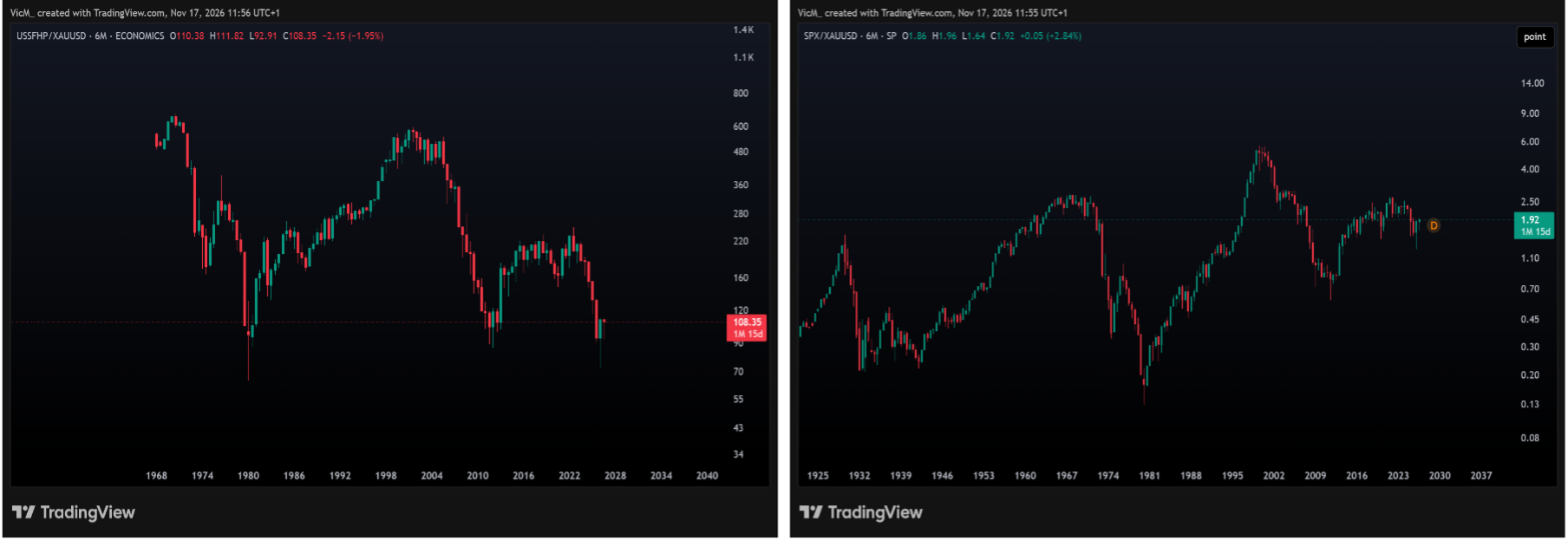
Anyone who measures prices only in euros can never see whether the euro itself is losing purchasing power. A measuring stick cannot measure itself. Inflation figures therefore tell us something about the price of a basket of consumer goods, but not about what is happening to the benchmark itself. Gold is not a perfect benchmark, because its value also fluctuates. But it is an independent benchmark: no one can change the definition. Measuring houses and shares in gold produces a different picture from measuring them in dollars or euros. It shows that prices expressed in money tell only part of the story.