English
EN


Nvidia CEO Jensen Huang has stepped down with immediate effect following an affair with an alleged Chinese spy. Meanwhile, Anthropic is preparing to go public next week at a massive valuation, and political opposition to data centers is growing. Is this the turning point for the AI boom?
Nvidia's share price is under pressure. Yesterday, the chip giant's shares fell by 4.34%, and the stock is now down more than 30% from its peak in early October. The decline stems from the controversy surrounding Jensen Huang, the company's co-founder, who had been at the helm for more than thirty years. His position came under pressure after The New York Times reported that he had had an extramarital affair with Alice Huang, a senior executive at data center company Megaspeed and an alleged Chinese spy.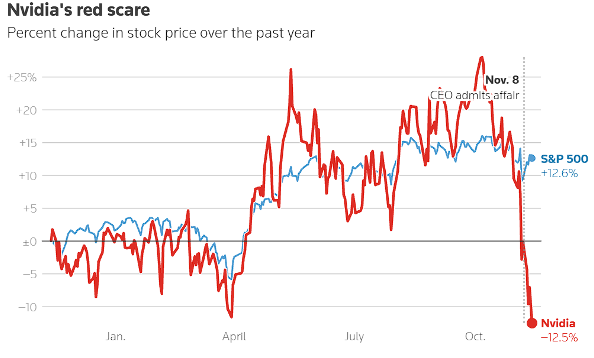
Nvidia share price performance. (Source: Reuters)
To start at the beginning: Megaspeed is at the center of the espionage allegations. Before operating independently, the company was part of Chinese video game company 7Road Holdings Ltd. Megaspeed's shares were then held by a company linked to Alice Huang. After the Biden administration had tightened the rules on investment in China's AI industry, the shares were transferred to Singapore-based shell company Swiftspeed in November 2023. Not long afterward, the company announced an official cloud partnership with Nvidia, giving Swiftspeed access to the tech company's advanced AI chips.
According to a timeline published by The New York Times, the computing power of those advanced chips was rented out to major Chinese AI companies Tencent and Alibaba. This prompted the US Department of Commerce to launch an investigation into Megaspeed in September 2025. The question is whether the company is giving Chinese AI companies access to high-end chips in violation of US export restrictions.
After lobbying efforts led to an easing of restrictions on exports of high-end chips to China, reports emerged in late October that Huang may have been targeted by a Chinese spy. On November 8, the Nvidia CEO admitted to the extramarital affair but denied that any national security or corporate secrets had been disclosed. Nvidia initially stood by him. However, when an investor filed a lawsuit and Huang admitted to a second extramarital affair, that was the last straw. He stepped down, and Colette Kress, the chief financial officer, is temporarily taking over his duties.
US intelligence agencies accuse Alice Huang of acting as a Chinese spy and attempting to extract chip technology secrets from Nvidia's CEO. Jensen Huang must therefore now testify before the Senate. The United States has long been concerned about exports of advanced chips to China and has sought to curb them through restrictions. Such chips could allow China to modernize its military and improve its AI models more quickly. The scandal reinforces the consensus that additional export restrictions and stricter controls are needed. As a result, Nvidia and the chip industry risk losing a major market.
Anthropic, the company behind AI chatbot Claude, is going public next week. Reuters reports that its shares are expected to begin trading next Thursday under the ticker symbol “ANT” on the Nasdaq technology stock exchange. The IPO is a crucial test of investor confidence in the AI boom.
The company is going public at a valuation of $1.4 trillion and hopes to raise up to $90.4 billion at that valuation. Of this amount, $26 billion will be raised through a private placement, in which the company sells shares directly to a select group of investors rather than to the general public. These investors include Alphabet, Google's parent company, and chip companies AMD and Nvidia.
As recently as September, Anthropic's potential valuation stood at $2 trillion. Concerns about costs and AI infrastructure have since brought that valuation down. Those concerns do not appear unfounded: in 2025, the company recorded a loss of no less than $42 billion on revenue that increased twelvefold that year to $4.6 billion. Its operating loss of $8.06 billion shows that profitability remains a long way off. The company does, however, expect strong growth this year. By October, its annualized revenue run rate had reached $81 billion.
In its prospectus, the document providing investors with information about the company and its risks, Anthropic also gives extensive warnings about the dangers of AI. These include “behavior resembling blackmail”, “refusing to shut down”, “concealing or manipulating information”, and behavior through which AI preserves itself, according to BNR, which lists these risks.
Rapid growth also brings risks and requires enormous spending on infrastructure. The company has almost $900 billion in future purchase and lease commitments with other companies. Moreover, a quarter of its revenue in 2025 depended on two customers. Many major customers have no fixed contractual commitments and may reduce their spending or even stop spending altogether.
Although Anthropic is growing at an unprecedented pace and offers an innovative product, that growth needs to continue. If growth slows, the company will remain tied to its commitments. Next week's IPO will provide insight into how much confidence investors have in that growth, and confidence appears high despite concerns about the enormous investments. The IPO is around six times oversubscribed. In other words, demand for shares is six times the number available.
Political opposition to data centers is growing, as the increasing number of protests clearly demonstrates. Bloomberg describes how people in several European countries took to the streets to voice their concerns about the impact of data centers on the climate and society. In Amsterdam, activists entered a Microsoft data center construction site. Around 2,000 people joined a march in Dublin, and approximately 1,300 took part in Helsinki. They are demanding a temporary halt to the construction of large data centers.
Major companies have recently been investing heavily in data centers. Google, for example, recently announced a €13 billion investment in Finland, the largest investment in Europe. In Ireland, data centers now consume 23% of the country's electricity.
Political tensions surrounding data centers are also rising in the United States. In states including Texas, Ohio, and Georgia, where many data centers are planned, Democrats won substantial support in the midterm elections. These Democrats are more critical of data centers and want to pause construction. Referendums were also held in several states, with voters opting for a construction moratorium in almost every case. The question is therefore whether all the planned data centers will actually be built.
In the short term, the impact of this opposition remains limited. According to Rogier Quaedvlieg, US economist at ABN AMRO, construction on most projects scheduled for 2027 has already begun, or permits have already been granted.
From 2028 onward, however, things will become more difficult for tech companies, as that is when the application process for new projects gets underway. For major tech companies, whose growth plans depend heavily on investment in infrastructure, this political climate could therefore pose a risk.
Also take a look at our YouTube channel
On behalf of Holland Gold, Paul Buitink and Yael Potjer interview a range of economists and macroeconomic experts. The podcast aims to give viewers a clearer understanding and a sense of direction in an increasingly fast-changing macroeconomic and monetary landscape. Click here to subscribe.