English
EN


There seems to be no stopping French interest rates. On Friday, the 10-year yield broke through the 5 percent mark, and the gap with Germany is now the widest it has been since the euro crisis. According to economist Robin Brooks, it has come to that: "France is now in a debt crisis." What can we expect, and what solutions are there?
France, and with it the entire eurozone, has a serious problem. On Friday afternoon, the French 10-year yield broke through the key threshold of 5 percent. At the start of the summer, it was still 3.51 percent. When a prominent politician openly talks about 'burning' government debt, as Jean-Luc Mélenchon did this summer, interest rates rise and the problems only get bigger. Who could have seen that coming?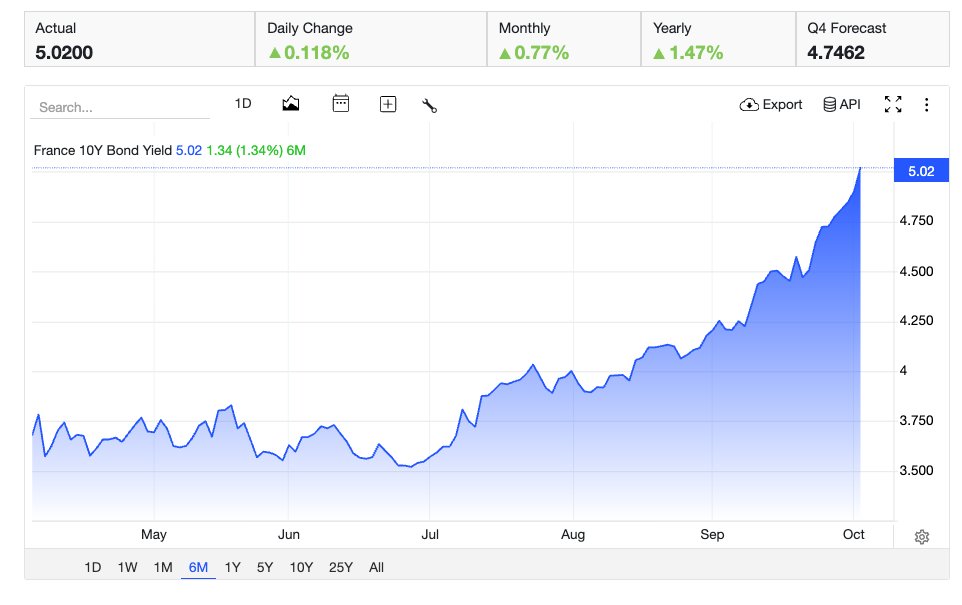 French 10-year yield rises to 5 percent (source: Tradingeconomics)
The market finally seems to realize that France is not simply going to solve its problems on its own. We already wrote several articles about this last year. Of course, interest rates are rising worldwide, but French rates are rising considerably faster. The spread, the difference between the French and German 10-year yields, is shooting straight up and now stands at around 1.5 percentage points. That is the highest level since 2011, when the euro crisis was in full swing.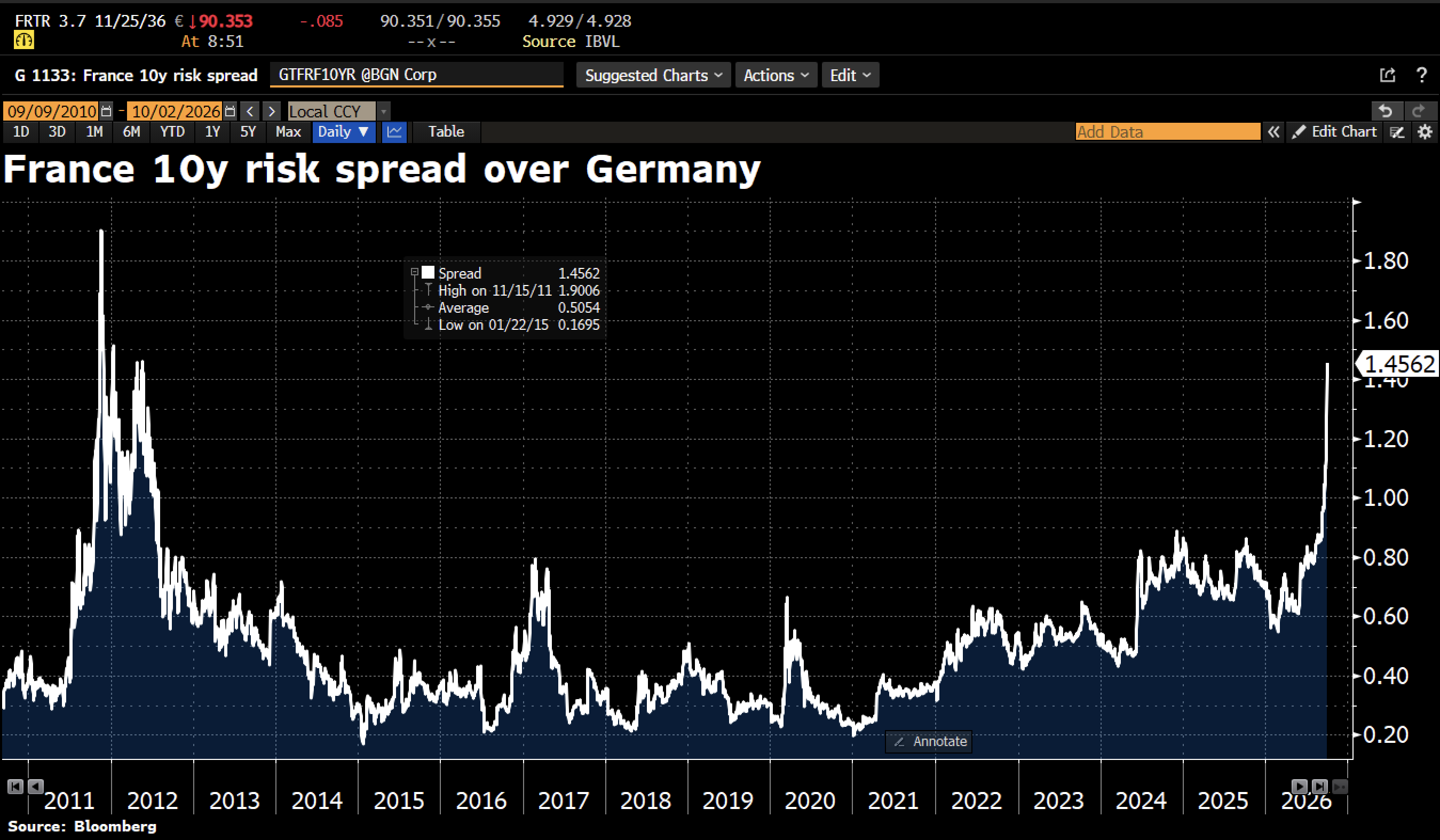
The spread back at euro crisis levels (source: Holger Zschaepitz)
According to Bloomberg, other eurozone countries could be dragged down with it if France does not get its budget in order soon. Investors could then also start demanding higher interest rates from other heavily indebted countries. With government debt of almost 120 percent of GDP, a budget deficit of 5.4 percent, government spending of more than 57 percent of GDP, an economy that is barely growing, huge unfunded liabilities (think pensions) and a political system that is completely deadlocked, it seems that an unsustainably high interest rate will be needed to force France into reforms and spending cuts.
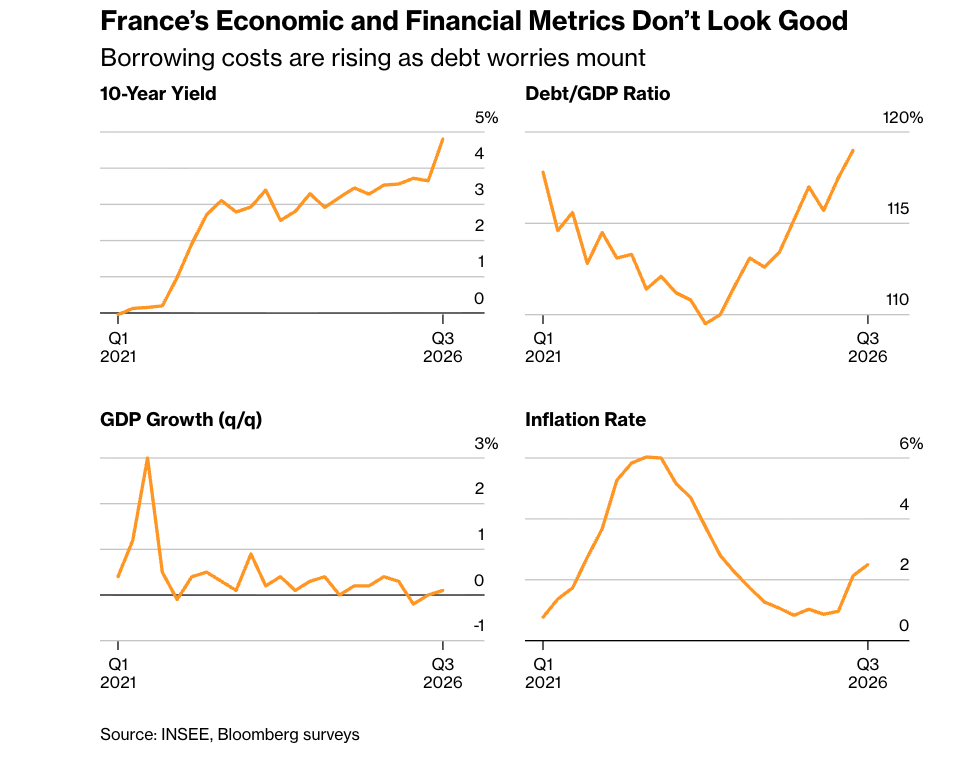 The French economy in four charts (source: Bloomberg)
To reassure the market, France's minority government on Thursday presented a plan to reduce the budget deficit to 5 percent, still well above the agreed 3 percent. The government wants to improve the budget by 43 billion euros, more than a third of which is to come from tax increases. Whether that will succeed is highly questionable. As regular readers know, previous austerity plans also fell apart. And with interest rates rising further on Friday, the market does not seem to have much confidence in this one either. Moreover, in the run-up to the presidential elections in April and May, France is likely heading into a period of great uncertainty.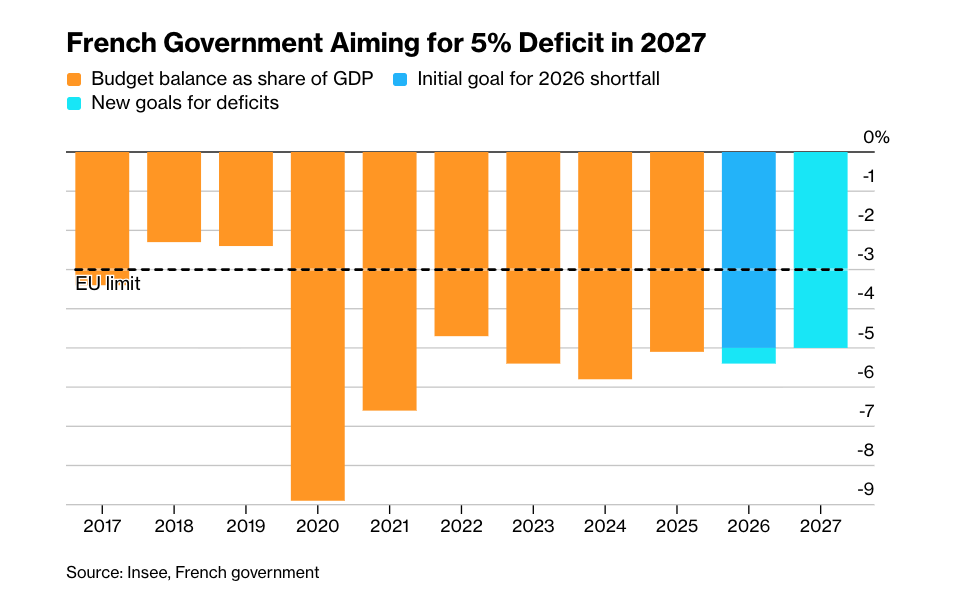
French budget deficit over time (source: Bloomberg)
Next year, the French state wants to borrow 340 billion euros, a record amount, to finance the deficit and refinance maturing debt. Interest costs will rise to 91 billion euros in 2027, almost 3 percent of the entire economy. That is more than France spends on defense, and also more than it spends on education.
Marine Le Pen, front-runner in the polls for the presidential election, proposed on Thursday to enshrine a golden budget rule in the French constitution, possibly also to reassure the markets. The rule is meant to force future governments to bring the deficit down: to 4.9 percent in 2027 and by half a percentage point every year after that. If she wins in May, she wants to hold a referendum on it. Whether that is realistic is doubtful. Either way, interest rates keep rising, and not exactly calmly.
Marine Le Pen (source: EP/Flickr)
Can this go on much longer? "I don't think so!" writes economist Han de Jong today in his weekly macro commentary. He fears that the ECB will eventually step in by buying French government bonds to push interest rates down. That comes at the expense of its most important task, safeguarding price stability. In other words: expect currency debasement.
Han de Jong is not the only one who thinks so. "France is now in a debt crisis," writes economist Robin Brooks. He too points to the ECB as the culprit. Because the ECB previously stepped in to push down Italian and Spanish interest rates, the incentive to reform disappeared. According to Brooks, this started even earlier, with Mario Draghi's famous "whatever it takes" speech in 2012. In his view, France should have put its budget in order long ago, but politicians simply respond to incentives. And in the eurozone, that incentive is clear: if a country's government debt comes under pressure, the ECB rushes to the rescue, because it fears for its own survival.
Brooks also proposes a radical solution: prohibit the ECB from being active in the government bond market any longer. He says this would cause considerable turmoil, but that it is the only way to save the euro in the long run. In addition, he believes that the representatives of low-debt countries such as the Netherlands have been too cowardly (to paraphrase) to stand up to the heavily indebted south. He also wants to keep policymakers personally accountable for the consequences of their policies, even after they leave office.
Meanwhile, inflation in the eurozone continues to rise, from 3.2 percent in August to 3.8 percent in September. To be continued!