English
EN


De Nederlandsche Bank announced in September that it had moved 86 tonnes of gold from New York and Ottawa to London. The Netherlands is not the only country reassessing its gold reserves. France previously repatriated its entire foreign-held gold reserves from the United States. Other central banks are also reconsidering where their reserves are stored.
For DNB, increasing geopolitical instability is a reason to improve its crisis preparedness. This has also drawn greater attention to the question of where central banks should store their gold. Why are gold reserves being moved now, and what does this say about gold’s changing role as a strategic reserve?
To understand why so many gold reserves are held in the United States, we need to go back to the gold standard. Under this system, currencies such as the dollar were linked to a fixed quantity of gold. If confidence in the dollar declined, dollars could be exchanged for gold. After the Second World War, a different monetary system was introduced: Bretton Woods. Under this system, currencies were pegged to the dollar at fixed exchange rates, while the dollar itself could be exchanged for gold. This system led to large trade deficits in the United States. Many European countries exported more to the US than they imported from it. As a result, dollars flowed to Europe and were subsequently exchanged for gold by European central banks. In this way, a large proportion of American gold was transferred to European central banks. When the system became unsustainable in 1971, much of the gold that had already flowed to Europe remained there.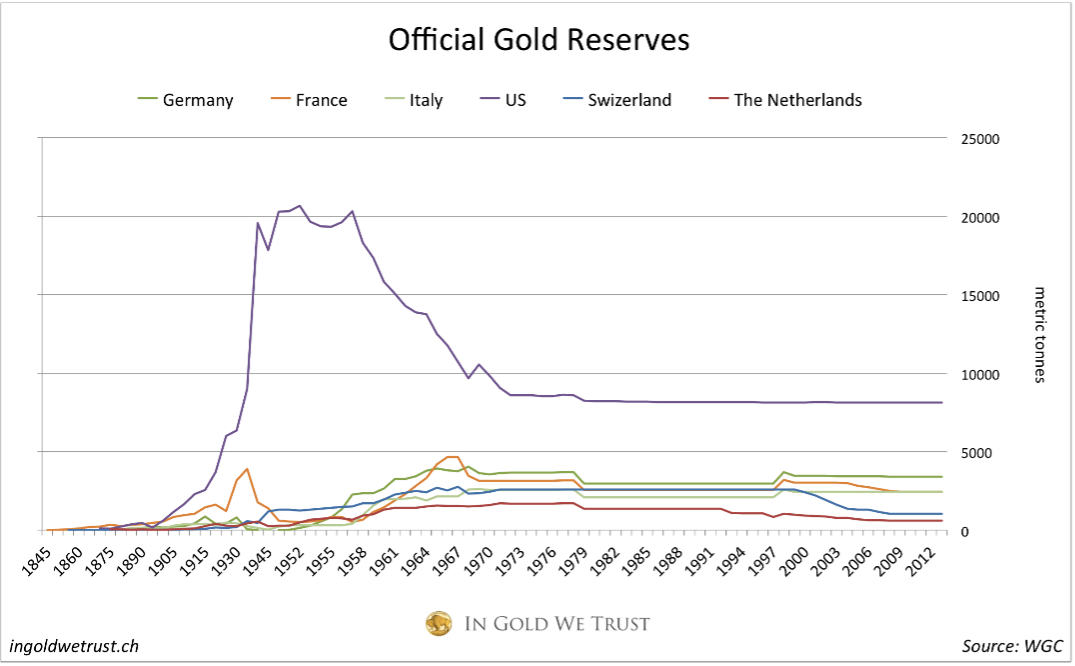
Development of Gold Reserves (Source: WGC)
In 2026, a clear trend is emerging. An increasing number of countries are repatriating their gold or moving it closer to home. In addition to the Netherlands and France, this debate has been taking place in Germany for some time. Leading German economists recently recommended repatriating part of Germany’s substantial gold reserves, worth approximately €164 billion, from New York. In the financial newspaper Handelsblatt, economist Emanuel Mönch, former head of research at Germany’s central bank, the Bundesbank, called for the gold to be returned to Germany. He considers it “risky” to store so much gold in the US under the current American administration. According to Mönch, Germany should therefore pursue greater strategic independence from the US and consider repatriating its gold reserves.
A shift towards domestic storage is also visible outside Europe. China stores all its gold reserves domestically, while India has repatriated approximately 300 tonnes of gold from the United Kingdom since 2024. As a result, by far the largest share of India’s gold reserves is now held within its own borders.
A recent survey of central banks shows how gold’s role within their reserves has changed in recent years. This survey by the World Gold Council provides insight into how central bankers view gold.
The survey shows that central banks increasingly regard gold as an active strategic reserve. Gold’s performance during crises, diversification and protection against inflation are among the main reasons for holding it. Protection against geopolitical risks and the broader diversification of reserves are also increasingly cited as reasons for expanding gold holdings. In the 1990s, central banks instead sold large quantities of gold because, following the end of Bretton Woods, it played virtually no active role in the monetary system. The precious metal has since regained a clear strategic function within central bank reserves.
The desire to become less dependent on other countries also plays an important role. Russia’s invasion of Ukraine and the sanctions that followed demonstrated that foreign reserves are not always entirely beyond the reach of geopolitical developments. Central banks have consequently become more aware of the risks associated with holding reserves in foreign currencies and at foreign institutions. The survey shows that 74% of central bankers expect the US dollar’s share of global reserves to decline over the next five years. At the same time, central banks are buying increasing quantities of gold. Gold therefore provides countries with a way to diversify their reserves and reduce their dependence on other countries and currencies.
Gold’s emergence as a strategic reserve and the desire to become less dependent on other countries therefore explain not only why central banks are buying increasing quantities of gold, but also why they are moving their gold reserves. The survey shows that 9% of central banks increased the amount of gold stored within their own borders over the past year, compared with 5% a year earlier. Even more striking is the increase in the proportion of central banks that have diversified their foreign storage locations: 10%, compared with just 2% last year. A larger proportion of central banks also expect to make further changes to their storage arrangements over the next twelve months.
Storing gold abroad entails geopolitical risks. In an uncertain world, central banks are increasingly opting for the security of having their gold close at hand.