English
EN


From tulip mania and the dot-com bubble to the financial crisis, financial bubbles keep returning. In 2026, the same question is being asked once again. Are the high valuations of AI stocks justified by a new technological era, or are we on the verge of another bubble?
Strikingly, the largest financial bubbles of the past often coincided with the construction of the world’s tallest skyscrapers. A coincidence, or a sign that optimism has gone too far? Behind this euphoria often lies a combination of monetary policy and psychological herd behaviour. What lessons can we draw from this phenomenon, and does it tell us anything about the current AI rally?
A financial bubble does not arise solely from optimistic investors or speculation. It is often preceded by a monetary environment that creates distorted economic incentives.
The function of capital
By postponing consumption, people can save. These savings make investments possible that only generate greater production and prosperity at a later stage. Imagine Robinson Crusoe washing ashore on a deserted island. He could eat all the food he gathers each day simply to survive, but he could also choose to save some of it so that he can spend a day making a bow and arrow. This investment would allow him to gather food much more efficiently in the future. If he wanted to develop further and build a house, for example, this would require even more time. He would first have to gather and store more food.
The structure of production
The production of consumer goods consists of several stages. Consumer goods, such as a loaf of bread from a bakery, are also known as lower-order goods. Capital goods that are further removed from the consumer, such as agricultural machinery or machines used to manufacture other machines, are known as higher-order goods.
In general, production processes become more productive as they take more time and involve more stages of production. An aircraft, for example, is far more complex than a bicycle and requires a much longer production chain involving specialised machinery, factories and suppliers. It is precisely this longer production structure that makes it possible to produce better products more efficiently.
Economic growth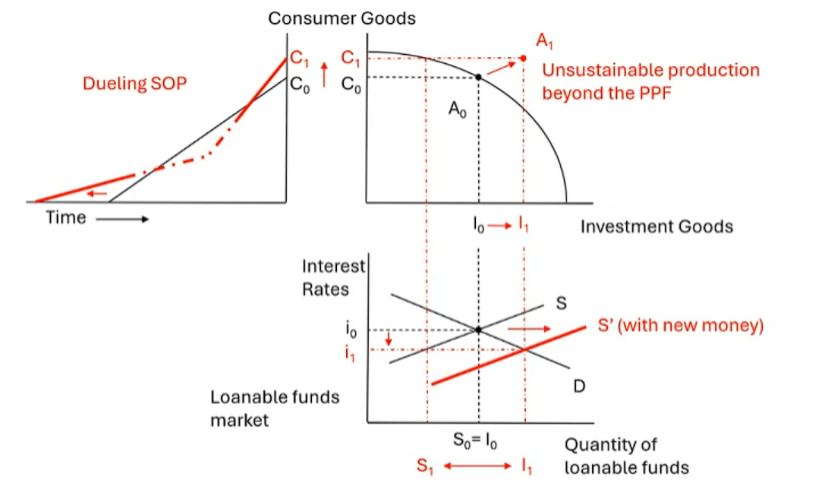
Now that the structure of production is clear, it also becomes apparent how economic growth occurs.

When central banks attempt to imitate this process by keeping interest rates artificially low, the result is unsustainable economic growth. An artificial expansion of the money supply lowers interest rates, encouraging entrepreneurs to undertake more long-term investments. After all, lower interest rates create the impression that more savings are available.
The problem, however, is that consumers’ time preference has not changed. They still attach the same value to present consumption and have therefore not saved more. In fact, lower interest rates make saving less attractive, encouraging consumers to spend more instead. This leads to both greater investment and higher consumption at the same time, even though both ultimately rely on the same scarce resources.
Entrepreneurs eventually discover that insufficient resources are available to complete all investment projects. Production costs therefore turn out to be higher than expected, and many companies require additional short-term financing to continue their projects. This can cause short-term interest rates to rise above long-term rates, creating what is known as an inverted yield curve. For decades, this inverted yield curve has been regarded as one of the most reliable predictors of a recession. Ultimately, many investments prove unprofitable, projects are abandoned and companies go bankrupt.
The Empire State Building (1931), the Petronas Towers (1997) and the Burj Khalifa (2009) were each the tallest skyscrapers in the world, and all were completed around the time a major economic bubble burst. Was this merely a coincidence, or is there an economic explanation for this remarkable pattern?
The construction of these skyscrapers is obviously not the cause of a crisis, but it does reveal something about behaviour during a financial bubble. It can be compared to a party where the drinks continue to flow freely. As the evening progresses, the guests feel increasingly energetic, confident and exuberant. They take greater risks, overestimate their own abilities and give less and less thought to the consequences of their decisions. No one wants to go home while the party is still going. A similar dynamic develops during a financial bubble. Years of rising prices and successful investments create the impression that risk has virtually disappeared. Entrepreneurs embark on increasingly ambitious projects, investors pay ever-higher prices and the belief grows that the good times will continue indefinitely. A record-breaking skyscraper may be the most ambitious investment an economy can undertake. Construction takes years, costs billions and requires enormous confidence in the future. That is precisely why the tallest skyscrapers are often built during the final phase of an economic boom, when optimism and cheap credit come together.
An economic bubble does not arise solely from speculation or euphoria. Distorted monetary incentives provide the fuel, while psychological herd behaviour fans the flames. The interaction between the two leads to ever-greater risks and increasingly ambitious investments, of which record-breaking skyscrapers may be the most visible symbol.
So is the current AI rally a bubble? Only hindsight will provide a definitive answer. AI is undoubtedly a revolutionary technology, but when high valuations, exceptional optimism, businesses built on artificially low interest rates and an inverted yield curve come together, extra caution is warranted. A well-diversified portfolio therefore remains important. And who knows: after reading this article, the completion of the world’s new tallest building in 2028, the Jeddah Tower, may give you pause for thought.
On 8 October, Holland Gold will bring familiar podcast guests to Theater Figi in Zeist for Freedom & Wealth 2026. View the programme and reserve your ticket for an evening about the future of the Netherlands, Europe and your wealth.