English
EN


The gold price rose by nearly 10 percent in August, while also experiencing extremely volatile price movements. Rising long-term interest rates around the world and uncertainty surrounding US monetary policy are causing turmoil in the financial markets. What does this mean for gold and silver?
Following a modest gain in July, August was the second consecutive month in which gold generated a positive return. At nearly 10%, the gain was also considerably larger. Silver added as much as 16%, causing the gold-silver ratio to decline again. Nevertheless, it was an extremely volatile month for both precious metals. With just over two-thirds of the year behind us, gold has now returned +3% in dollar terms and +4% in euro terms. For silver, these figures are -8% and -7%, respectively.
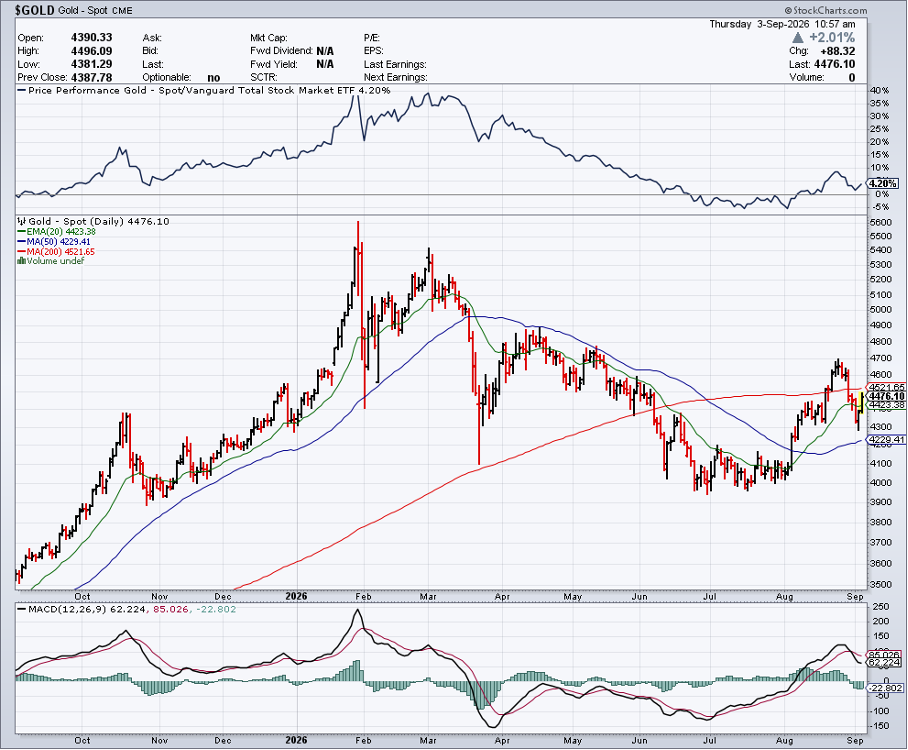 Chart: gold price over one year with 50-day and 200-day averages (Source: StockCharts)
Treasury Secretary Scott Bessent’s announcement that purchases of longer-dated government bonds would be increased was not met with universal applause. Bessent faced pushback from, among others, legendary hedge fund manager Stan Druckenmiller, with whom he engaged in a war of words in the Wall Street Journal.
Bessent’s announcement did have a positive effect on precious metal prices, as gold surged from $4,000 to nearly $4,700 in no time. The rally came to an abrupt end when the market reacted negatively to Federal Reserve Chair Kevin Warsh’s speech at the annual Jackson Hole gathering for central bankers.
Although Warsh repeatedly stressed that he did not want to provide the market with any guidance on the future path of interest rates, the market interpreted his focus on persistently high inflation as a sign that a higher policy rate could be on the cards. The market-implied probability of a rate increase on September 16 promptly rose from 30% to 70%, according to the CME FedWatch Tool. It has since fallen back to 55%.
Inflation has now remained above the desired level of 2% for 65 months, or almost five and a half years. The August inflation figures will not be published until September 11, but the July data confirmed that the rate of increase in the Consumer Price Index (CPI) is trending downward. The labour market has also cooled. A new jobs report will be published tomorrow, September 4.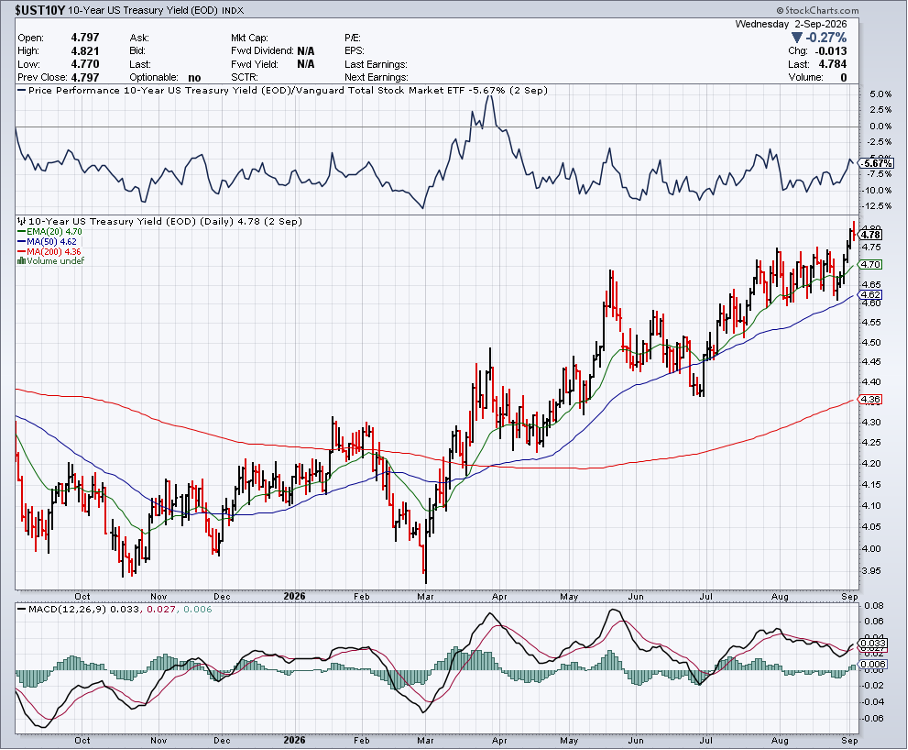
Chart: yield on the ten-year US government bond (Source: StockCharts)
Despite Bessent’s bond purchases and Warsh’s remarks, long-term interest rates continue to rise. In the US, the yield on the ten-year government bond climbed to its highest level in almost three years. This yield serves as a benchmark for products including credit card debt and car loans. In Japan and the United Kingdom, long-term interest rates reached their highest levels in 30 years. This represents a vote of no confidence by investors in the bond markets.
In the US, the gap between the policy rate (the federal funds rate) and the yield on the two-year Treasury note continues to widen. Pressure on the monetary policy committee to raise interest rates on September 16 is therefore mounting. Nevertheless, a rate increase is unlikely to make much difference, as research shows that inflation is driven not so much by demand as by supply. A 25-basis-point increase in the policy rate will do nothing to change that. Nevertheless, the Federal Reserve has little choice but to implement at least one more rate increase this year if it wants to preserve its credibility.
Alongside the gold price, investment inflows into physical gold ETFs have also picked up again. Gold holdings in these funds have risen by 2.8% over the past month to 98.9 million troy ounces, putting them at the same level as at the beginning of this year. The peak reached at the end of February, which coincided with a gold price of nearly $5,600, remains 2% above the current level. The same trend can be seen in silver, where holdings have increased by 2.6% since reaching a low in mid-July. The amount of silver under management nevertheless remains 7.2% lower than at the start of 2026.
The World Gold Council reported that central banks collectively purchased 23 tonnes of gold in July. China’s central bank increased its gold reserves by 20 tonnes, while Poland purchased another six tonnes. Poland has consequently replaced the Netherlands in the top ten countries with the largest gold reserves. Russia was on the selling side, disposing of six tonnes, while Turkey, Jordan and Uzbekistan each purchased one tonne.