English
EN


The Fed left interest rates unchanged last night. Fed Chair Kevin Warsh deliberately offered markets as little guidance as possible on the decision. Markets are now pricing in a rate hike in December. Precious metals initially showed a muted response before moving into the red on Thursday morning, with gold down 0.9% and silver down 2%. Elevated oil prices continue to fuel inflation concerns, while markets are now turning their attention to US growth and PCE inflation data due on Thursday afternoon. Analysts still see higher gold prices ahead; where they differ is on when the next inflection point for gold will arrive.
A brief look back to January 2025 highlights the key turning points in precious metal prices. Silver is still up 98% since the start of 2025, gold 56% and platinum 85%. This puts the price declines of recent months into perspective. Several catalysts have pushed precious metals lower again, and almost all of them are linked to expectations for Fed monetary policy.
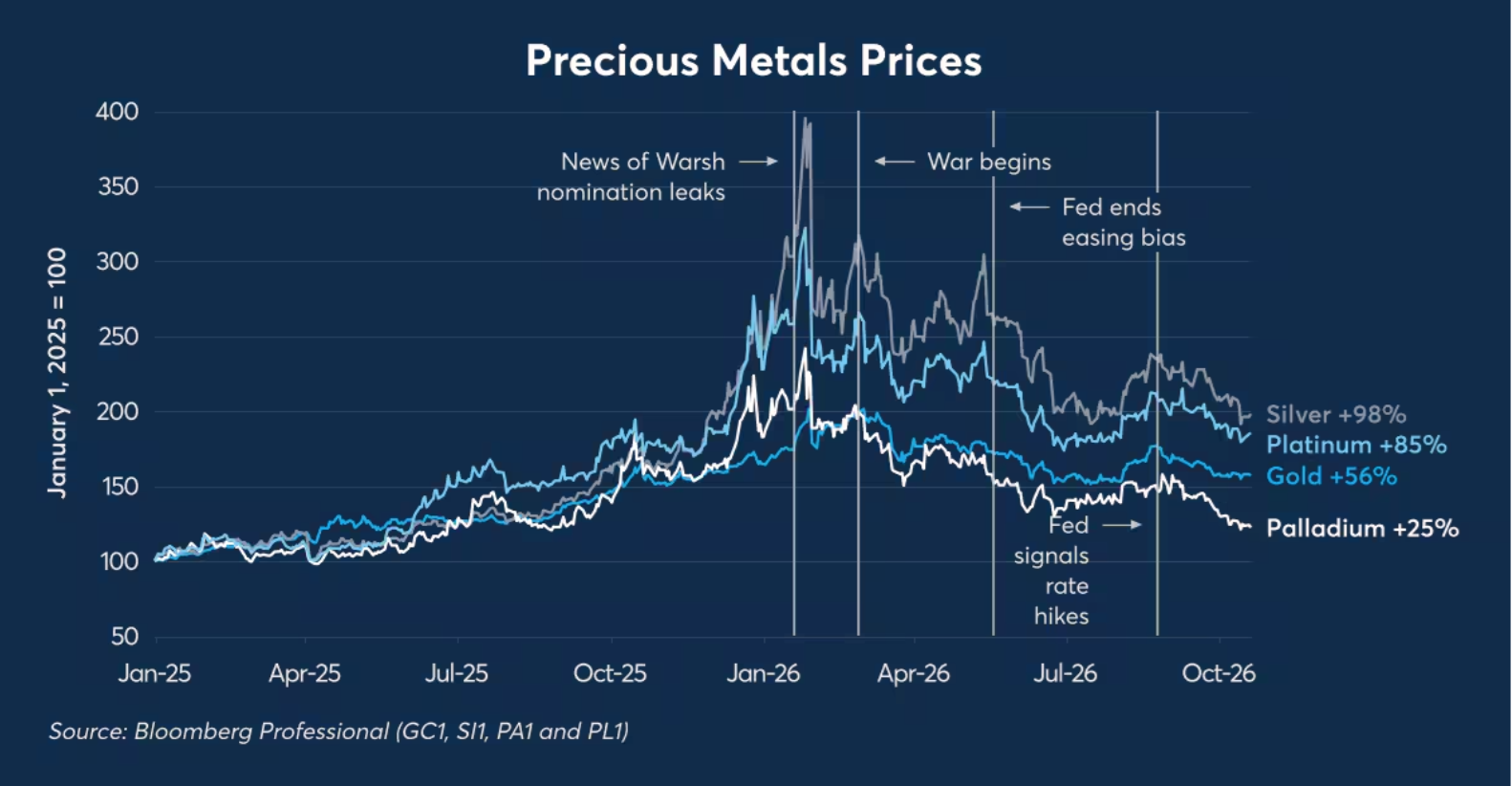 Percentage price performance of gold, silver, platinum and palladium since January 2025, with all four metals indexed at 100 on that date to make their relative performance comparable. (Source: CME Group).
The chart shows several important turning points for precious metals. The first was the leaked news of Warsh’s nomination as the new Fed Chair. The second was the start of the war against Iran, which pushed oil prices higher and lifted inflation expectations. That, in turn, fed into expectations for Fed interest rates. The final two lines first mark the Fed’s signal that rates would not be cut any further, followed by a signal that rates were likely to rise.
The Federal Reserve, commonly known as the Fed, is the US central bank. Markets closely follow the Fed’s policy-rate decisions, as well as any clues the Fed Chair provides about the economy and the future path of monetary policy during the press conference. But why does this matter so much for gold?
The Fed sets the interest rate at which US banks lend money to one another. This may sound like a domestic financial detail, but its effects are felt worldwide. Banks pass changes in interest rates on to consumers and businesses through borrowing costs, mortgages and savings rates. In that sense, the Fed’s policy rate plays a major role in determining the price of money.
The policy rate applies to the US dollar, which remains the world’s dominant reserve currency. Commodities such as gold and silver are also traded globally in dollars. Fed policy therefore influences government bond yields, borrowing costs and the value of the dollar, with consequences for financial markets around the world.
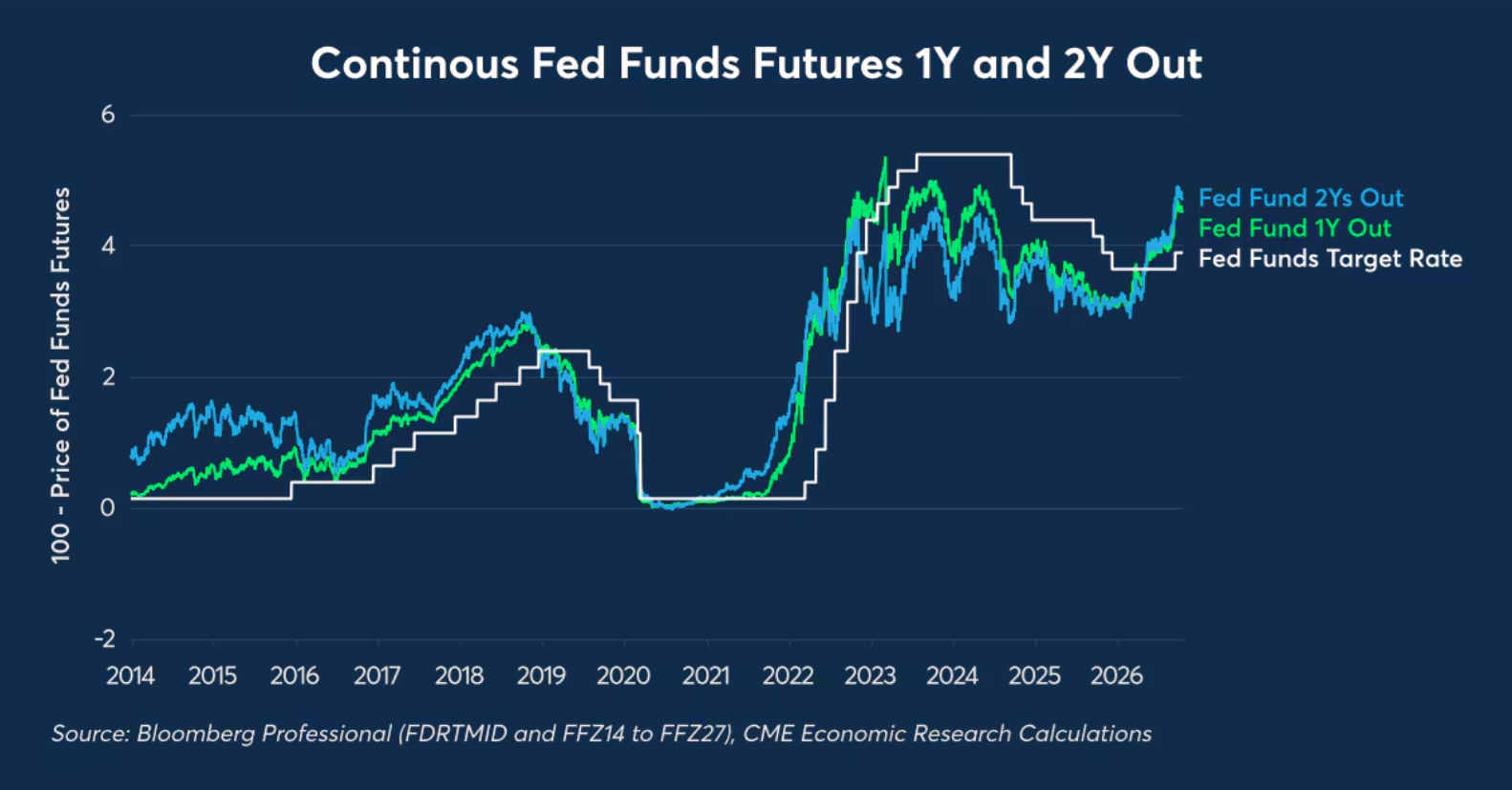 Markets expect several interest rate hikes over the next 12 to 24 months. The white line shows the Fed’s policy rate. The blue and green lines show market expectations for rates two years and one year ahead, respectively. (Source: CME Group).
Investors therefore react not only to the rate decision itself, but above all to any signal about what the Fed may do next. Because Kevin Warsh, unlike his predecessors, deliberately provides less forward guidance, markets have less information on which to base expectations for the future path of interest rates.
The impact on gold and other precious metals is not always straightforward. In the short term, higher interest rates make interest-bearing assets such as bonds more attractive relative to gold, which does not generate interest. Higher rates can also support the US dollar. Because gold is priced globally in dollars, a stronger dollar makes gold more expensive for buyers using other currencies.
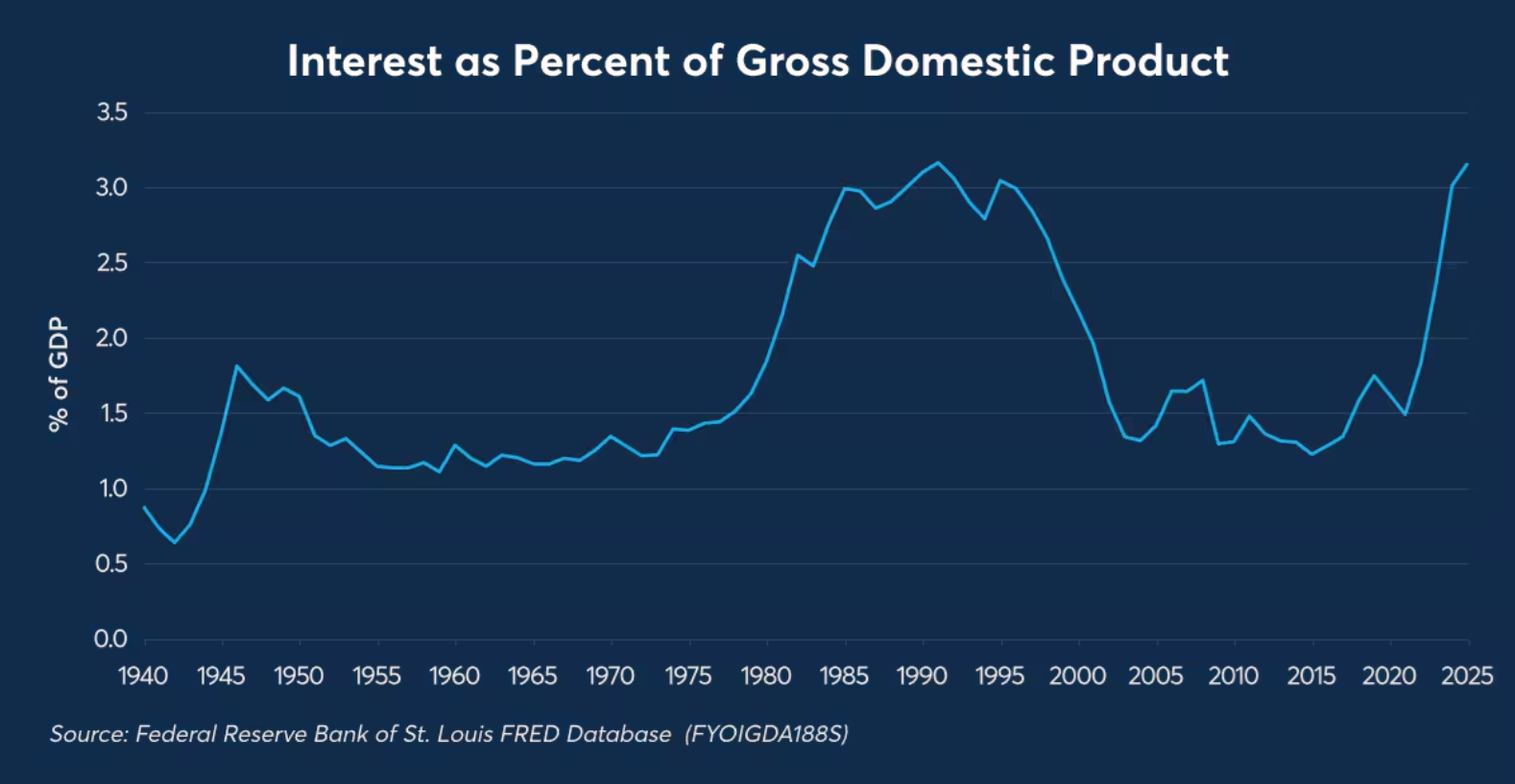 Interest payments on US government debt as a percentage of GDP have risen above 3% again, comparable with the peak seen in the early 1990s. According to CME Group, the figure has now reached 3.4%. (Source: CME Group).
However, higher rates also feed through into government borrowing costs, forcing countries to spend more on servicing their debt. The United States, with national debt of more than $40 trillion, now spends more on interest payments than on defence. It is therefore no surprise that Trump and Treasury Secretary Scott Bessent are concerned about higher interest rates.
Investors often turn to gold as a safe haven during periods of financial uncertainty, including concerns about unsustainable government debt. If interest rates remain elevated for an extended period, the pressure on government finances in the United States, as well as in countries such as France and the United Kingdom, increases significantly. This is one reason why many analysts expect higher gold prices over the coming years.
Most analysts at major banks and asset managers agree on one point: over the longer term, they expect gold prices to move higher. The key question is when gold will find a bottom. Views differ considerably on that point, and once again much depends on the Fed.
Amundi, Europe’s largest asset manager, expects gold to recover towards around $4,500 per troy ounce. That would represent an increase of more than 10% and would equate to around €4,040 of gold content in a 1 troy ounce bullion coin. “The worst is behind us,” says Lorenzo Portelli, head of cross-asset strategy at the Amundi Investment Institute.
According to Portelli, the market has already priced the worst-case scenario for gold into current prices. That scenario is inflation without a recession, which would force the Fed to raise interest rates aggressively. A December rate hike is already largely priced into the market.
Following last week’s sell-off, investor positioning in gold is also relatively light, which Portelli believes could support a recovery over the coming weeks. Amundi no longer expects gold to reach $5,000 this year. Portelli advises long-term investors to remain patient.
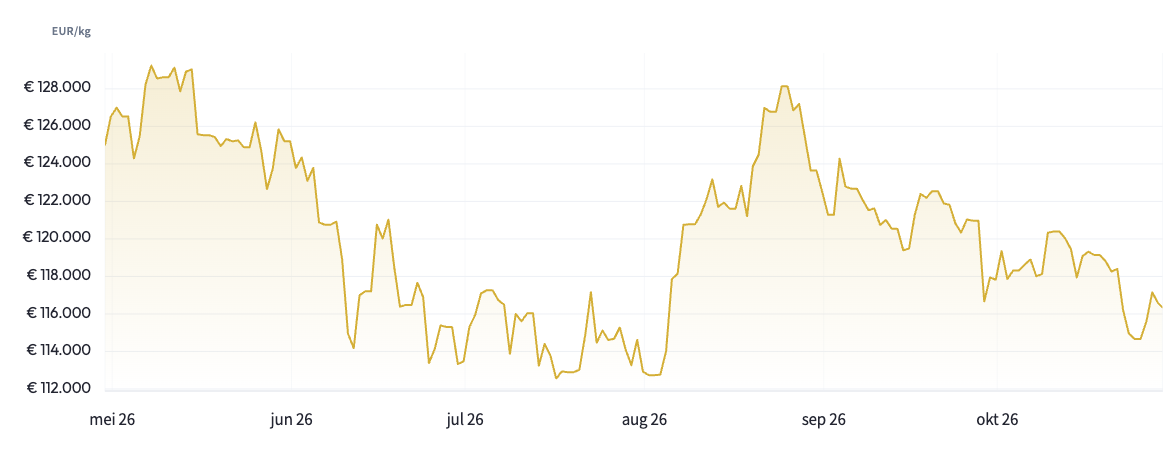 Gold price in euros per kilogram over the past six months. (Source: Holland Gold).
JPMorgan Private Bank is more cautious in the short term. “Gold will find a firm floor once interest rates peak,” says Yuxuan Tang, head of Asia rates and FX strategy. The bank expects Fed rate hikes in December and in the first quarter of 2027, potentially pushing the US 10-year Treasury yield to a peak of between 5.25% and 5.5% by mid-2027.
Tang describes the gold market as vulnerable, with limited technical support below $4,000 and thin trading conditions into year-end. Over the longer term, however, JPMorgan remains bullish on gold. Once the Fed has finished raising rates, the bank expects gold to reach $4,500 by mid-2027 and $5,000 by the end of 2027, equivalent to approximately €4,040 and €4,490 respectively.
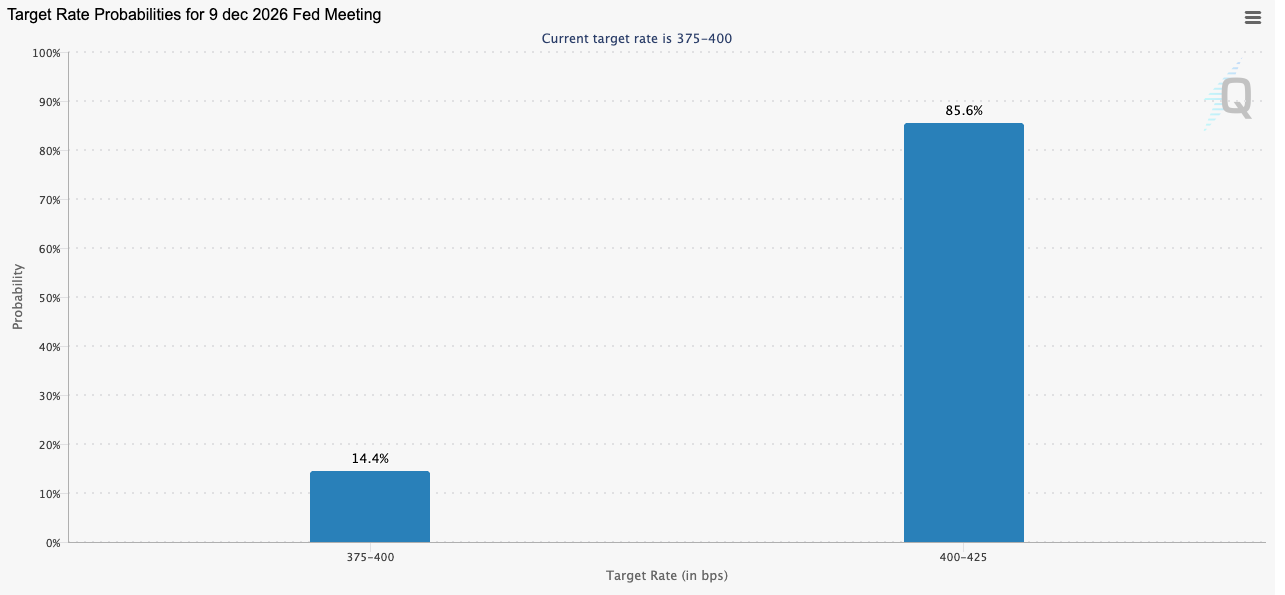 Markets are pricing in an 85% probability of a rate hike on 9 December. (Source: CME FedWatch Tool).
Both sides are therefore focused on the same inflection point: the moment when the Fed stops raising interest rates. Amundi believes the market has already largely priced this in, while JPMorgan expects rates to peak later and at a higher level. This makes the next Fed rate decision on 9 December particularly important.
While Western investors remain cautious, Chinese households are buying into the dip. On the Shanghai Gold Exchange, trading volume in the Au99.99 contract rose to around 430 tonnes last week, the highest level since April. The contract requires full payment and results in physical delivery. It therefore reflects genuine physical demand rather than leveraged speculation. Purchases through bank gold savings plans have already exceeded the total recorded for all of 2025.
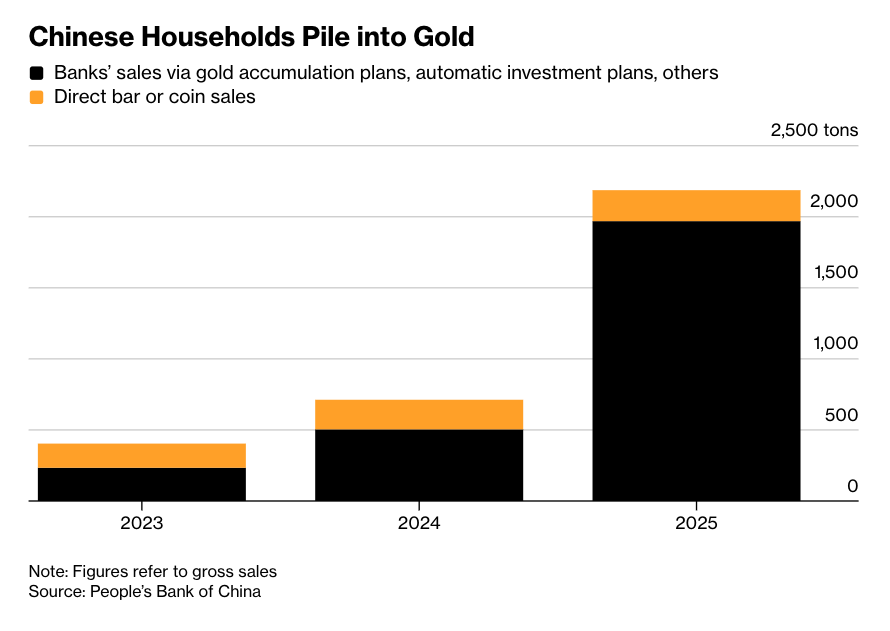 Chinese households are investing heavily in gold, with volumes shown in tonnes. The black segment represents gold sold by banks through gold savings and automatic investment plans, while the orange segment shows direct purchases of gold bars and bullion coins. (Source: People’s Bank of China, via Bloomberg).
Gold is a popular safe-haven asset in China as the property market struggles, government bond yields sit at record lows and the stock market has lost $2.4 trillion in value since May. Chinese gold imports rose 34% in September to 144.9 tonnes, while the Chinese central bank purchased 23 tonnes of gold in the same month, marking the 23rd consecutive month of official gold purchases.