English
EN


With all the problems in Dutch politics, it is easy to forget that things are not going much better among our neighbours at the moment. France, with its high national debt and uncertain political future, is putting additional pressure on the weakening euro. One place where the sun is shining is Sorrento, Italy, where the LBMA conference took place over the past few days. There, the president of the German central bank emphasised that gold still has a very significant role to play. Central banks also continue to buy gold in large quantities, while high oil prices are creating headwinds for the yellow metal. Here is the latest gold news at a glance.
Over the past few days, the gold price has mainly moved sideways, with two opposing forces influencing the price. On the one hand, oil prices are rising again as Iran increases its attacks on tankers in the Strait of Hormuz. Brent crude rose above $101 per barrel on Wednesday morning. Together with rising government bond yields, this is creating a short-term headwind for gold.
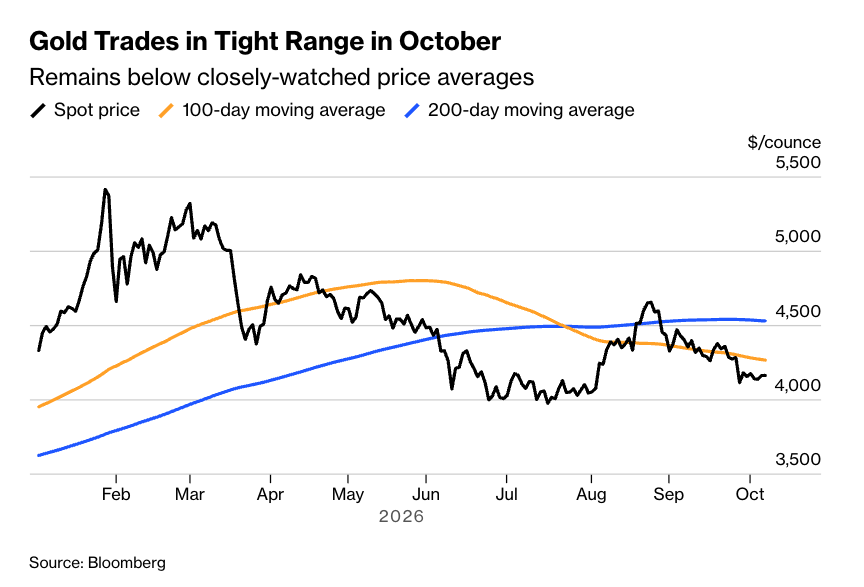 Gold is moving sideways but remains below its 100- and 200-day moving averages. (Bloomberg).
On the other hand, the market is scaling back its expectations of an interest rate hike by the Fed. The Fed, the US central bank, had previously appeared ready to raise interest rates again to combat inflation. The most recent rate hike led to falling gold prices. Since then, Fed officials have tempered those expectations. Markets now see only a 22% chance of a rate hike on 28 October, whereas last week this was still 70%. This is a positive force for gold.
The minutes of the latest Fed meeting will be released on Wednesday evening at 20:00 Dutch time. Markets will be looking for clues in the minutes about upcoming interest rate decisions.
Although it is too early to draw that conclusion, the problems are building and this is being reflected in a weaker euro. “French risk is now clearly starting to feed through into the euro, further increasing pressure on French government debt,” analysts at Bloomberg write. The euro fell on Monday to its lowest level since 2025 and is therefore losing ground against other currencies.
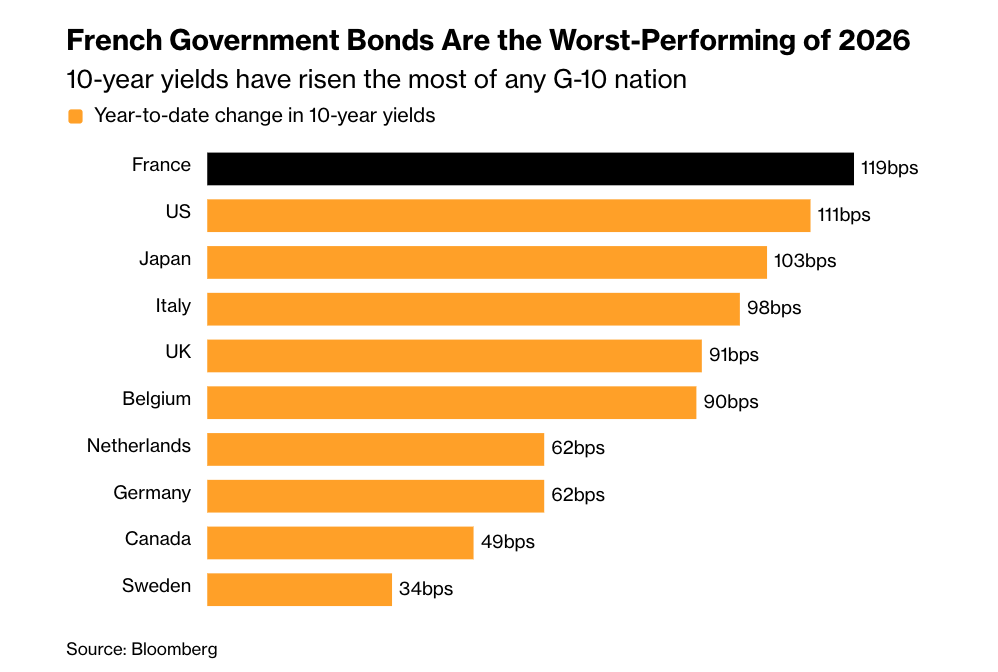 French 10-year government bonds are the worst-performing among all G10 countries in 2026. (Bloomberg).
French 10-year government bonds have recorded the worst performance of all G10 countries this year. The yield spread between German and French government bonds rose on Friday to its highest level since the euro crisis in 2012. Presidential candidate Le Pen, who is leading in the polls, appears to be trying to reassure markets with new plans to curb France’s national debt. So far, this appears to have done little to convince the markets.
Read our full analysis of the situation in France in our weekly selection from last Friday, 2 October.
Ray Dalio, the well-known American investor, author and billionaire, recently issued another warning about a US debt crisis. The biggest risk, he argues, is that Japan and China will absorb fewer US government securities. China, which still held $618 billion in US government debt in July, has a difficult relationship with the United States. This complicates the debtor-creditor relationship between the two countries, and China will certainly not want to purchase more US Treasuries.
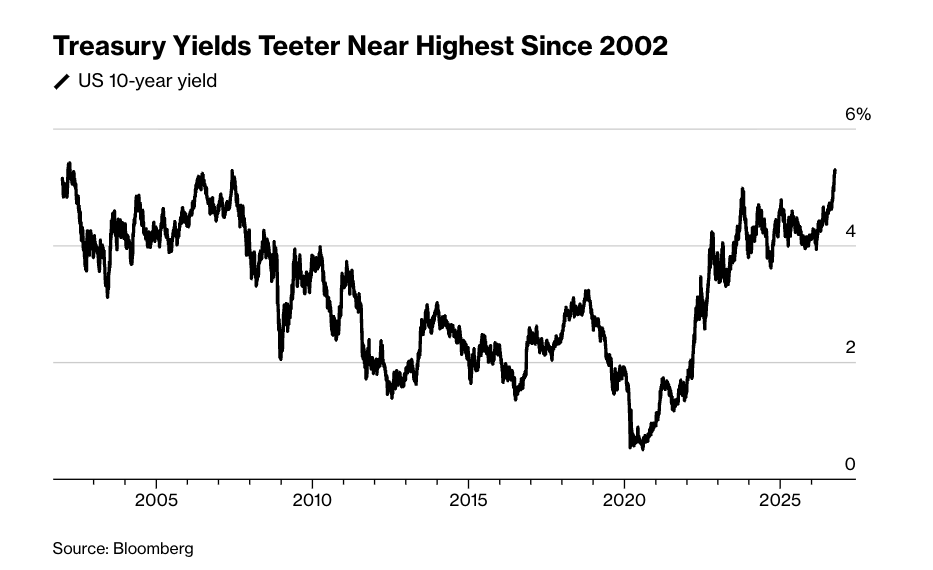 The yield on US 10-year government bonds also reached its highest level since 2002. (Bloomberg).
Dalio made his comments against the backdrop of rising 10-year yields. US 10-year government bonds are now yielding levels last seen in 2002. US Treasury Secretary Scott Bessent is trying to calm the market, but if Dalio is right, there are still plenty of challenges ahead.
Central banks bought a net 39 tonnes of gold in August, led by the Chinese central bank, followed by Poland and Uzbekistan (both 8 tonnes), according to the World Gold Council. This marked China’s 23rd consecutive month of gold purchases.
Earlier this year, there were signs that the trend might reverse, particularly because Turkey and Russia were selling gold. Turkey did so to absorb the initial impact of higher oil prices. However, in the months that followed, net gold purchases continued much as before. This consistent demand for gold from central banks is an important reason why the gold price has remained so strong, above $4,000 per troy ounce, despite high bond yields and oil prices.
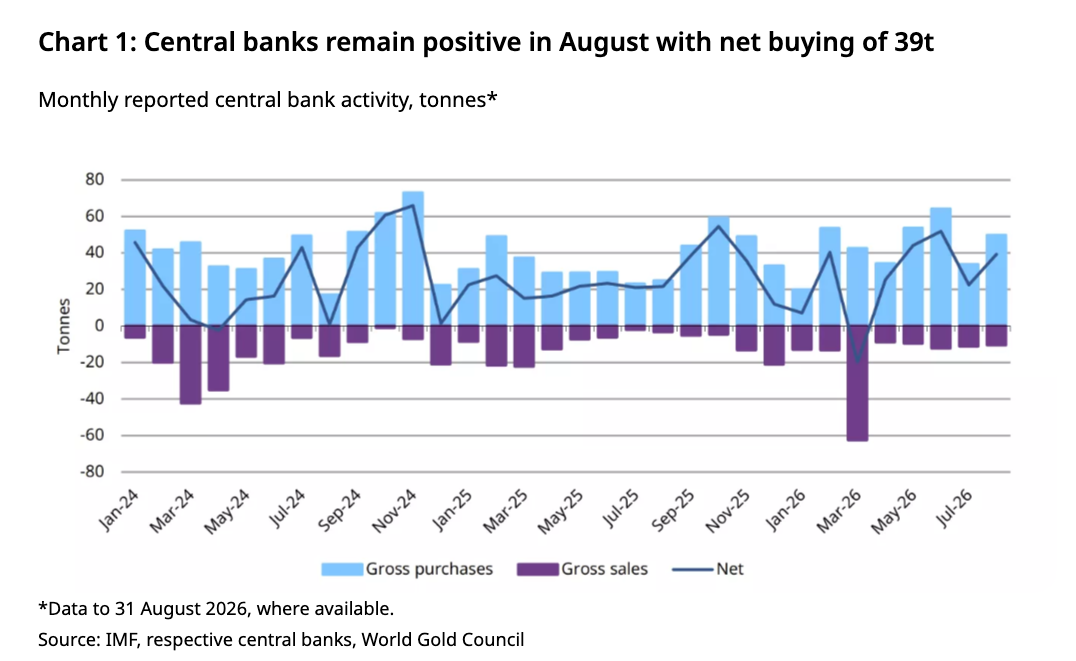 Monthly gold purchases (light blue) and sales (purple) by central banks worldwide, in tonnes of gold. (World Gold Council).
Ever-rising government debt is an important reason for central banks to expand their gold reserves at this time, according to Joachim Nagel, president of the German central bank, the Bundesbank.
On the one hand, high bond yields have made it more attractive for central banks to hold debt securities, as central banks also receive that interest income. “At the same time, rising government debt is increasing concerns about the credit risk of these investments. In addition, geopolitical risks are expected to continue playing an important role in decisions concerning reserve management,” Nagel said at the annual LBMA conference.
The German central bank has the world’s second-largest gold reserve, but has kept it stable for years. It is notable that a Bundesbank central banker in particular is highlighting the important role that gold still has to play.
Nagel concluded that “taken together, the arguments for further diversification into gold remain significant for central banks”.
The LBMA conference took place earlier this week in the beautiful coastal town of Sorrento, Italy. Every year, the most important participants in the international gold industry gather at this conference, from financial institutions and central bankers to refineries.
The LBMA is the London Bullion Market Association, the independent authority for the international gold market, which also accredits refineries. LBMA-accredited companies must meet the highest standards, and Holland Gold exclusively sells gold bars and bullion coins from these producers. Holland Gold is also proud to have been accepted as an LBMA Affiliate Member, as the only gold dealer in the Netherlands. Holland Gold also attended this important conference.
Each year, a survey is conducted among delegates at the LBMA conference. They expect the gold price to reach around $5,013 per troy ounce in twelve months, more than 20% above its current level, and the silver price to reach approximately $94.70.