English
EN


All the gold that has ever been mined fits into a cube measuring approximately 22.6 by 22.6 by 22.6 metres. This scarcity has always been one of the foundations of gold’s role as a store of value. But what if gold were to become less scarce?
The American technology company Marathon Fusion claims to have created gold using nuclear fusion. How does this process work, and does it threaten gold’s scarcity, or is it largely a storm in a teacup?
To understand the process, it is first important to understand what gold actually is. The element gold is made up of individual atoms. To illustrate this, you can compare atoms to the individual bricks in a wall. Together, these individual bricks form the wall. Atoms are the smallest particles that still characterise a chemical element. Pure gold does not rust, does not discolour under normal conditions and is resistant to many acids. The number of protons in an atom’s nucleus determines which element it is. Its chemical properties depend primarily on the electrons surrounding that nucleus. 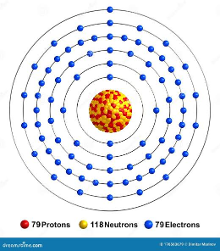
The chemical symbol for gold is Au. The isotope gold-197 is written as Au-197, with the mass number 197 indicating the number of protons + neutrons. Gold’s atomic number is 79, indicating the number of protons. The gold nucleus therefore contains 79 protons and 118 neutrons.
Marathon Fusion’s method converts mercury into gold by changing the atomic nucleus. It uses fast neutrons released during nuclear fusion. When such a neutron strikes the nucleus of mercury-198 (Hg-198), a reaction can occur in which one neutron enters the nucleus and two emerge. The nucleus therefore loses one neutron overall and becomes mercury-197 (Hg-197). This form of mercury is radioactive. The nucleus then captures an electron, causing a proton to turn into a neutron. The number of protons thus falls from 80 to 79: the mercury has become stable gold-197 (Au-197).
It would therefore be possible in theory, but is it economically and practically feasible? At CERN, where research into elementary particles is conducted, researchers have already produced gold from lead. They did this by making lead nuclei pass very close to one another at almost the speed of light. Some nuclei lost three protons in the process, turning into gold nuclei. However, the quantity was commercially negligible: an estimated 29 picograms of gold, or 0.000000000029 grams, were produced during the 2015–2018 measurement period. The gold nuclei produced could not be collected. They collided with parts of the particle accelerator almost immediately and were lost in the process.
Marathon Fusion’s approach is fundamentally different, however. On the platform X, the company announced that it had produced real, stable gold from mercury and surpassed CERN’s record by a factor of 10. In a document published in July 2025, the company states, based on theoretical computer simulations, that a fusion reactor could produce around two tonnes of gold per gigawatt of thermal power per year. For a reactor with one gigawatt of electrical output, this would translate into approximately five tonnes of gold per year.
Nevertheless, considerable uncertainty remains. The tech start-up has not disclosed how much gold was produced, and the claim has not been verified by an independent party. The production costs are also unknown. Beyond these questions, there is a more important issue. This technique depends on the neutrons released in a nuclear fusion reactor and could help increase a reactor’s revenue alongside electricity sales. Yet no nuclear fusion reactor is currently selling electricity, and the first commercial fusion reactors are still years away, with their arrival still uncertain, let alone their use to produce gold.
In an interview, physicist Karl Lackner also highlights other challenges associated with this technique. Although the main reaction produces stable gold, other mercury isotopes can produce radioactive gold isotopes during the process. According to Lackner, this gold must be stored for at least 18 years before it is suitable for jewellery. However, this does not pose a major problem for gold held as an investment or kept in storage. Another issue is the availability of mercury-198. This isotope accounts for only around 10% of naturally occurring mercury. To obtain sufficient feedstock, the mercury must first be enriched, which entails additional costs.
In short: Marathon Fusion has achieved an important scientific milestone with this technique. However, there is still no operational commercial fusion reactor, and that remains years away. Using such a fusion reactor to produce gold is theoretically possible, but there is still no evidence that this would be economically viable on a large scale.