English
EN


At first glance, gold's remarkable rise to an all-time high seems easy to explain given the unstable geopolitical situation and the uncertain outlook for the global economy. Gold is known as a "safe haven" and the general expectation is that prices of the precious metal will rise when interest rates fall — something many investors expect to happen later this year.
A more in-depth evaluation reveals the reason for the recent increase in the Gold price not immediately clear. After prolonged stability within a certain price range, the price of gold suddenly started to climb in early March. Since that time, it has risen by 14% and several new daily records have been set. Geopolitical tensions have been intense for some time and the recent prospects for Interest rate cuts by the Federal Reserve have become increasingly uncertain. What has brought about this change?
Experts and market analysts offer a wide range of Statements for gold's recent rise to record highs. Could it be that a central bank, concerned about the influence of the dollar as an economic instrument, is behind this? Is it the funds that are anticipating an imminent interest rate cut by the Federal Reserve? Is a wave of algorithmic traders responding to rising gold prices? Is it the persistent inflation and the fear of an economic downturn? Weaker currencies? Elections approaching? Or is it an interplay of all these elements?
The mystery surrounding the recent surge has prompted insiders to delve deeper into the complex and opaque world of global gold trading. This ranges from futures and exchange-traded funds in New York to a huge over-the-counter hub in London and a global network of traders who Gold barsand Gold Coins and selling jewelry to anyone, anywhere. Despite the historical closedness of this market, there has been a years-long effort to increase transparency, which goes some way to shedding more light on the unexpected rally of one of the oldest stores of value in the world.
A clear group of buyers are the Central Banks, large institutions and traders preparing for an easing of monetary policy. Chinese consumers are worried about falling yields on other assets and a depreciating currency. On Reddit Inc.'s platform, self-proclaimed "stackers" boast about storing bars and coins. But these groups have been a consistent bullish force for months, if not years, and it's not clear why any of them would buy with a much greater sense of fear, greed or exuberance right now.
In the larger futures and over-the-counter markets, trading activity is increasing sharply, indicating that the usual institutional buyers — central banks, investment banks, pension funds, sovereign wealth funds — are involved. Options activity is also on the rise, and gold prices are expected to jump even higher as options traders hedge against their exposure.
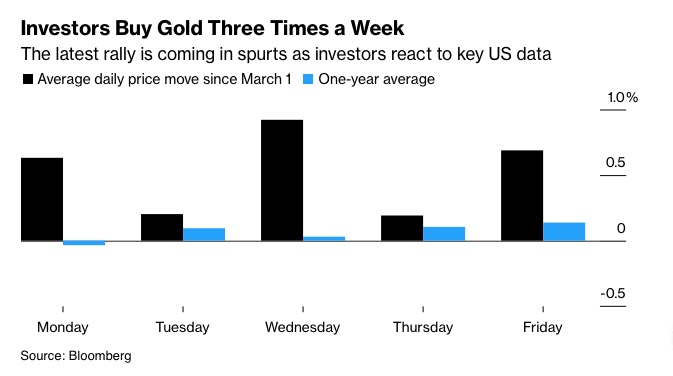
Mainly on Mondays, Wednesdays and Fridays. The gold market is notoriously sensitive to shifts in U.S. economic data, and that has only intensified since the price surges in early March. Key economic releases on these days offer insights into the strength of output, employment, GDP, and inflation, and a concentrated wave of purchases following these data provides a strong clue about the identities of the most influential actors.
Recent movements in the gold market, including the reversal of the spread between the spot price in London and three-month futures contracts that are now below the Fed Interest Rates dives, indicate that nervous investors are rushing to get their hands on physical gold as a hedge against potential turmoil. This phenomenon defies many mainstream thinking, especially given the still-high interest rates, and seems to point to persistent inflation and potentially a hard economic landing, seasoned with a lot of geopolitical uncertainty and de-globalization driving central bank demand.
On Thursday 16 May 2024, Holland Gold will host a event on Gold and world politics in the Georg Kessler Lounge at the AFAS AZ Stadium.
The event consists of three parts: one interview, one presentation and a Q&A session for the audience. For example, the gold rush is discussed in World Politics, the geopolitical tensions that are rising every day; in Ukraine, the Middle East, in West Africa and around Taiwan. What impact does this have on the financial system? Central banks seem to be caught in a gold rush. The yellow metal achieves a Record price. How long will the US dollar remain dominant?
Have a look at us YouTube channel
On behalf of Holland Gold, Paul Buitink and Joris Beemsterboer interview various economists and experts in the field of macroeconomics. The aim of the podcast is to provide the viewer with a better picture and guidance in an increasingly rapidly changing macroeconomic and monetary landscape. Click here to subscribe.
Author: Yvonne Yue Li
Brom: Bloomberg