English
EN


The price of germanium has risen by 84 per cent over the past year. The rise of drones and the billions being invested in counter-drone systems could drive demand for this relatively unknown metal even higher. What makes germanium so important?
Germanium has unique properties in infrared and semiconductor technology. As a result, it is widely used in military applications such as thermal imaging cameras for tanks, fighter aircraft, naval vessels and drones.
Canada’s Bank of Montreal estimates that 15 million drones will be deployed in the Russo-Ukrainian War in 2026. Estimates suggest that this would consume 4% of the global germanium supply in a market that has already been tight for years. The large-scale deployment of drones by the Ukrainian armed forces is also being facilitated through the Drone Line Initiative, to which the Netherlands, as a driving force, has already contributed €1 billion.
NATO plans to invest an additional $40 billion in counter-drone defence over the next five years. Counter-drone installations in particular require larger quantities of germanium in the lenses and optical windows of infrared and camera systems. These camera systems must be able to detect drones at a distance under all daytime and night-time conditions.
Drone incidents (or were they “false flags”?), such as the recent incident in the German city of Leipzig, will lead to tighter security around critical infrastructure in Europe through the use of counter-drone installations. This month, Germany decided to equip several German cities with anti-drone shields and drone defences. Poland and the Baltic states are jointly building the “Baltic Drone Wall”. Finally, the European Commission said in July that counter-drone capabilities would become a strategic European priority, and virtually all European countries are therefore scaling up their demand.
In May, French-listed company Exosens announced that it was doubling its production capacity for cooled infrared cameras. This is specifically intended to meet the growing demand for long-range counter-drone systems. In July, Exosens tripled its production capacity for thermal cameras, again to capitalise on drone technology, the fastest-growing segment of the defence market. It is this increased production of infrared cameras that is adding pressure to the already tight germanium market.
Germanium is one of the best-performing commodities this year. Its price continues to reach new records. The chart shows the development of the germanium price in China. It has risen sharply to 26,500 yuan, or $4,000 per kilogram. Western germanium prices have meanwhile reached around $6,400 per kilogram. The Western price therefore trades at a 60% premium to prices in China. 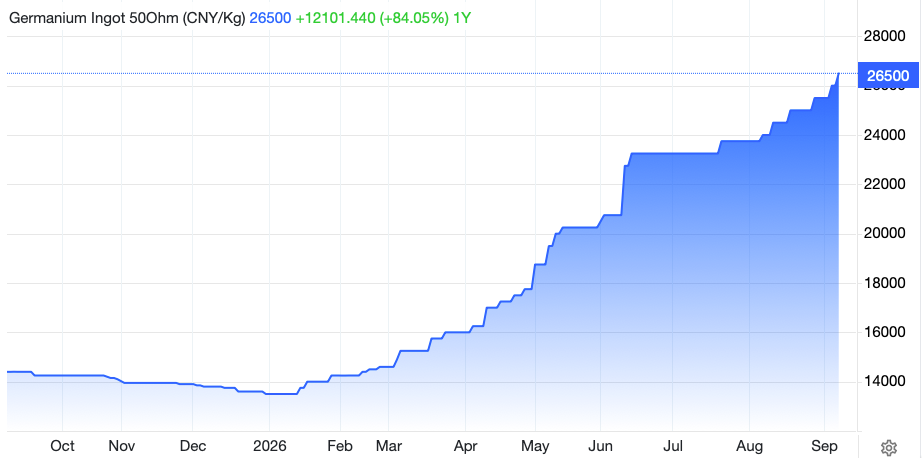
Market price of germanium in China. Western prices are around 60% higher (Source: Trading Economics)
There are virtually no primary germanium mines anywhere in the world. The metal is mainly extracted as a by-product of zinc mining. It is therefore not easy to increase global germanium production quickly.
China accounts for 60% of global production and 77% of global germanium refining. The rest of the world, led by the United States, is now trying to become independent of China, which controls a large part of the supply chain, as it does with other strategic metals.
Germanium was one of the first critical metals on which China imposed export controls in 2023. In its trade war with the US, China uses its control over metals such as germanium as a bargaining chip. The export controls have been relaxed for one year since November 2025, but supplies for military applications remain strictly limited or prohibited.
Belgian materials and recycling group Umicore calls germanium “the salt and pepper of our modern society”. It is used in small quantities but in many modern technological applications. In addition to defence applications, germanium is used in semiconductors and telecommunications technology for 5G connections, fibre-optic networks for data centres, and thermal imaging cameras for firefighting. Germanium solar cells are three times more efficient than silicon-based solar cells. They are therefore used in solar panels for satellites and space technology.
Given the increasing investment in the space sector, demand for high-efficiency solar cells based on germanium technology is soaring. Ultra-pure germanium crystals are also used in particle physics and space-based instruments. NASA uses gamma-ray spectrometers containing pure germanium, including on the Mars Odyssey mission, which orbits Mars. These instruments are used to map the elemental composition of the Martian surface. Germanium therefore has many other interesting applications in addition to the defence sector.
NATO has compiled a list of 12 metals that are essential to the global defence sector. Germanium is naturally on this list, alongside metals such as cobalt, gallium, graphite, tungsten, titanium and rare earth metals. 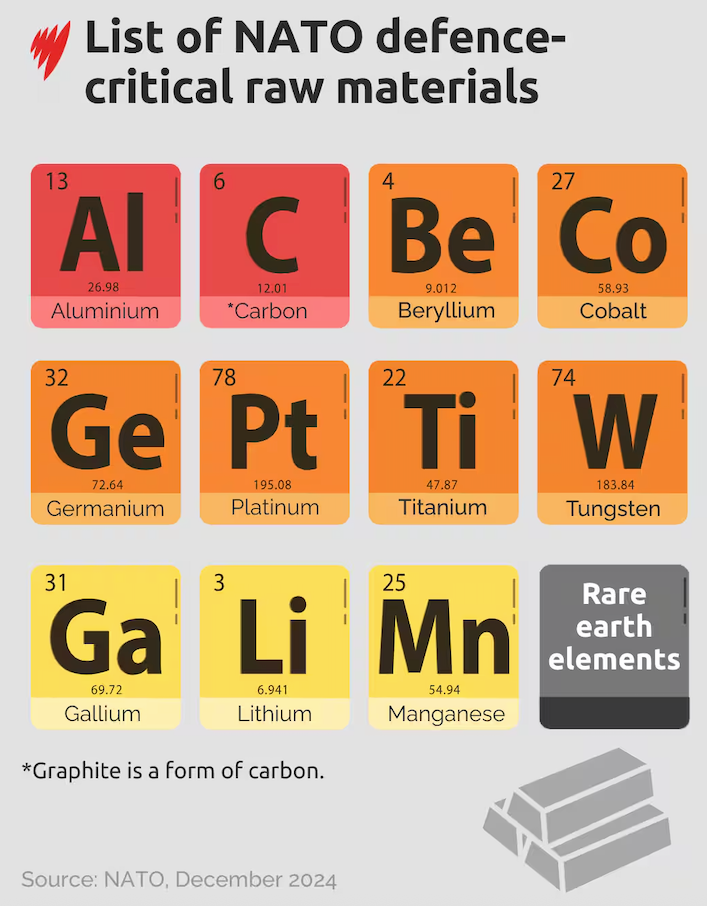
List of critical raw materials (Source: NATO; SBS News)
As NATO member states increase their defence production in response to the war in Ukraine, a reliable supply of critical minerals has become a central strategic priority.
There is also one precious metal on NATO’s list. Neither silver, gold nor palladium is on the list. Platinum is. Platinum is becoming increasingly strategically important within the defence sector. Platinum is used in defence applications that demand exceptionally high reliability, including coatings for fighter aircraft, missile guidance systems, exhaust catalysts in tanks, rugged communications systems and infrared sensors. Thanks to its good electrical conductivity, high melting point and resistance to corrosion and oxidation, platinum is particularly well suited to operating under the most extreme conditions.
Rising defence investment worldwide is disrupting some commodity markets and could create an additional source of demand in the relatively small platinum market.
Jeroen Vandamme is the driving force behind Analyse, which is regarded as one of Belgium’s most established investment publications. He has been following the markets closely for more than twenty years, with particular expertise in precious metals. He also offers in-depth insights into commodity stocks, critical minerals and royalty stocks, earning his analyses widespread appreciation among both retail and professional investors. Read more from Jeroen Vandamme.