9.3
8.064 reviews

English
EN


Central banks added gold to their stockpiles again in November. The latest figures from the World Gold Council show that they bought a net 31 tonnes of gold in October, increasing the total gold reserves of central banks to 36,782 tonnes. This is the highest level since November 1974. But which countries bought the most gold this year?
In October, only a few central banks bought gold, not a single central bank sold precious metals. The biggest buyers were the central banks of the United Arab Emirates, Turkey and Uzbekistan. They all added 9 tons of gold to their reserves. Kazakhstan bought 3 tonnes, while Qatar completes the list with a purchase of 1 ton. Almost all of these countries also bought precious metals earlier this year to replenish their reserves.
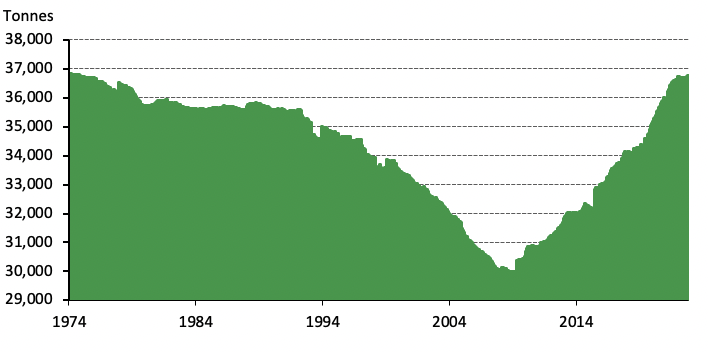
Central banks' gold stocks back to 1974 levels (Source: World Gold Council)
In the third quarter, central banks bought another Record quantity of almost 400 tons of gold. The last time they bought so much bullion worldwide in one quarter was in 1967, when the London Gold Pool with the fixed Gold price of $35 per troy ounce. Central banks are apparently more concerned about the stability of the monetary system and rising geopolitical tensions. Since the beginning of this year, mainly non-Western countries have added the precious metal to their reserves, as the overview below from the World Gold Council shows.
Turkey is the largest buyer this year with a total of 103 tonnes of gold, followed by Egypt (+44 tonnes) and Uzbekistan (+37 tonnes). The central banks of Iraq, India, Qatar and the United Arab Emirates also added a substantial amount of gold to their reserves this year. Only Kazakhstan sold a substantial amount of gold this year. In recent years, this country has bought a lot of gold and on balance this country still has much more precious metal than ten years ago.
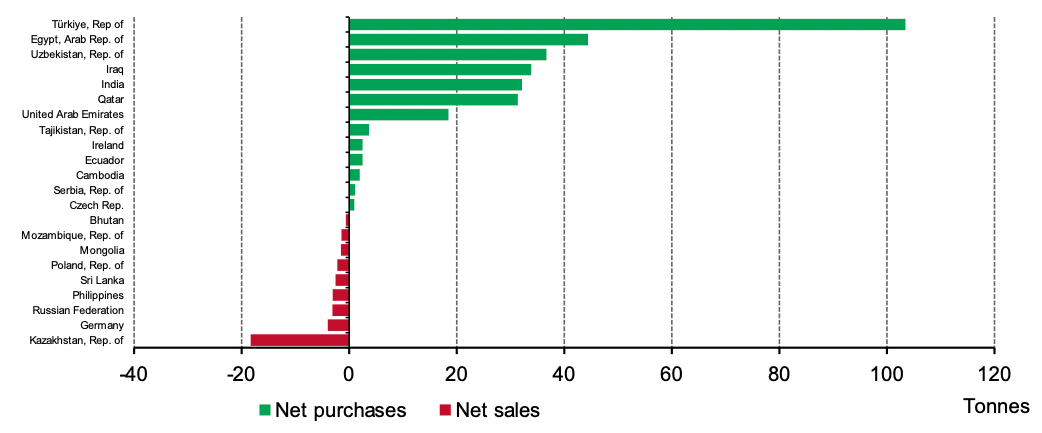
Which central banks bought the most gold this year? (Source: World Gold Council)
Last summer Wrote We think that many central banks were considering buying gold over the next twelve months. Central banks cited high inflation, geopolitical instability and an uncertain economic outlook as reasons to own more gold. Central bankers were also more concerned about a new financial crisis due to rising interest rates and changes in the international monetary system.
Recently Said Klaas Knot of the Dutch Central Bank (DNB) in Buitenhof that he certainly does not intend to sell gold and that the gold stock and revaluation reserve are important instruments to strengthen the central bank's balance sheet. Aerdt Houben, director of DNB, also emphasised in a recent interview with The Telegraph the importance of the gold supply. "In turmoil times, the value of gold reserves increases and DNB is seen as more confidence-inspiring. That's a fantastic mechanism."
 Have a look at us YouTube channel
On behalf of Holland Gold, Paul Buitink and Joris Beemsterboer interview various economists and experts in the field of macroeconomics. The aim of the podcast is to provide the viewer with a better picture and guidance in an increasingly rapidly changing macroeconomic and monetary landscape. Click here to subscribe.


