English
EN


The supply of scrap gold will not be much higher this year than in the past year, the Boston Consulting Group writes in a report for the World Gold Council. The consultancy firm researched the market for scrap gold and concluded that the supply is strongly influenced by the gold price on the one hand and the state of the global economy on the other. Based on these indicators, the Boston Consulting Group judges that the supply of scrap gold will continue to be relatively low this year.
In 2009, a record amount of 1,728 tonnes of scrap gold came onto the market, equivalent to 42% of the total supply of gold in that year. Due to the fall in the gold price from 2012 and a mild recovery of the world economy, less and less scrap gold has come onto the market in recent years. For example, the supply of scrap gold over the past year was only 1,122 tonnes, which is equivalent to 2% of the total supply of gold in that year.
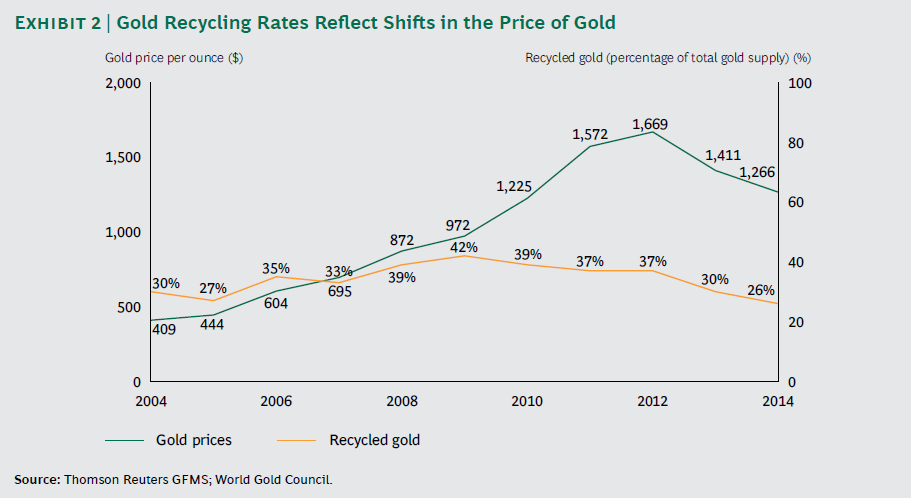
Recycling of gold increasingly important
Although the supply of scrap gold has decreased in recent years, an upward trend is visible over the longer term. In 1999, for example, only 17% of the total global supply of gold was accounted for by scrap gold.
The Boston Consulting Group writes in its report that the total above-ground supply of gold has increased from 153 to 176 thousand tons since 2004, of which about half still consists of gold jewelry. As a result, the amount of scrap gold that comes onto the market every year will also increase in the long term.
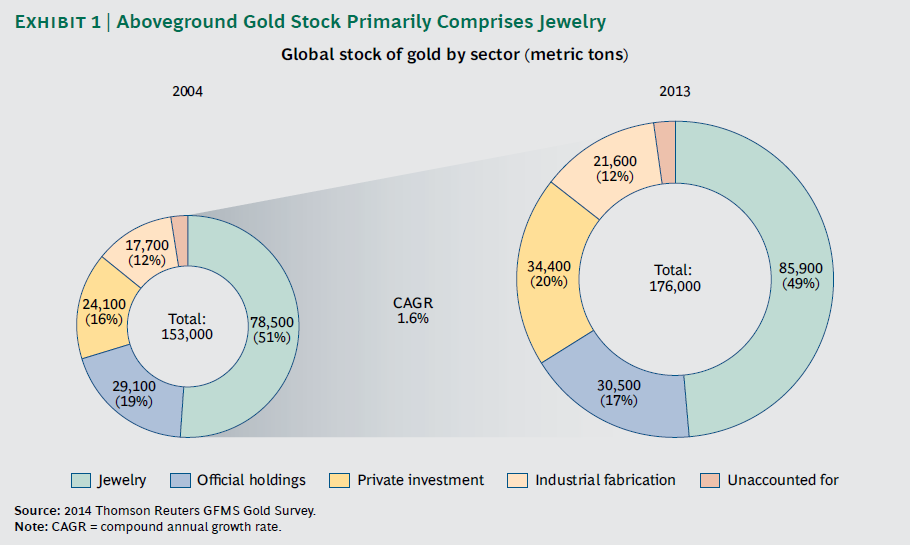
Total above-ground gold reserves
Shift towards Asia
Over the past decade, a large part of the scrap gold has come from Europe and North America, which has to do with the outbreak of the crisis in 2008 and the continued rise in the Gold price between 2002 and 2012. Whereas in 2004 the contribution of the two 'Western' continents to the global supply of scrap gold was about 27%, in 2011 it had increased to 43%. During this period, the supply of scrap gold in a country like India remained relatively constant.
Because the Chinese gold market has developed rapidly in recent years, the Boston Consulting Group expects that the center of gravity in the market for scrap gold will eventually shift towards Asia.
Less and less gold in electronic waste
Another trend described in the report is that of increasingly complex extraction of gold from electronics. Although the demand for electronic equipment is increasing worldwide and the turnover rate is increasing, the concentration of precious metals in these devices is actually decreasing. The total volume of e-waste grew from 337,000 tonnes in 2008 to 600,000 tonnes in 2014, but on the other hand, the gold content in waste has decreased by 40% over the past decade. So it will become more and more expensive to extract gold from old computers, laptops, televisions and the like.
The following graph shows that there is currently overcapacity in the recycling of electronic waste. This overcapacity will not be fully utilised until 2017.
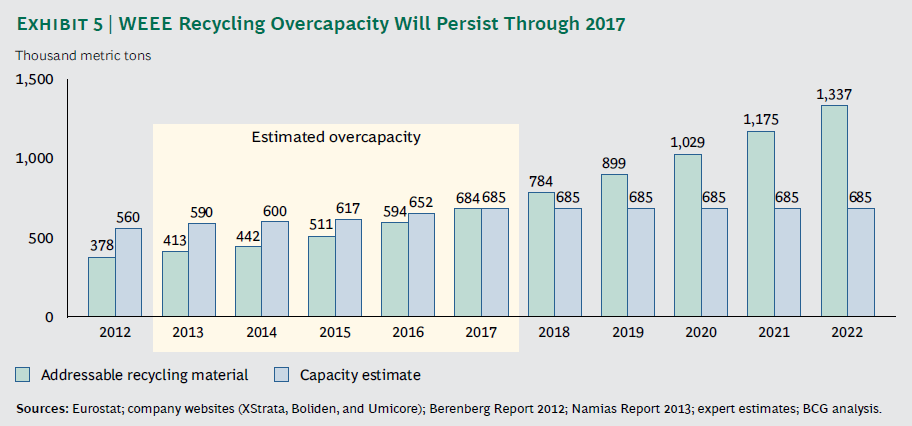
Overcapacity in industrial waste processing not eliminated until 2017