English
EN


The silver price is once again approaching the $50 per troy ounce threshold, and the gold price even briefly dipped below $4,000. Despite a weaker dollar and slightly lower interest rates, precious metals remain under pressure. What is going on?
Long-term interest rates have fallen slightly in recent weeks, while the dollar has also lost ground, both factors that should theoretically work in favour of gold and silver. But this proved to be of no avail, as the sell-off in precious metals continued, with silver even falling below its previous July low. Gold is still holding up (for now), but the margin is extremely narrow.
With just 2 months to go, the year-to-date return on gold stands at -6.5% in dollar terms and -1.5% in euro terms. Over 12 months, this translates to roughly break-even in dollar terms and +5% in euro terms.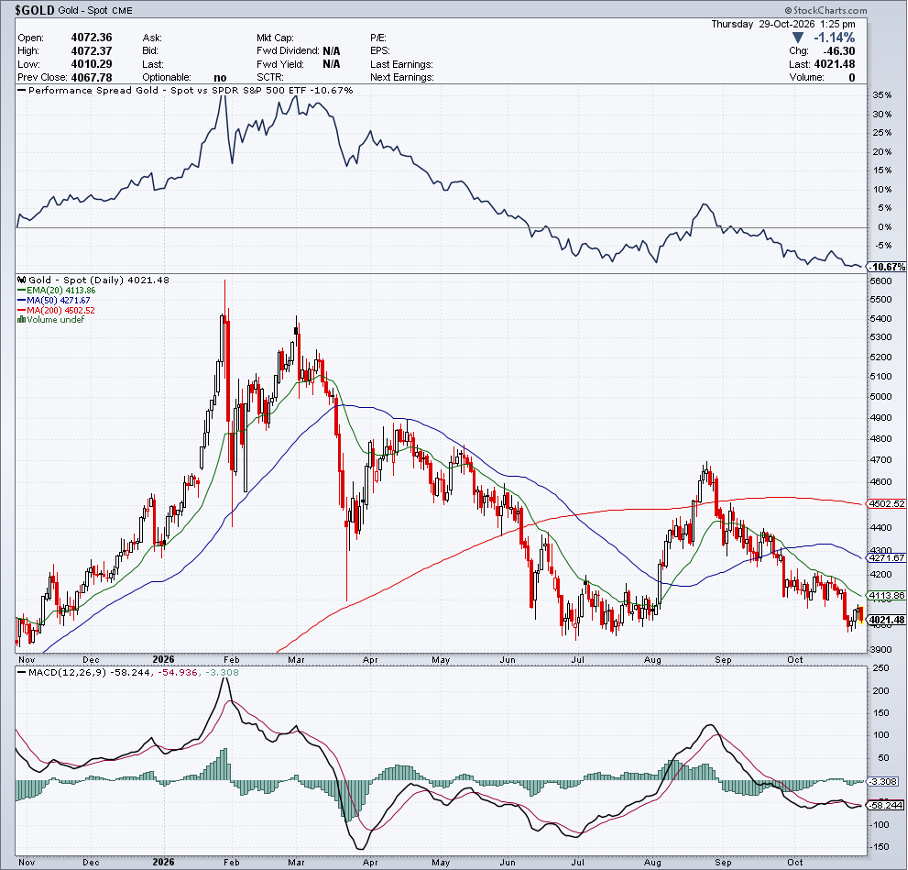
Gold price over 1 year with 50-day and 200-day moving averages (Source: StockCharts)
The most striking difference compared with a year ago is sentiment. Around this time last year, I attended several gold conferences, and sentiment bordered on euphoria because the gold price had reached the $4,000 mark for the first time. A year later, we are at the same price, and sentiment is decidedly negative. Of course, this is because gold rose by a further 40% in the following months, and those gains have since evaporated. But that does not change the fact that $4,000 is still a very attractive price by historical standards.
For silver, $50 is a crucial threshold from both a technical and a psychological perspective. This level had previously been reached in 1980 and 2011, with a breakout finally occurring in November last year. It appeared to be a decisive breakout, as the price more than doubled over the following 3 months. Those additional gains have now almost entirely evaporated, leaving silver back at square one. The 12-month return is still (slightly) positive, but the picture looks far less favourable when measured against the peak. Since the start of this year, the return stands at -26% in dollar terms and -21% in euro terms. However, silver is still trading 8% higher than it was 12 months ago.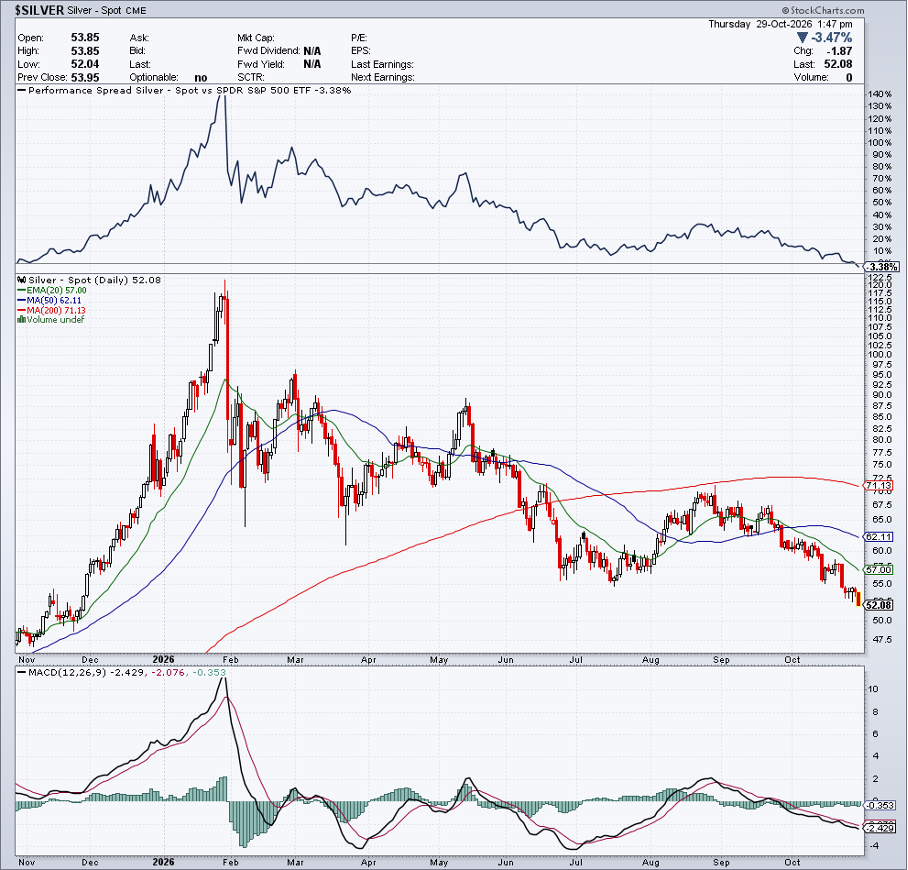
Silver price over 1 year with 50-day and 200-day moving averages (Source: StockCharts)
As expected, the Federal Reserve left its policy rate unchanged on 28 October. Ahead of the decision, a large majority of 91% had expected no change following the earlier increase of 25 basis points on 16 September. In his remarks, Chair Kevin Warsh acknowledges that inflation remains high, but the policy committee is choosing to adopt a wait-and-see approach for now.
Another interest rate increase is expected at the final meeting of 2026, which takes place on 9 December. According to the CME FedWatch Tool, the probability of a 25-basis-point increase stands at 79%. A 50-basis-point increase therefore appears to be off the table for now. The probability of rates remaining unchanged is just 21%. Next year, Warsh wants interest rate decisions to be made at only 7 of the 8 monetary policy meetings, and at just 6 in 2028.
Long-term interest rates in the United States have declined somewhat in recent weeks after reaching their highest levels since 2002 in early October. The situation in Europe was no better, with yields rising on various government bonds in European Union countries (particularly France and Italy), as well as in the United Kingdom, where the 30-year yield had even reached its highest level since 1998.
Meanwhile, the US 10-year Treasury yield has fallen back below 5% amid concerns about growth, as high energy prices begin to weigh on the economic outlook. However, the historical correlations between gold on the one hand and the dollar and interest rates on the other have not been holding up lately.
The fact that precious metals are not behaving as they (theoretically) should in an environment of lower interest rates and a weaker dollar may point to an underlying liquidity problem in financial markets. Gold is a ‘victim’ of its own liquidity in this regard, which allows it to be converted into cash immediately, particularly when held through futures contracts.
We last observed a similar phenomenon in 2008, which is hardly a period that brings back fond memories for investors. Still, there is no need to immediately assume the worst-case scenario. Spreads between investment-grade and high-yield bonds are widening, and a substantial amount of government debt will also need to be refinanced in the period ahead. In many cases, these are bonds that carried extremely low interest rates (<1.5%). Upon refinancing, those rates will more than triple. On top of this, the appetite for capital among AI companies investing in infrastructure knows no bounds. In other words, competition for (expensive) capital is currently intense, and this is draining liquidity from financial markets.
Incidentally, that decline in 2008 was short-lived. The gold price peaked at $1,033 in March 2008 before reaching a low of $682 in October, a decline of one-third. By the end of the year, however, the gold price had recovered to $880, or 30% above the low. In September 2009, less than a year after the bottom, the previous March 2008 peak was surpassed. Since then, the gold price has never fallen below $1,000 again.
The Central Bank of Russia is also continuing to liquidate gold holdings. The war against Ukraine is costing vast sums of money, while the various economic sanctions imposed on the country are constraining revenues. Selling government bonds abroad is virtually impossible for Russia. Russia can sell oil, gas and other commodities to countries that do not support Western sanctions, but gold is one of the most liquid assets that can quickly generate cash to finance its deficits.
In September, the Russian central bank sold 6 tonnes of gold. This marked the tenth consecutive month of gold sales. Since December last year, a total of 62 tonnes of gold has been sold. As a result, Russia's gold reserves have fallen to 2,260 tonnes. This is the country's lowest gold stockpile since 2019, but Russia still ranks sixth among individual countries, behind the United States, Germany, Italy, France and China.