9.3
8.064 reviews

English
EN


The profit margins of gold mines are under pressure due to the combination of a Lower gold price and ever-increasing production costs. That explains why gold mining stocks have underperformed the precious metal itself in relative terms in recent months. The main reasons for this are increased fuel costs, energy prices and labour costs. The gold mining sector has also increased the production of less profitable mines due to high profit margins in recent quarters, which has further increased the average cost price.
U.S.-based Newmont Mining, the world's largest gold mining company, reported this week a Profit decline of 41% in the second quarter due to higher production costs. The All-In Sustaining Costs (AISC), a measure of total cost of production, including investments in new production, had risen 16% to $1,199 per troy ounce. The quarterly figures show that this increase is mainly due to higher energy prices and personnel costs.
Other mining companies that have already published second-quarter figures also saw an increase in production costs. At Australia's Perseus Mining, the AISC rose by more than 10 percent to $1,004 per troy ounce, while Australia's Evolution Mining saw its average production costs rise by 30 percent to $1,290 per troy ounce. Other major players in the gold mining sector, such as Barrick Gold, Polyus Gold and Anglogold Ashanti, will only report quarterly results in August. These figures will provide more insight into the extent of this trend.
The extraction of gold is not only a very capital-intensive process, it also takes a lot of energy to extract precious metal from the ground. According to the World Gold Council, the average ore grade of a gold mine is currently 1.35 grams per ton, which means that mines have to process large amounts of earth and rock. Due to increased fuel costs and electricity prices, gold mining has become a lot more expensive. The graph below shows the World Gold Council shows the development of the average production costs of gold mines since 2012.
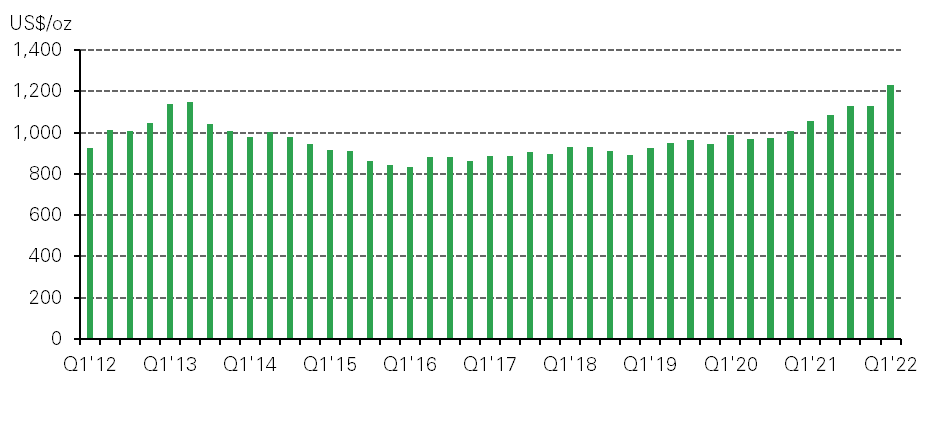
Gold mining production costs to record high in first quarter 2022 (Source: World Gold Council)
In the third quarter of 2020, gold miners' profit margins rose to an all-time high of $938 per troy ounce. As a result, more reserves became economically viable to extract. The Gold price At the time, it was at a record high and gave mines the space to tap into relatively expensive reserves. This trend continued until the beginning of this year, as the gold price rose again to $2,000 per troy ounce due to the Russian invasion of Ukraine. Since then, however, the price of gold in dollar terms has fallen more than 15 percent to around $1,700 per troy ounce. And that pushes down the profit margin.
At the end of the first quarter, profit margins at $646 per troy ounce were about 31% lower than the record level of 2020. From a historical perspective, that's still relatively high. By comparison, between 2012 and 2019, gold miners achieved an average profit margin of $338 on each troy ounce of gold mined. The graph below shows the gold price per quarter, compared to the average production costs of all mines (blue) and of the tenth decile of mines with the highest production costs (red). This graph clearly shows how the gold mining sector is constantly adjusting its production capacity to the gold price.
It is difficult to predict how the profit margin of gold miners will develop further in the second half of this year. This depends not only on the price of gold, but also on energy prices. Energy prices are expected to remain high for the rest of this year, but at the same time the strong dollar will have a positive impact on the mining sector. Mines usually sell their gold in dollars, while the production costs are largely paid in the local currency. The strengthening of the dollar is therefore a small windfall for the sector.
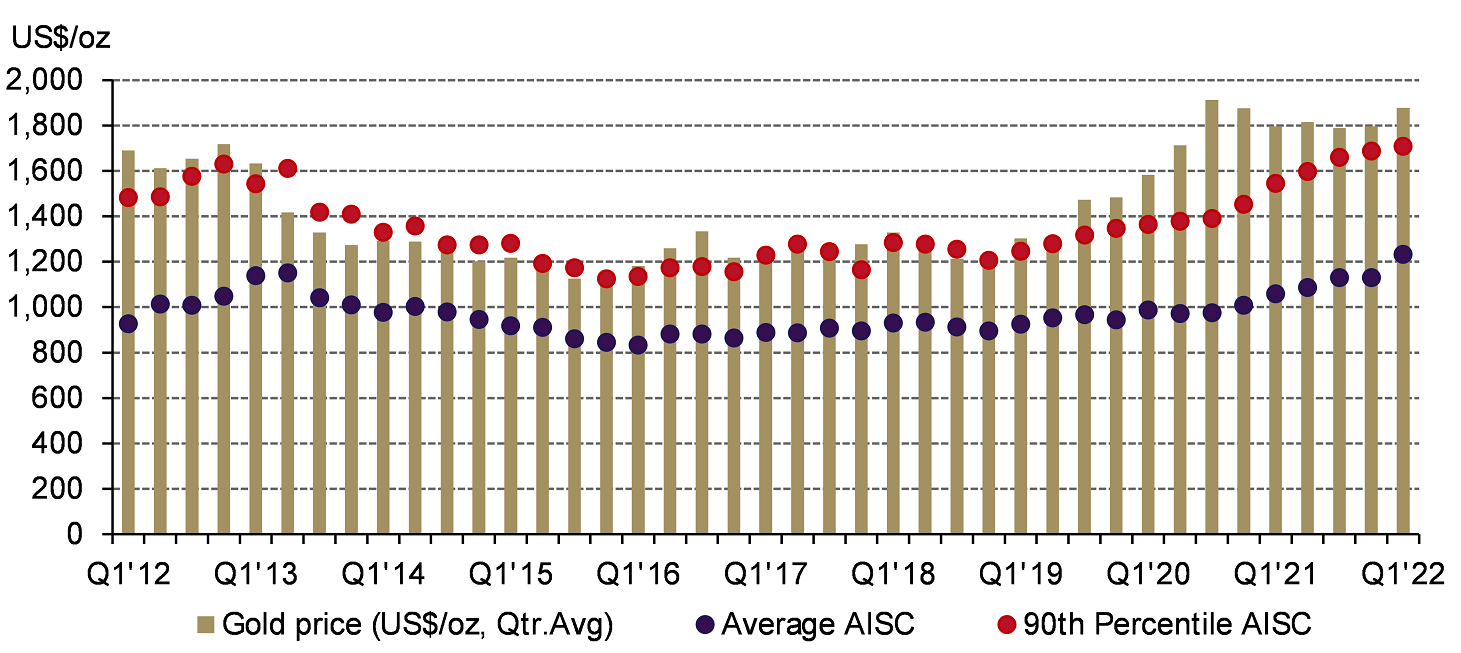
Gold miners adjust their production capacity to the price of gold (Source: Metals Focus Gold Mine Cost Service, Bloomberg, via World Gold Council)
Previously we have several articles written about investing in physical gold versus investing in gold mining stocks. These are two completely different asset classes, each with its own risk profile. Results in recent years confirm that gold miner stocks are much more volatile than the precious metal itself, partly due to large fluctuations in mining profit margins. High energy prices and labour costs appear to be very detrimental to the gold mining sector, while the gold price is much less sensitive to this.
The chart below shows that the price of gold is down almost 5% since the beginning of this year, while the Philadelphia Gold and Silver Index of 30 major gold and silver miners (XAU) is down 24% this year. And that's a big change from a few months ago, when gold prices were higher and mining stocks were in better shape. Investing in mining stocks is therefore riskier than investing in the precious metal itself.
Is there also a higher return in return? That depends on the period over which you look at it. If we take the beginning of 2016 as the starting point, then gold mines have yielded higher returns on balance. If we take the beginning of 2000 as a starting point, physical gold turns out to be the better investment. Not only did the precious metal yield a higher return, it was also less volatile than a basket of gold mining stocks. For savers who want to take little risk with their assets, it is Buy physical gold thus, the better option.
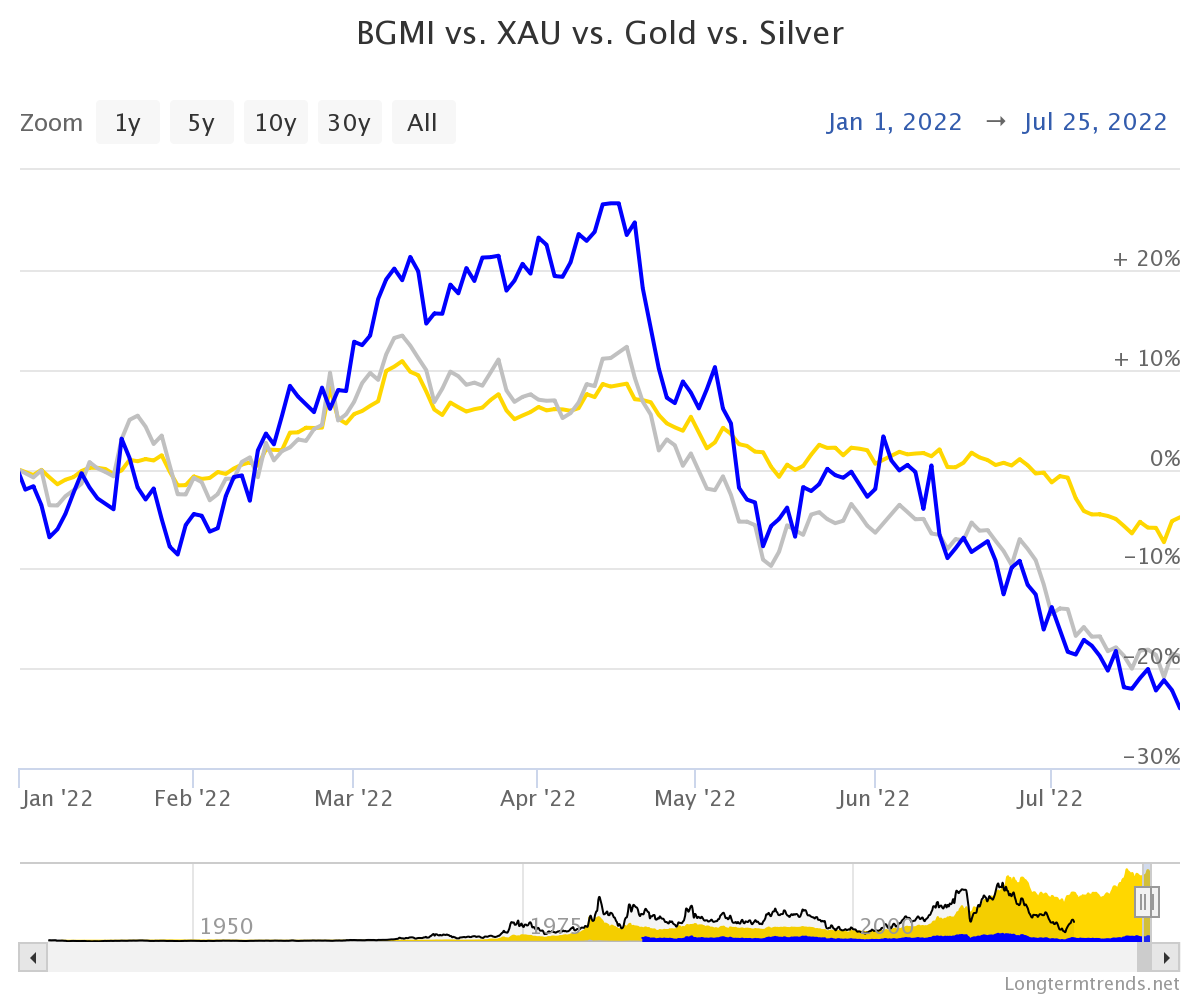
Result of mining stocks versus physical gold and silver (Source: Long-term trends)
 Have a look at us YouTube channel
On behalf of Holland Gold, Paul Buitink and Joris Beemsterboer interview various economists and experts in the field of macroeconomics. The aim of the podcast is to provide the viewer with a better picture and guidance in an increasingly rapidly changing macroeconomic and monetary landscape. Click here to subscribe.


