English
EN


For the first time since the start of the war, even JPMorgan’s professional oil analysts no longer have a clear base case for the oil market. Meanwhile, high energy prices are fuelling inflation, and the Fed has raised interest rates for the first time since 2023. Why does gold remain so strong despite this?
Oil prices edged lower this week but remain high. Brent crude fell from around $107 per barrel at the beginning of the week to approximately $103 on Friday afternoon, 18 September. Oil prices have been rising again since July. Another price surge followed last week after a drone attack damaged and shut down Saudi Arabia’s East-West Pipeline. The pipeline transports approximately 4 million barrels of oil per day from eastern Saudi Arabia to the Red Sea, bypassing the Strait of Hormuz. Oil prices have a major influence on inflation. The question, therefore, is how they will develop over the coming period.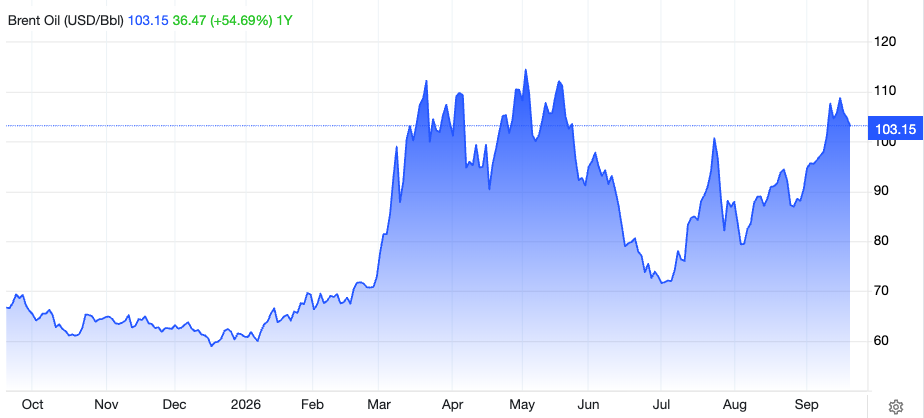
Brent crude price performance (source: Trading Economics)
In this week’s Holland Gold Podcast, we discussed economist Robin Brooks’s analysis with Kees de Kort. Brooks considers the recent rise in oil prices to be an overreaction. According to him, the market is pricing in the prolonged loss of millions of barrels per day, whereas the disruption is primarily a temporary logistical problem. Saudi Arabia can maintain oil exports for the time being by drawing on inventories at the port of Yanbu. Brooks also expects the pipeline to be repaired quickly.
Brooks maintained his position this week, despite reports of cancelled oil deliveries to Europe and rumours that full repairs could take five to six weeks. He wrote on Thursday: “I think we can call an official end to the latest oil price panic around the attack on the Saudi East-West pipeline. What we are learning, over and over, is that the global oil market is way more resilient and robust than the $200 oil crowd likes to admit.”
Kees de Kort said in the podcast that he strongly disagreed with Brooks’s analysis. He expects oil prices to rise much further and described the recent increase as “only the beginning”. After all, if the pipeline can be hit once, it can also be hit again.
If you find it difficult to predict where oil prices are headed, you are not alone. The oil analysts at JPMorgan are also struggling with that question. Due to the unpredictable course of the war with Iran and the continuing supply disruptions, the bank no longer has a clear base case for the first time since the conflict began.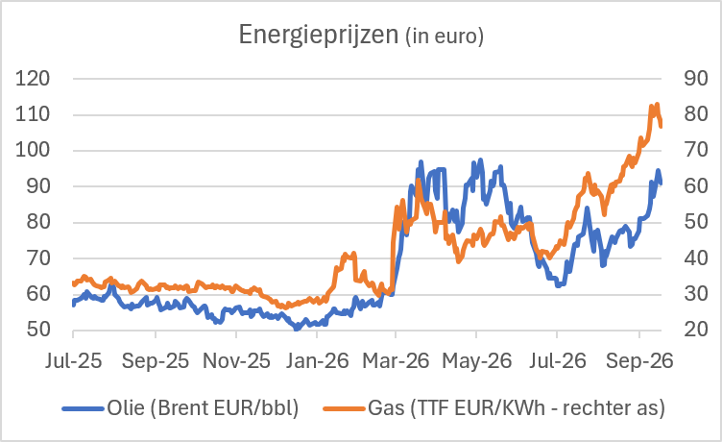
Energy price movements measured in euros (source: Han de Jong)
What does seem clear is that persistently high energy prices could push inflation higher while simultaneously weakening economic growth by putting pressure on household incomes and spending. ECB Vice President Boris Vujčić said: “If inflation remains high through the autumn and affects household incomes and consumer behaviour, that will also have a dampening impact on GDP.” According to Vujčić, a cold winter would compound the economic damage by raising heating bills.
Fuel prices in the Netherlands continue to rise sharply. Diesel has already been spotted at €2.90 per litre, and it appears to be only a matter of time before the €3 threshold is breached for the first time. An article on CNBC clearly explains why diesel prices are so crucial to the economy. Almost every product is transported by truck at some point in the supply chain, while agricultural machinery, construction equipment, rail transport and delivery services are also heavily dependent on diesel. Higher fuel costs therefore feed through into the prices of groceries, building materials and other everyday products through freight rates and fuel surcharges. Persistently high diesel prices ultimately make almost everything in the economy more expensive.
The gold price has recovered in recent days despite the Federal Reserve’s first interest-rate increase since 2023. The US central bank raised its policy rate by 25 basis points to between 3.75% and 4.00% because inflation remains stubbornly above its 2% target. Higher interest rates are generally unfavourable for gold because the precious metal itself pays no interest. In August, US consumer prices were 3.4% higher than a year earlier. Fuel prices played a major role in this.
In this week’s market update, we wrote the following about the increase: “The higher-than-desired inflation is not attributable to the demand side, but rather to problems on the supply side. The United States brought the main factor behind this, namely high energy prices, upon itself, and by extension upon the rest of the world, by starting a war with Iran. A 25-basis-point increase in the policy rate will do nothing to change that and is certainly not conducive to the growth policymakers hope to generate in order to reduce the debt organically.”
Canadian economist James E. Thorne was even more outspoken. In his article Warsh Fails the Oil-Shock Test, he argues that the Fed is repeating an old mistake: raising interest rates during a supply shock. After all, the central bank cannot pump additional oil or make petrol cheaper by making mortgages more expensive. Thorne refers to research by Ben Bernanke, Mark Gertler and Mark Watson showing that previous oil crises were exacerbated primarily by interest-rate increases. He believes the Fed now risks amplifying another energy shock and thereby causing a recession.
For the time being, gold does not appear to be falling despite the Fed’s rate increase. According to Bloomberg, investors have flocked to gold in recent weeks in the expectation that the structural drivers of the gold price remain intact. Gold ETFs have now recorded inflows for eight consecutive days, the longest streak since October 2025.
Peter Schiff, perhaps the world’s best-known goldbug, wrote on X on Thursday: “Gold’s morning rise of over $100 is a clear no-confidence vote in the Fed’s 25 basis point rate hike. Investors would rather own gold with no yield than 10-year Treasuries with a 5% yield (read last week’s Weekly Selection on rising government bond yields), as that is not nearly enough to offset the purchasing power that will be lost to inflation.”
Goldbugs expect excessive debt ultimately to be dealt with in the only politically feasible way: through currency debasement and the gradual erosion of purchasing power. Matthew Piepenburg writes: “What was once dismissed as a distant risk is becoming increasingly visible.” According to him, debt levels continue to rise, bond markets are under growing pressure, and the move away from US dollar dominance is accelerating. Meanwhile, central banks are accumulating physical gold at a rapid pace. Their purchases, Piepenburg argues, speak louder than their words.