English
EN


The IMF is sounding the alarm over rising government debt and interest costs: the longer countries wait to act, the more painful it will become. Naturally, France has not escaped scrutiny either. Minister Eelco Heinen said this week that he would consider it ‘a sorry state of affairs’ if the ECB were to come to the country’s rescue.
On Wednesday, the International Monetary Fund (IMF) issued an urgent call for governments to cut spending and reduce budget deficits. The fund is concerned about the combination of rising government debt and increasing government bond yields. Average government debt is approaching 100 percent of GDP, the highest level since World War II. According to the IMF, delaying action will only make it more difficult and painful to restore order to public finances.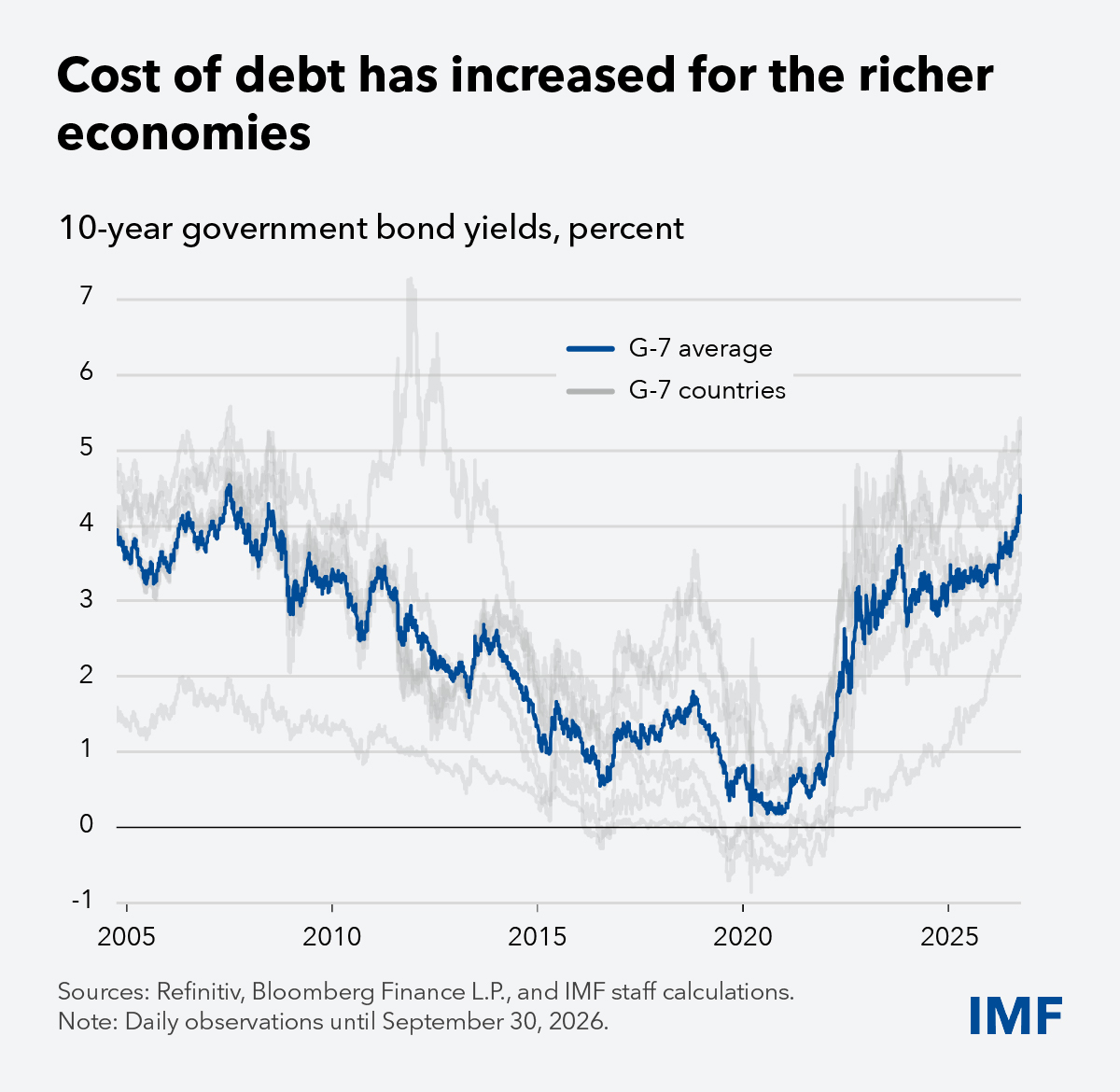
Government borrowing costs are rising (source: IMF)
Between February and September, the average ten-year government bond yield across the G7 countries rose by more than 1 percentage point to its highest level in almost twenty years. Rising government bond yields increase interest costs. This can create a vicious circle: higher interest costs lead to larger budget deficits and more debt, prompting investors to demand even higher yields.
“We are now saying that it is urgent and that it needs to happen now, because circumstances have changed,” said Rodrigo Valdés, director of the IMF’s Fiscal Affairs Department, on the need for fiscal discipline.
Valdés sees the situation deteriorating and is concerned that a majority of countries are increasing government spending rather than making cuts. The longer countries wait, the more painful it will ultimately become, the IMF writes. Many countries will have to refinance a large share of their debt over the coming year, potentially at much higher interest rates. For the G7 countries and Spain, the share of debt maturing within one year is approaching 30 percent.
The IMF cites the United States as a specific example. Interest payments there are expected to rise from around 2.8 percent of GDP before the pandemic to 5.7 percent in 2031. In low-income countries, interest payments already account for more than 15 percent of total government revenue, compared with an average of 9 percent between 2011 and 2019.
On Friday afternoon, we will publish a podcast featuring Matthew Piepenburg on our English-language channel Reinvent Money. He warns that Europe is sleepwalking into a debt crisis and describes America as ‘broke’.
When discussing a lack of fiscal discipline, France naturally comes to mind. With a budget deficit of 5.4 percent, the country remains well above the 3 percent limit agreed within the eurozone. Yields on French government bonds are therefore rising at an alarming pace.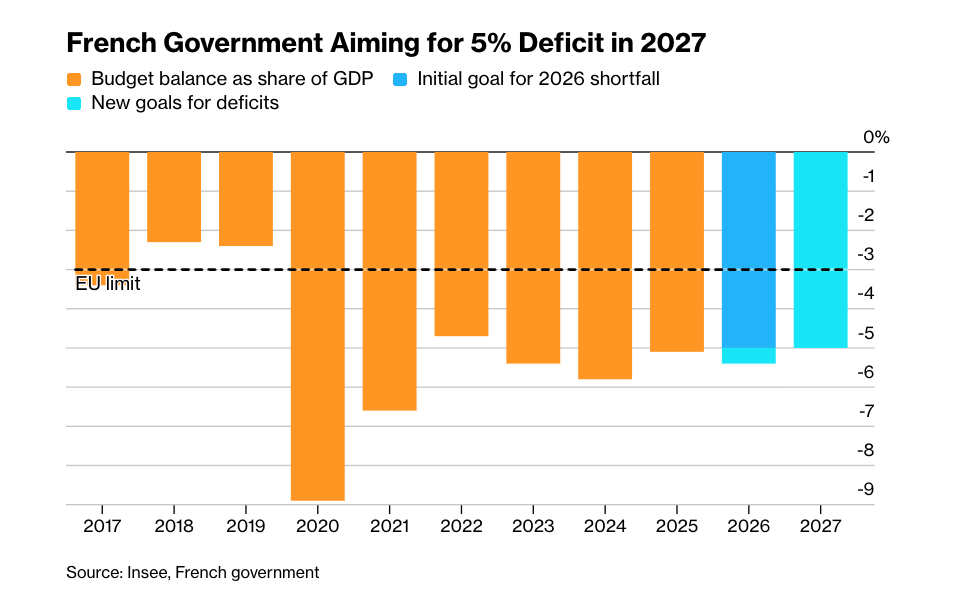
France’s budget deficit over time (source: Bloomberg)
Valdés is also concerned about France, as an interview with Bloomberg makes clear. In it, he specifically addressed the country’s budget problems. He says France must secure ‘timely approval’ of its 2027 budget proposal, without watering down the measures, to maintain its credibility and strengthen market confidence. The proposal aims to bring the budget deficit down to 5 percent of GDP.
With elections approaching, it is uncertain whether there is sufficient support for the French minority government’s plan. According to Valdés, France will have to address its bloated welfare and pension system. 25 percent of total French government spending goes toward pensions. In a previous Weekly Selection, we explained why reforms are so difficult to get off the ground in France. For both the right-wing presidential candidate Le Pen and her left-wing rival Mélenchon, opposing an increase in the retirement age is electorally attractive.
ING writes that France is currently in the eye of the storm. Nevertheless, the bank expects the budget to pass, probably without a vote and possibly with concessions. According to the bank, approval would represent a relative success, as it would prevent the deficit from rising toward 6.5 percent. However, this would not resolve the underlying problems. With a budget deficit of 5 percent and weak economic growth, the debt-to-GDP ratio will continue to rise, reaching an expected 121.7 percent in 2027. ING also notes that virtually no one in France is willing to tackle pensions.
Last week, we wrote that there is a real possibility that the ECB will eventually come to France’s rescue. One potential tool is the Transmission Protection Instrument (TPI), which allows the central bank to purchase government bonds. This can ease funding pressures, but it does not solve the underlying budget problems. Such support could come at the expense of efforts to combat inflation, meaning ordinary citizens (including those in the Netherlands) could ultimately foot the bill.
Finance Minister Eelco Heinen of the VVD spoke out against such a rescue operation this week. In an interview with the FD during the annual meetings of the IMF and the World Bank in Bangkok, he says it would be ‘a sorry state of affairs’ if the ECB were to come to France’s rescue. He calls on France to implement reforms and put its public finances in order. Economist Lex Hoogduin agrees with him.
Heinen says he has also discussed this with ECB President Christine Lagarde. His message: politicians must take responsibility and solve the problems, rather than shifting the burden onto the central bank. Bravo, Minister Heinen! And that deserves to be said, even after our critical podcast about the VVD earlier this week.