English
EN


Cheap money appears to be disappearing for now, but the debts remain. Rising interest rates are putting pressure on the US housing market and fuelling concerns about France’s public finances. Why, meanwhile, is gold holding up remarkably well?
Government bond yields continued to rise this week. The yield on US government bonds with a maturity of thirty years climbed to almost 5.5 percent, its highest level since 2004. The US five-year yield is now also above 5 percent. According to Bloomberg, the rise is being driven by inflation and America’s enormous (and growing) debt mountain.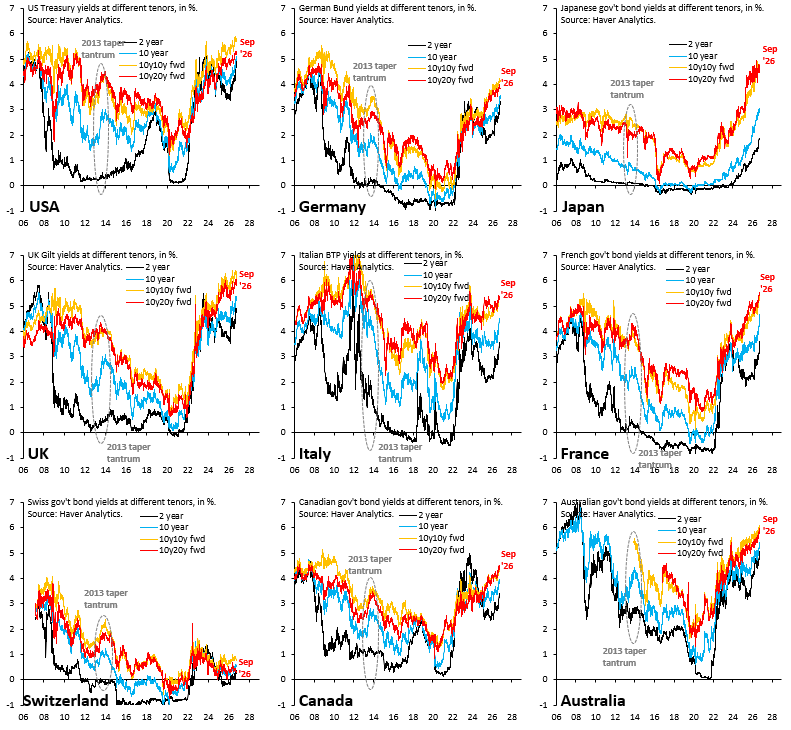
Overview of rising government bond yields across several countries (source: Robin Brooks)
Europe is moving in the same direction. The yield on Dutch ten-year government bonds was still just above 2.7 percent at the end of February, but is now almost 3.7 percent. In troubled France, the increase has been even sharper: the ten-year yield rose from 3.5 percent at the beginning of the summer to 4.7 percent in just three months. Japanese yields even reached their highest level since 1996.
We are no longer used to interest rates like these, but before 2008 they were quite common. An entire generation has grown up with low interest rates and has never experienced this before. The era of cheap money appears to be over. There may even be a fundamental shift underway. “We are in a new regime,” says Samuel Martinez, a portfolio manager at Vanguard. According to him, central bankers’ emphasis on fighting inflation is prompting traders to price in several interest rate increases.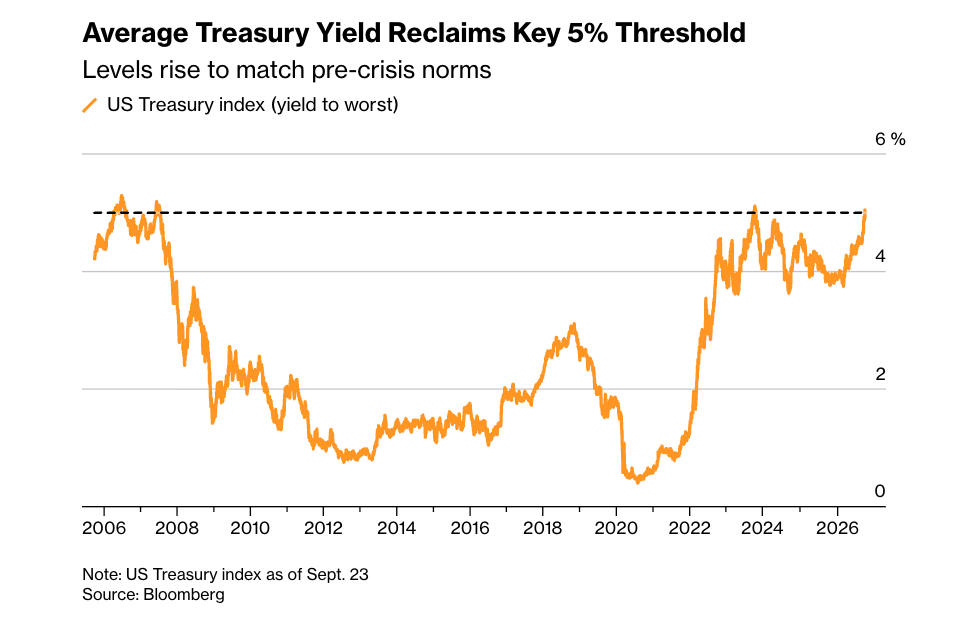
Average yield index for US government bonds over time (source: Bloomberg)
Many see this rise in interest rates as a return to normal, but it does have consequences for an economy that has grown accustomed to (almost) free money. People with student loans or credit card debt, for example, could face higher interest costs. More expensive financing can also put pressure on the housing market: US mortgage rates are now above 7 percent.
The effects are already visible in the US. Higher mortgage rates are forcing home sellers to cut their asking prices, sometimes substantially. According to Lawrence Yun, chief economist at the US real estate trade association the National Association of Realtors, buyers and sellers need to accept higher interest rates as the ‘new normal’.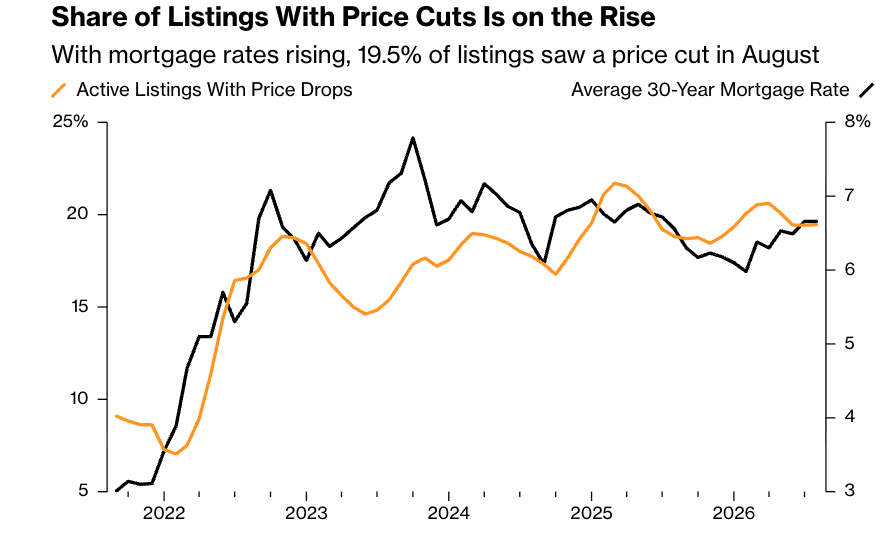
Mortgage rates and the percentage of homes for sale with price reductions over time (source: Bloomberg)
US mortgage rates are still far below the levels seen in the 1980s, but prospective buyers appear to be growing more hesitant. In addition to higher financing costs, high house prices, increased housing expenses and more expensive energy are making them more cautious. Almost one in five homes for sale had its asking price reduced in August. According to Bloomberg, some buyers now expect rising interest rates to push house prices down further.
Rising interest rates are normally bad news for gold: when real interest rates rise, investments that pay interest become relatively more attractive. Yet the gold price is not collapsing. Since real interest rates turned positive again in April 2022, gold has actually risen in price. According to In Gold We Trust (IGWT), this is because central banks are expanding their gold reserves. Their purchases have become the main driver of the gold price, counterbalancing higher interest rates.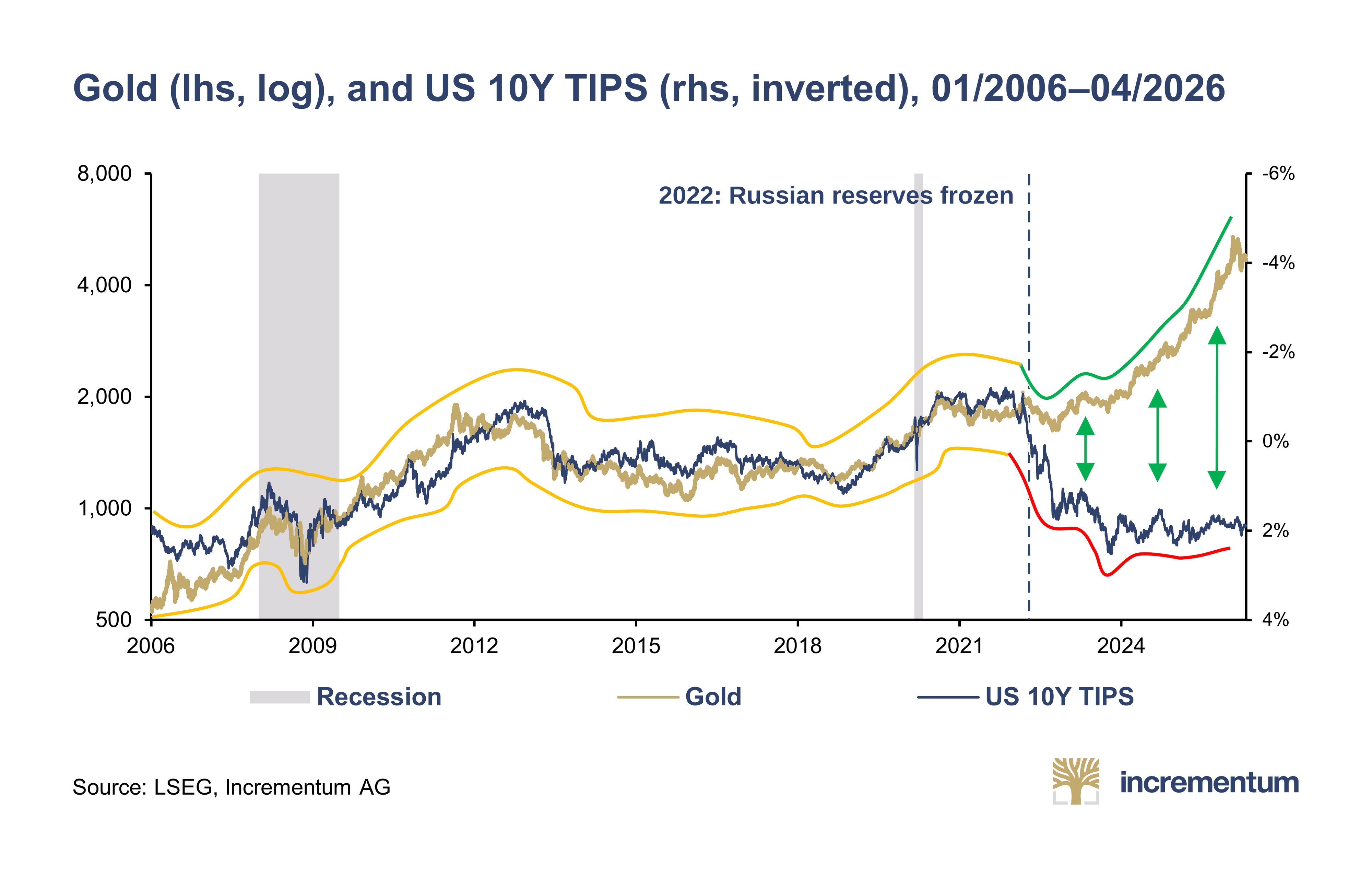
Both the gold price and real interest rates are rising (source: IGWT)
Ole Hansen of Saxo observes that gold is weathering the ‘stress test’ of higher interest rates and a stronger dollar remarkably well. Gold holdings in ETFs are also approaching their February peak, when the gold price was higher. According to Hansen, higher interest rates create headwinds in the short term, but could actually make gold more attractive in the longer term. Persistently high financing costs put pressure on heavily indebted governments, companies and other borrowers. This heightens concerns about the sustainability of those debts and the stability of the financial system. That uncertainty could prompt investors to seek protection in gold.
Australian hedge fund manager Raphael Lamm also views the recent decline in the gold price as temporary. He points to unsustainable public finances in major economies and increasing gold purchases by central banks. “Most of the key drivers of demand for gold will remain intact or even strengthen over the medium term,” he says.
A major cause of the developments described above is that governments seem unable to get their budget deficits under control. Efforts to push down long-term yields, such as US Treasury Secretary Scott Bessent’s buyback programme for long-term government bonds, can temporarily lower yields. But they do not address the underlying causes of rising yields, warns Howard Marks, co-founder of Oaktree.
“You cannot ignore the laws of economics and expect to be better off,” says Marks. He warns that the United States cannot indefinitely spend more than it takes in without putting its creditworthiness and confidence in the dollar and US government bonds at risk.
Any discussion of persistent budget deficits soon turns to France. Prime Minister Sébastien Lecornu wants to make 54 billion euros in budget cuts. He, too, sees greater fiscal discipline as the way to curb rising government debt and interest rates. French government debt is expected to reach a record 121.7 percent of gross domestic product in 2027.
But as we wrote previously, France is more vulnerable than the United States even with comparable budget deficits and debt-to-GDP ratios. After all, the French economy is growing much more slowly than the US economy. France also has substantial future obligations (pensions) for which insufficient funding has been set aside.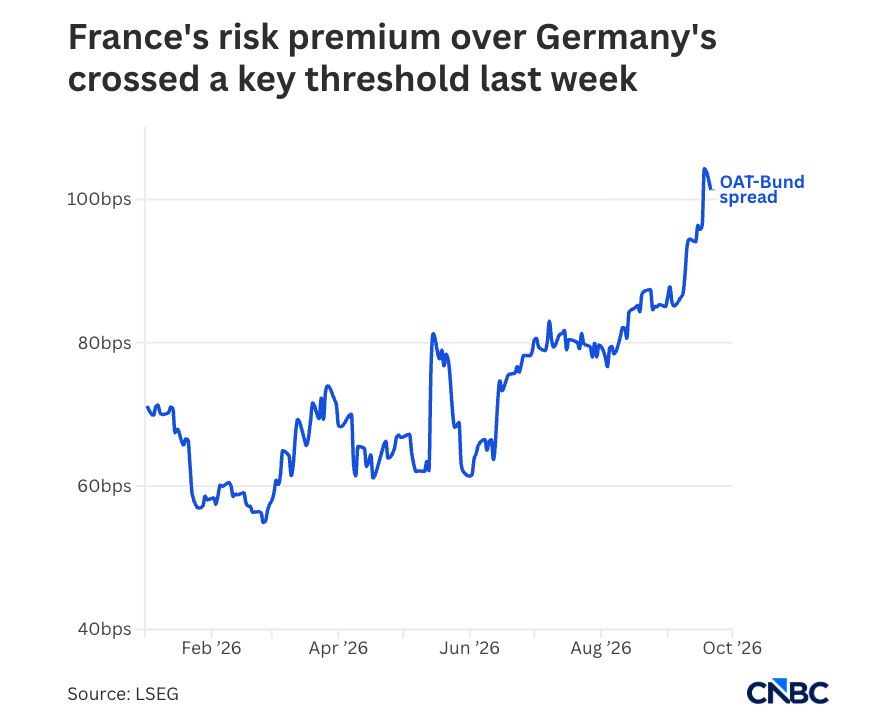
The spread is widening (source: CNBC)
For now, the market appears to have little confidence that France’s budget-cutting plans will succeed. This is justified, as there is little political support for spending cuts. With the April 2027 presidential election approaching, the spread has widened considerably in recent weeks. This is the difference in yields between French and German government bonds with the same maturity. Investors are therefore demanding an increasingly large yield premium to lend their money to France rather than Germany.
Economist Robin Brooks expects the ECB to intervene eventually if the situation gets further out of hand. In his view, the central bank has fallen entirely under the sway of heavily indebted eurozone countries. If the ECB artificially pushes down French yields, this could reduce the pressure on Paris to cut spending and implement reforms. The risk is that necessary measures are postponed once again and the debt problems worsen.