9.3
8.058 reviews

English
EN


Global demand for platinum rose sharply in the first quarter of 2023, according to new figures from the World Platinum Investment Council (WPIC). Industrial demand has risen to record highs due to a 17% year-on-year growth. The increasing demand for platinum is mainly driven by the automotive and industrial sectors, while investment demand has also increased significantly due to global geopolitical uncertainties. Together, these developments have led to an upward revision of the expected platinum shortfall of 983,000 troy ounces for the whole of 2023.
Demand for platinum in the automotive industry has risen sharply, despite a weak macroeconomic outlook. In the first quarter of 2023, demand rose 9% to 806,000 troy ounces, mainly due to an increase in platinum usage per vehicle. For the full year, the WPIC expects global demand for this precious metal from the automotive industry to rise 12% to 3,255,000 troy ounces, mainly driven by heavy-duty vehicle production, stricter emissions regulations and the replacement of palladium with the cheaper platinum in gasoline car exhaust systems.
The medical sector and other industrial segments are also showing strong growth. In addition, there is a high demand for platinum in the glass industry, with a growth of 76% compared to last year. Investment demand for platinum has also increased significantly, with a growth of 28% compared to last year. Total platinum demand in 2023 is estimated to reach 8,176,000 troy ounces, as the table below from the WPIC's quarterly report shows.
Despite the macroeconomic uncertainties, the WPIC foresees that platinum demand will rise significantly in 2023, with an expected shortfall of nearly 1 million ounces. The growing shortage is mainly driven by the demand for platinum as a substitute for palladium in the automotive industry. Platinum's role in the hydrogen economy is also becoming increasingly important, attracting interest from investors worldwide.
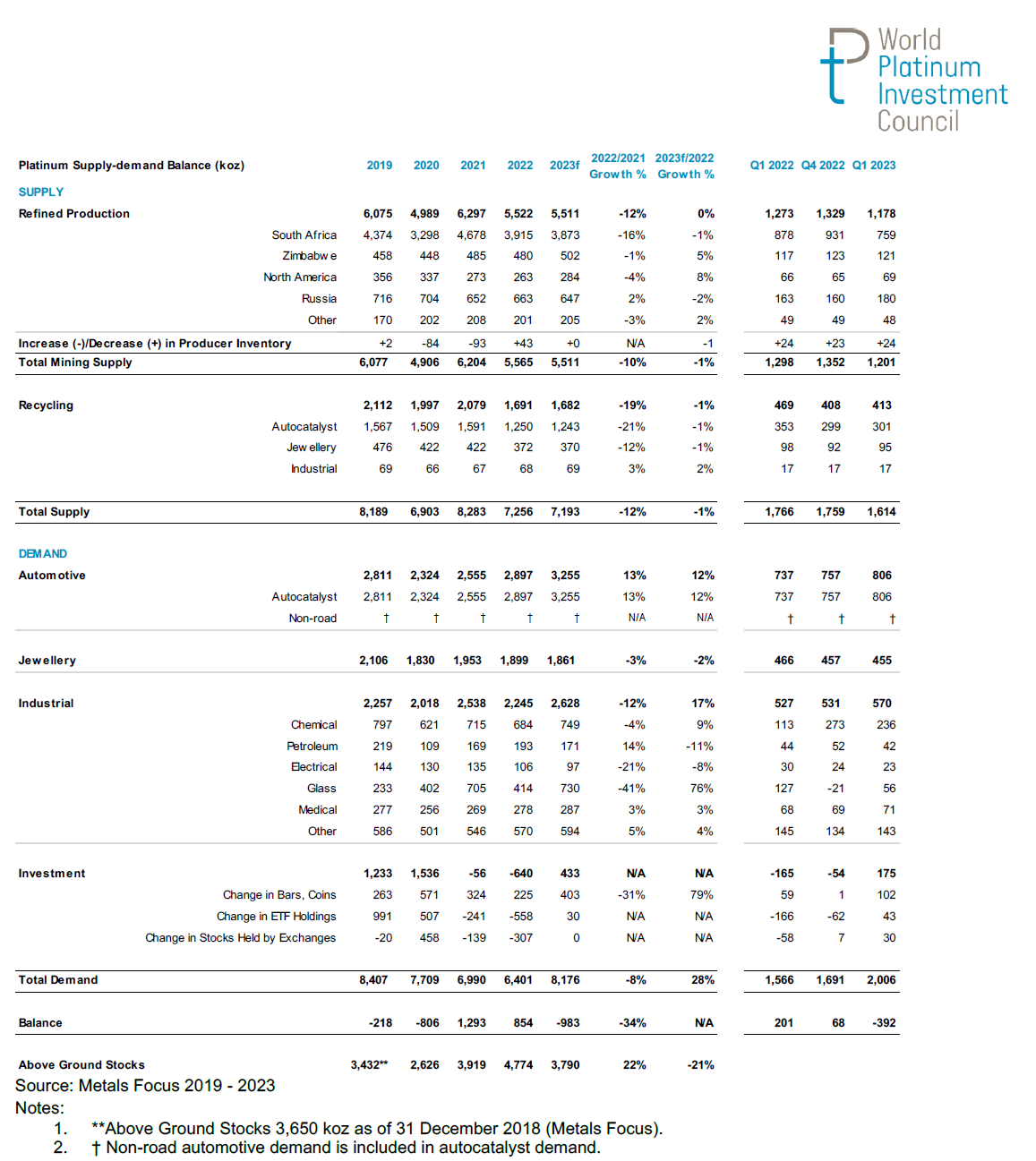
Supply and demand figures for the platinum market (Source: World Platinum Investment Council)
The first quarter of 2023 also saw a surge in investor interest, driven by increased global uncertainty, strong growth in industrial demand for platinum, and mining production concerns. The investment in the form of Platinum Bars and Platinum Coins increased by 42,000 troy ounces from the previous year to 102,000 troy ounces, an increase of 72%. That was the highest volume since the third quarter of 2021, mainly driven by a strong rebound in Japan.
This trend is expected to continue for the remainder of the year, with a forecast increase of 79% year-on-year to 178,000 troy ounces. Also, platinum ETF inventories rose by 43,000 troy ounces in the first quarter of 2023, reversing a trend of six consecutive quarters of declining inventories. South African funds showed significant renewed interest in holding platinum ETFs rather than investing in mining sector stocks. This trend is also expected in 2023. The result will be a net investment demand of 433,000 troy ounces for the full year 2023. By comparison, last year net investment demand was minus 640,000 troy ounces due to large-scale selling of platinum ETFs and a decline in inventories on commodity exchanges.
Platinum supply has been problematic in recent years and is expected to remain so in 2023. Refined mine production fell 8% year-on-year in the first quarter, mainly due to reduced production in South Africa due to smelter maintenance and power shortages. This country accounts for 70% of the global mining production of the precious metal. Globally, mining production will fall by 1% this year to 5,511,000 troy ounces. Platinum recycling was also disappointing due to lower volumes of end-of-life vehicles and regulatory restrictions. As a result, the WPIC expects full-year recycling supply to decline 1% year-over-year, to 1,682,000 troy ounces.
A shortage of platinum means that the supply from recycling and mining is not enough to meet the demand. This is not to say that there will be an acute shortage, because every year the total above-ground supply of platinum increases due to mining production. However, it does mean that part of the demand this year will have to be met with platinum reserves that are already present above ground. That will have a price-pushing effect. Compared to gold and silver, the above-ground reserves of platinum are smaller, but still substantial. This is because platinum can always be reused and that it also serves as an investment due to its relative scarcity.
The platinum price has been hovering around $1,000 per troy ounce in recent years, reaching a peak of over $2,100 per troy ounce in February 2008. Historically, the precious metal tended to be more expensive than gold, but now the yellow metal is worth almost twice as much. That makes platinum relatively cheap historically.
Do you want to buy platinum? Currently we have the platinum Maple Leaf coins in stock
Disclaimer: Holland Gold does not provide investment advice and this article should not be read as such. Investing involves risk, and past performance is no guarantee of future results.


