English
EN


Shortly after yields on US government bonds reached their highest level since 2007, US Treasury Secretary Scott Bessent intervened. Gold responded by rising to a three-month high. This week, however, attention is focused primarily on the annual central banking symposium in Jackson Hole, where leading policymakers will gather and are expected to provide greater clarity on monetary policy. Could Jackson Hole give the gold and silver rally fresh momentum?
Gold and silver responded strongly to the news that long-term government bonds would be bought back. Gold reached $4,680 per troy ounce (31.1 grams), while silver reached $69.70 per troy ounce.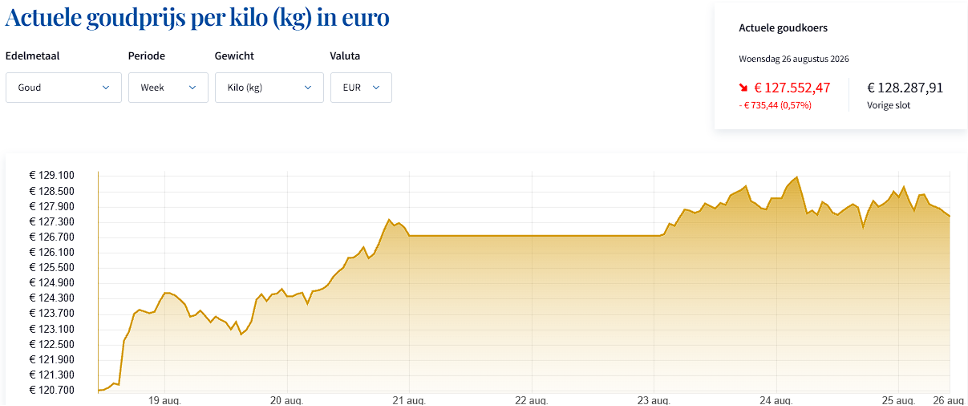
In the previous market update, it was explained that breaking through the 200-day moving average at around $4,500 per troy ounce was important for a further rise. This moving average is often used to assess a price trend. Now that gold has broken through this level, Ole Hansen writes that the next important resistance level is $4,770. He also notes that the recent rise is being supported by increasing investor demand. The amount of gold held in ETFs has increased by approximately 60 tonnes this month, putting August on track for the strongest monthly inflow since September last year. Hedge funds have also increased their net long position in gold futures to its highest level in eleven months. According to Hansen, these developments demonstrate how a technical breakout and mounting political, financial and fiscal concerns can quickly lead to additional demand for gold.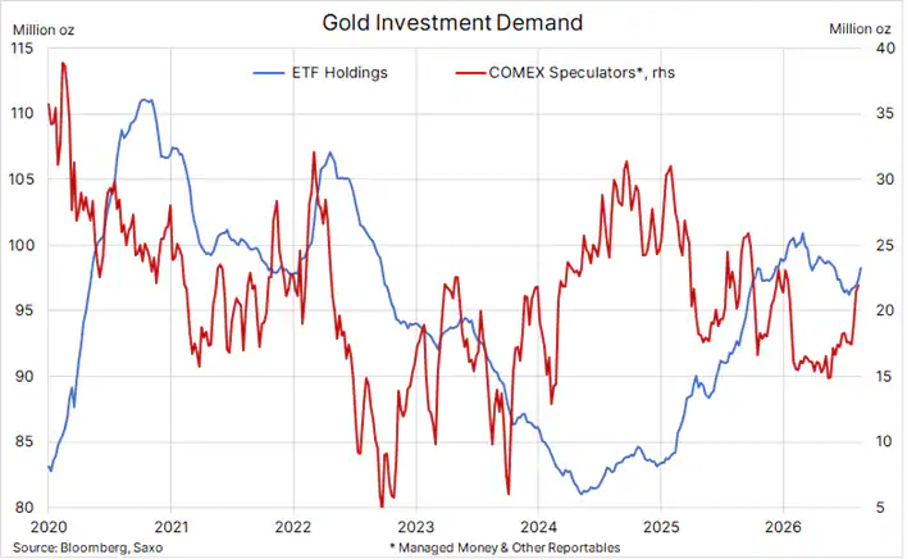
Investment demand for gold. (Source: Saxo)
According to Hansen, the factors that have brought these investors back to gold have not changed, and he expects them to continue providing support in the coming months. “These include concerns about the sustainability of US public finances, the possibility of further dollar weakness, demand from central banks and persistent geopolitical uncertainty.” In short, high interest rates, intervention in the bond market, geopolitical turmoil and persistent inflation have once again brought the so-called debasement trade, in which investors buy gold and silver as protection against these risks, firmly into focus.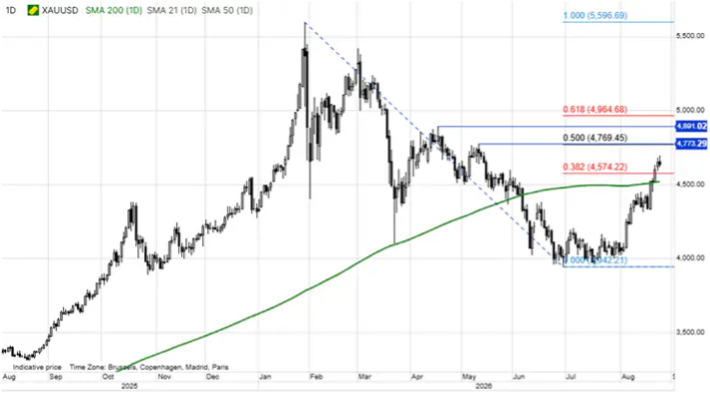
Gold moves above its 200-day moving average (green). (Source: Saxo)
On Friday, Federal Reserve (Fed) Chair Kevin Warsh will deliver a speech at the Jackson Hole symposium. The event traditionally provides investors with clues about the Fed’s interest-rate policy. However, it appears unlikely that Warsh, the Fed’s new chair, will discuss this extensively during his debut speech. He does not attach much importance to ‘forward guidance’ and believes investors should focus more on market signals. Reuters reports that this is creating uncertainty among investors. They also believe that his credibility on tackling inflation is under pressure. This is partly because Warsh has argued that rising government bond yields are already slowing the economy. As a result, the Fed may have less reason to raise interest rates further, even though inflation remains well above its 2% target.
Investors therefore primarily want to know how aggressively Warsh is prepared to act if inflation remains above the 2% target. A hawkish Fed could keep interest rates high for longer or raise them even further, while a less hawkish Fed may see more scope to lower rates to support the economy and labour market. “Are they going to give it a year, or are they going to try to meet the target within six months?” asks Vishal Khanduja of Morgan Stanley Investment Management. The current data do not make that choice any easier. Job growth and inflation are slowing. If the labour market weakens further, the Fed could instead cut interest rates sooner to stimulate the economy. Nevertheless, the market is now pricing in a 40% chance of an interest-rate increase next month, up from 33% a week earlier. Warsh’s speech could therefore clarify how the Fed intends to balance inflation against conditions in the labour market.
A more hawkish Fed policy could weigh on the gold price. When interest rates rise, interest-bearing investments such as bonds become more attractive. When interest rates are lower and inflation remains high, gold becomes more appealing.