English
EN


The Fed raises interest rates, a headwind for gold? Koen Lauwers sees a very different development. Gold ETFs and central banks’ appetite for gold are changing the picture completely. And why did the Fed raise rates in the first place, while inflation is largely driven by rising oil prices and the policy rate has no effect on that?
Gold and silver prices remain under pressure from rising interest rates. In the United States, the long-term interest rate (10-year Treasury yield) climbed above 5%, its highest level since July 2007. In Germany, Europe’s largest economy, the yield on the 10-year Bund had not been this high since 2009.
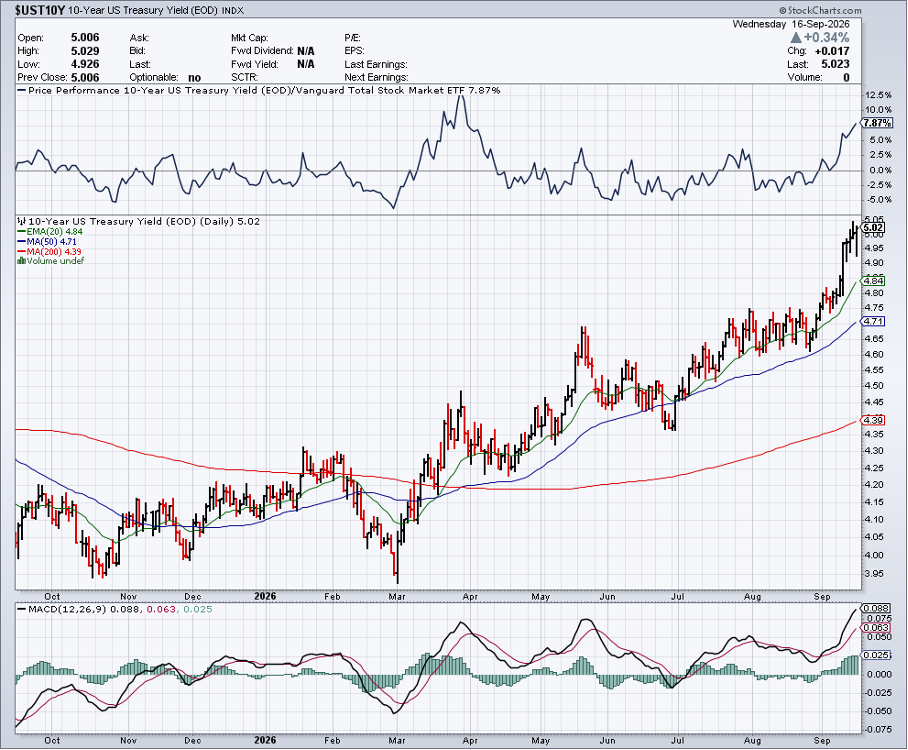 Chart: yield on the 10-year US Treasury bond over 12 months (Source: StockCharts)
The Federal Reserve ultimately went ahead and raised its policy rate by 25 basis points to 3.75 to 4%, the first increase since July 2023. Following the speech by Federal Reserve Chair Kevin Warsh at the annual Jackson Hole gathering for central bankers, a rate increase had already been broadly in line with expectations.
The so-called dot plot, part of the Summary of Economic Projections, also showed that another increase is expected this year, which would bring the policy rate to 4 to 4.25%. Two monetary policy meetings remain in 2026, on 28 October and 9 December. The first date falls just before the US midterm elections. According to the CME FedWatch Tool, the probability of another rate move at that meeting currently stands at 55%.
Although the rate increase had therefore been expected, the initial price reaction in gold and silver was negative. Gold fell by almost $100 in the hour after the rate decision, although the gold price had risen on Wednesday in the run-up to the announcement. A day later, most of the loss had already been recovered and gold was trading back at roughly the same level as on Tuesday evening. Because the dollar rose alongside interest rates, the impact on the gold price measured in euros was smaller. Since the start of 2026, gold is now up almost 1% in dollar terms and 2.5% in euros. For silver, the corresponding figures are -9.5% and -8%.
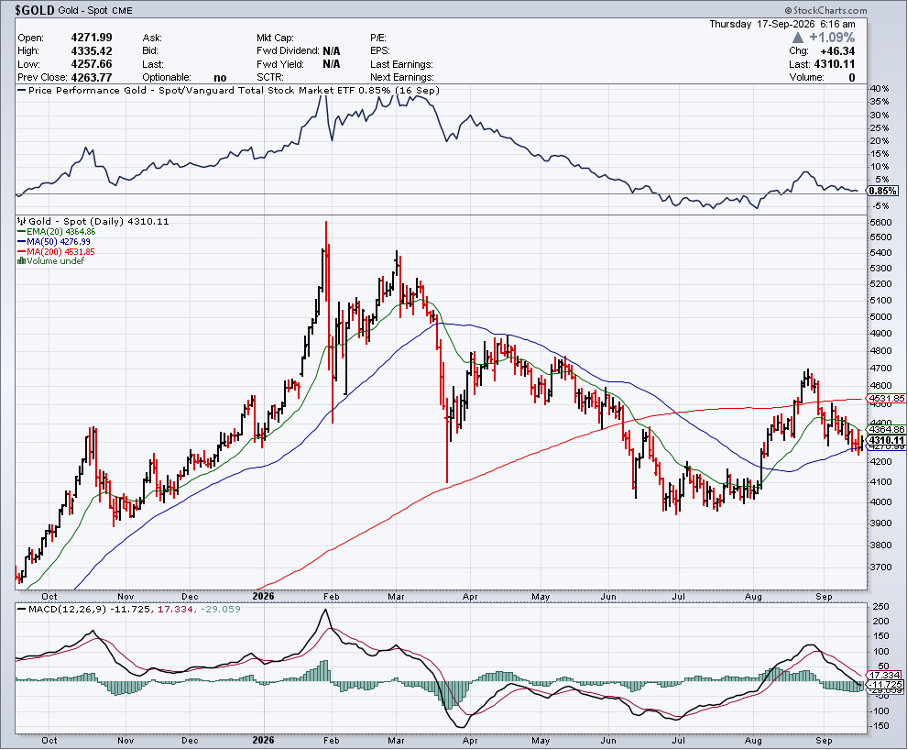 Chart: gold price over 1 year with 50-day and 200-day moving averages (Source: StockCharts)
The US inflation report for August was in line with expectations, but the Federal Reserve nevertheless used it as an argument for raising the policy rate. The Consumer Price Index (CPI) rose by 3.4% year-on-year in August, the same as in July. On a monthly basis, the increase was 0.4%, with energy in particular becoming more expensive. The diesel price in the US even reached a record level. Core inflation, excluding food and energy, rose by 2.4% in August, a slightly smaller increase than in June (2.5%). Compared with July, core inflation rose by 0.3%.
As argued previously, inflation running above the desired level is not attributable to the demand side, but to problems on the supply side. The United States brought the main factor, namely high energy prices, upon itself (and by extension the rest of the world) by starting a war with Iran. A 25-basis-point increase in the policy rate will do nothing to change that and is certainly not conducive to the growth policymakers want to generate in order to reduce the debt organically. The rate increase is aimed more at calming the bond markets and at trying to preserve the perception that the central bank still has them under control. Which, of course, it does not, but perception is everything in financial markets.
China’s central bank bought 650,000 troy ounces of gold in August, equivalent to 20.2 tonnes. This is shown by data from China’s State Administration of Foreign Exchange (SAFE). The People’s Bank of China (PBOC) had not bought this much gold in a single month since October 2023, when purchases totalled 740,000 troy ounces, or 23 tonnes. August was also the 22nd consecutive month of net gold purchases. China’s official gold reserves have therefore risen to 76.73 million troy ounces, or 2,386.3 tonnes. As a result of the additional purchase, combined with the rise in the gold price during August, the value of these gold reserves increased to $350.1 billion, 14% more than a month earlier.
Physical gold ETFs recorded their second-highest monthly inflow of investment capital ever last month. This was shown by figures compiled by the World Gold Council. No less than $18 billion was invested in gold ETFs during the month, bringing the total amount of gold under management to a record 4,189 tonnes.
European funds bought the most, with inflows of $7.9 billion. The largest part of that total ($4.4 billion) came from the United Kingdom, because many funds are headquartered in London. The United States followed with $7.7 billion. Notably, more than half of this amount was bought in the week of 17 August, when Scott Bessent announced that he would step up bond purchases. Following this strong August, US funds have returned to a net inflow since the start of the year. Asia bought $2 billion and the rest of the world $0.4 billion. Asia traditionally has higher volumes in physical metal than in ETFs.