9.3
8.064 reviews

English
EN


The situation on the housing market has fundamentally changed in recent months. In the third quarter, the NVM reported a price decrease of 5.8% quarter-on-quarter, the largest quarter-on-quarter decline ever recorded. Statistics Netherlands (CBS), which monitors house prices on a monthly basis, saw the Largest price drop since May 2013. This does not bode well, as the figures from Statistics Netherlands are on average two to three months behind figures from the NVM. Elsewhere in the world, house prices are also falling sharply. What's in store for us in the coming years?
Until the beginning of this year, house prices in many Western countries were still rising at a record pace, driven by historically low mortgage rates. But now that interest rates are rising rapidly and energy prices have gone up three to four times, most households are stretched thin. Potential buyers drop out due to the higher monthly costs or are no longer able to arrange financing. Sellers notice that Viewers stay away and therefore have to lower the price more often. Especially now that more people are putting their homes up for sale and the supply is increasing.
Most people who buy a house take out a mortgage with the bank. According to figures from the Dutch Central Bank, many people are looking for the maximum of their borrowing capacity on. And in a tight housing market, that ultimately determines the price people pay for a house. Add to that savings, equity from a previous home and the tax-free donation of up to a hundred thousand euros and you see the explanation for the extreme overbidding in the final phase of the bubble.
All of these factors have pushed house prices to record levels this year. This is despite the fact that borrowing capacity is declining due to increased mortgage interest rates. As the graph below from Woningnieuws shows, banks already charge 4.5% interest for an NHG mortgage with a term of thirty years and a fixed-rate period of 10 years, while until the beginning of this year it was only slightly more than 1%.
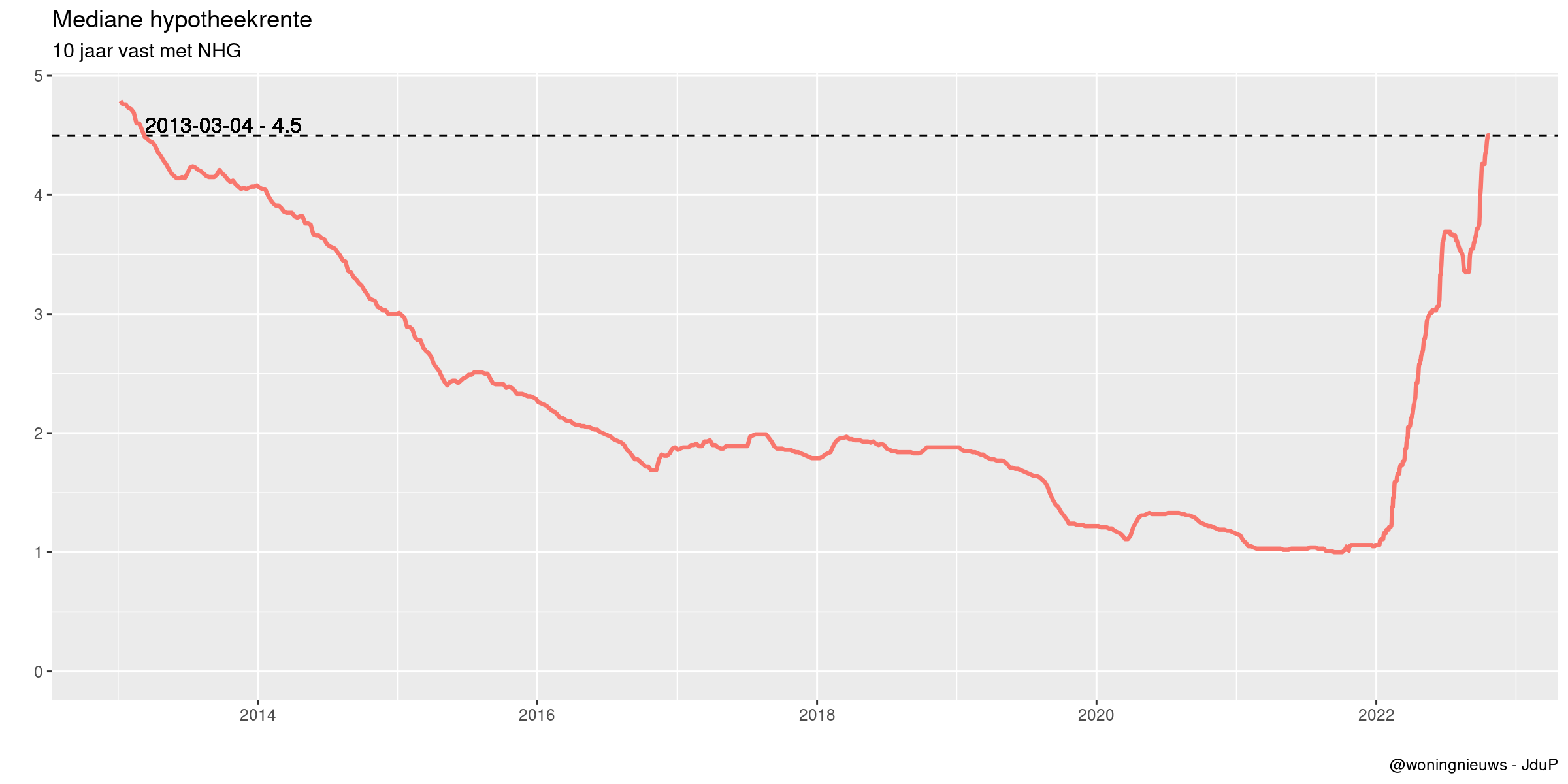
Mortgage interest rate for NHG mortgage with fixed-rate period (Source: @Woningnieuws)
This rise in interest rates has major consequences for the affordability of housing. The gross monthly costs for an average owner-occupied home have risen by tens of percent in a short period of time, as the graph below shows. As a result, it becomes less interesting for many households to seek out the maximum borrowing capacity. This means that house prices will have to fall further to improve affordability. Due to the increased interest rates, the affordability of homes is now even worse than during the extreme overbidding at the beginning of this year.
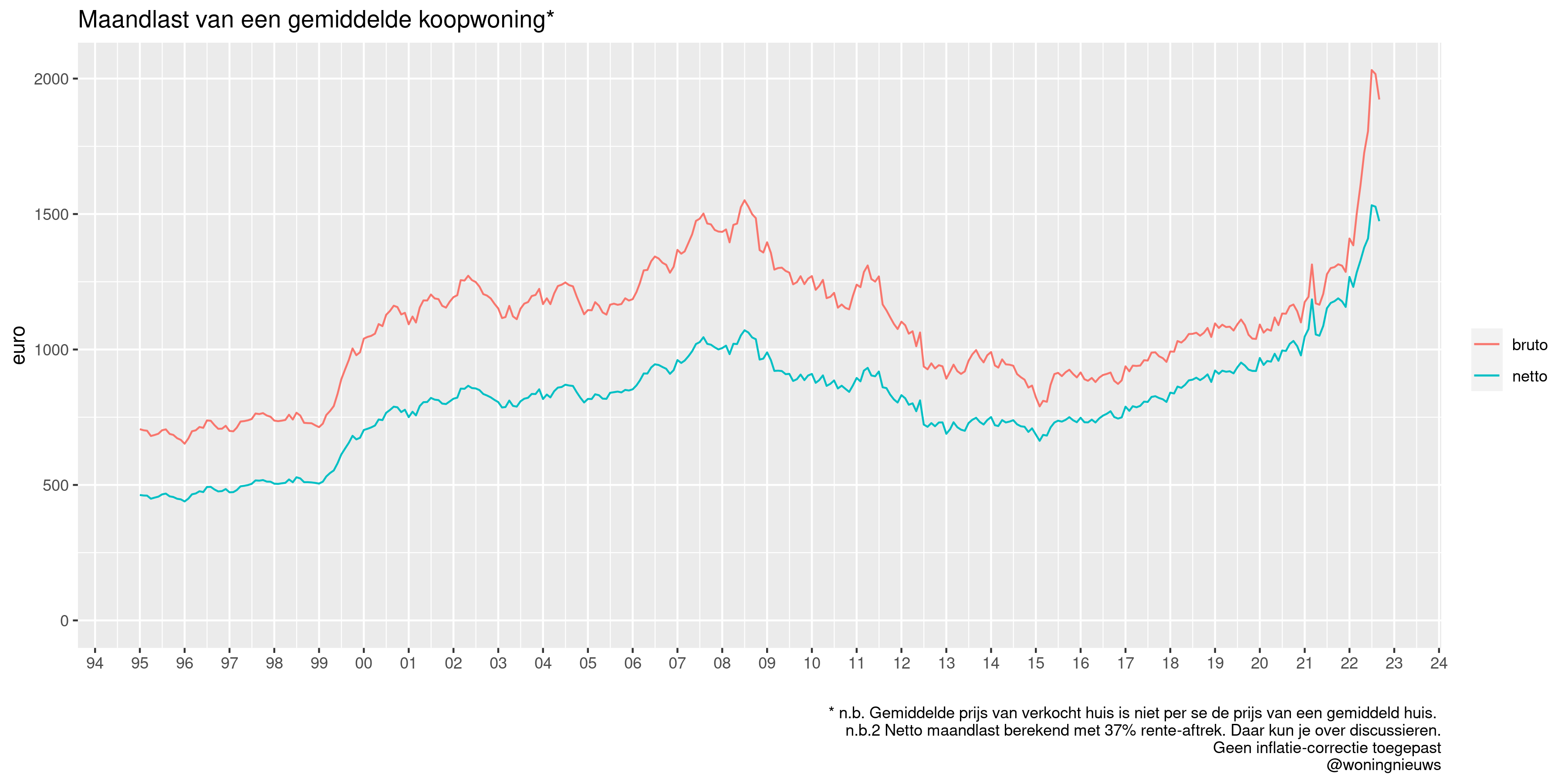
Monthly costs for an average owner-occupied home (Source: @Woningnieuws)
In recent years, interest-only mortgages have played an important role in further boosting house prices. Homebuyers were able to finance up to half interest-only, which became increasingly interesting with the exceptionally low interest rates. Moreover, the need for full repayment became less and less, because people who own a house were already building up capital in the form of surplus value. That these two phenomena are directly related to each other will become clear in the near future.
Due to the increased interest rates, the interest-only mortgage has become much less attractive. The interest on the interest-only part of the mortgage has no longer been deductible in recent years, so the advantage of this type of loan has disappeared. The graph below shows that this financial trick to reduce monthly expenses, which became increasingly popular, no longer works.
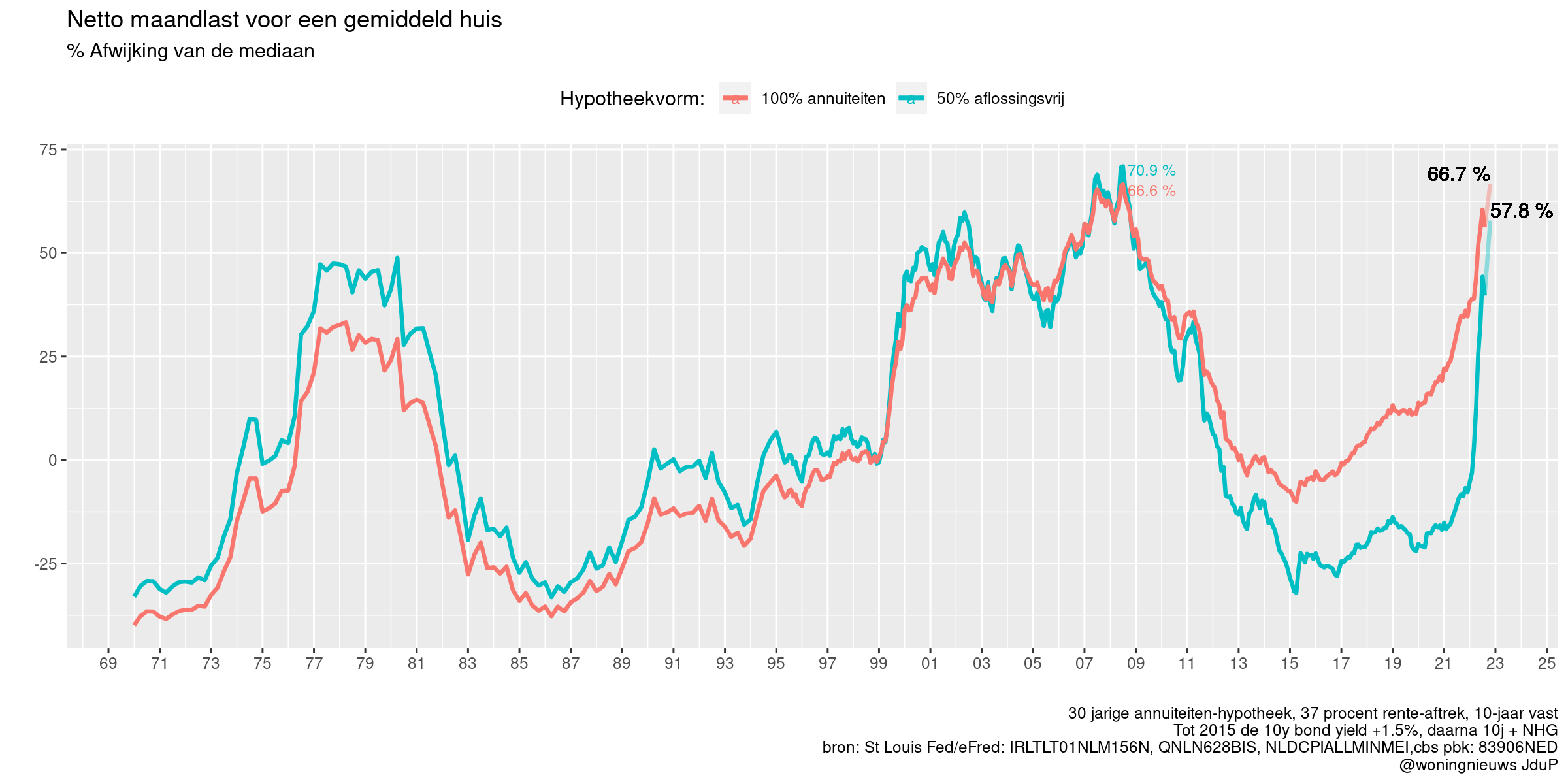
Interest-only financing is no longer interesting (Source: @Woningnieuws)
House prices are slowly adapting to a new reality, in which buyers can and want to borrow less. And that means that house prices will have to fall much further to restore affordability. The scarcity on the housing market is already decreasing, and buyers are getting more and more choice. The need to bid above the asking price is gone, bidding below the asking price will become more and more common.
Sellers are lagging behind this development and sometimes expect to receive the prices that were paid at the beginning of this year. These sellers will be disappointed, because a house that is priced too high will not easily find a buyer. Buyers will also consider the energy efficiency of a home. Due to high energy prices, they will offer less for a draughty old house than for a well-insulated home.
In recent years, low interest rates have been the main driver behind the ever-rising house prices. Now we have house prices that correspond to an interest rate of one percent, while in reality it is more than four times as high. If mortgage rates remain around the current level of 4.5%, this could reverse a large part of the rise in house prices in recent years. The last time interest rates were at this level was in 2013, when house prices were about half as low.
Will house prices fall by 50%? It's hard to say. Due to migration, the population in the Netherlands has grown sharply in recent years. New construction is also lagging behind demand, which means that there will continue to be some tightness in the housing market. As a result, prices are unlikely to fall as much, but a 20% drop is not unlikely based on monthly costs. The decrease could be lower if mortgage rates fall somewhat, but also higher if energy prices remain high for a long time.
According to a new British study, there is a chance that Dutch house prices will fall by more than ten percent limited, because unemployment in our country is still very low. As long as people don't lose their jobs, there will be fewer forced sales and people can continue to pay the mortgage payments. However, this analysis does not take into account the interconnectedness of the economy and the second-round effects of falling house prices.
Both De Nederlandsche Bank If the IMF have warned several times about the vulnerability of the Dutch economy. Due to high mortgage debts, house prices have risen sharply, which means that homeowners have a lot of capital in our own homes. As a result, homeowners feel rich. But when prices fall, the wealth of many households also evaporates. And that, in turn, has an impact on spending. Instead of withdrawing surplus value to do fun things, people will keep their hands on the purse strings and spend less money on luxury goods and services, which will still increase unemployment.
The situation on the Dutch housing market is problematic, but different from 2008. At that time, banks granted much higher mortgages relative to the value of the collateral. Many people were quickly submerged. In recent years, credit standards have been tightened, but it is still possible to finance 100%. With the rapidly rising house prices of the past two years, there are still households that could be in negative equity. House prices are now falling faster than what people with a standard annuity mortgage can repay.
In the third quarter, mortgage debt reached for the first time more than €800 billion, indicating that the debt problem is still very high. Compared to 2008, it will now take longer for people to go under the water financially. The exposure to the housing market explains why the Dutch economy performs above average when house prices rise and below average when prices fall. So that does not bode well if house prices fall further and consumer spending goes down with it. Consumer confidence remains historically low and willingness-to-buy continued in October Deteriorated compared to September. The new trend of falling house prices will therefore continue for some time.
This contribution was made from Geotrendlines


