English
EN


For years, borrowing in Japan was virtually free, and investors took full advantage. They borrowed yen at very low interest rates and invested that money in markets offering higher returns. This strategy is known as the yen carry trade. Now that Japanese interest rates are rising, the strategy is coming under increasing pressure. Intervention by the Bank of Japan in the foreign exchange market can also pose significant risks to these investors. How does the carry trade work, and what happens if investors unwind their positions en masse?
In a carry trade, investors borrow money in a country with low interest rates and invest it in countries with higher interest rates, or in bond and equity markets. The Japanese yen is one of the main funding currencies for this strategy. An investor borrows yen in Japan, exchanges them for dollars, for example, and invests the money in US stocks or bonds. This allows him to benefit from the interest rate differential between the two countries and the potentially higher returns on his investments.
Alongside the interest rate differential, the exchange rate between the yen and the dollar also plays an important role. Consider an example: an investor borrows 10 million yen at an interest rate of 0.5%. At an exchange rate of 100 yen per dollar, he receives 100,000 dollars. He invests that amount in US government bonds for three years at an interest rate of 3.5%, bringing the value of his investment to approximately 111,000 dollars. If the exchange rate remains unchanged, that is around 11.1 million yen. If the yen weakens and the exchange rate rises to 110 yen per dollar, the same investment is worth approximately 12.2 million yen. That represents more than 1.1 million yen in additional returns.
For years, the yen carry trade proved particularly lucrative. Japanese interest rates have been exceptionally low since the economic bubble burst in the early 1990s. The Bank of Japan and the Japanese government spent years trying to stimulate the economy through accommodative monetary policy and low interest rates, but these efforts had little effect for a long time: Japan faced prolonged economic stagnation. As a result, interest rates remained low for decades. From 2016 through 2024, the Bank of Japan even maintained a negative policy rate.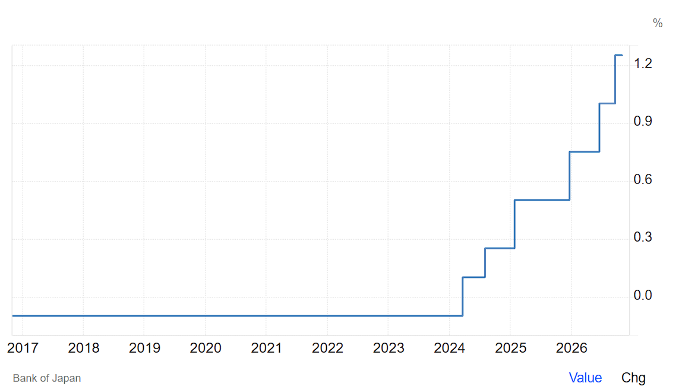
Bank of Japan policy rate (Source: TradingEconomics)
At the same time, the yen weakened sharply against the dollar and reached its lowest level in more than forty years, as reported by The Japan Times. The first reason was the large interest rate differential with the United States: this made it attractive to borrow yen and exchange them for dollars, increasing selling pressure on the yen. Rising oil prices also put pressure on the currency. Japan imports large amounts of energy, which is traded internationally primarily in dollars. When oil prices rise, more yen therefore need to be sold to buy the same quantity of oil. Finally, weak economic growth and limited domestic returns made overseas investments more attractive to investors.
All these circumstances made the yen carry trade particularly attractive. Extremely low interest rates made borrowing cheap, while the weak yen also generated additional returns for investors.
Yet the era of virtually free money appears to be drawing to a close. Japan experienced very low inflation for years, but that has changed since 2022. Inflation rose and remained above the 2% target for an extended period. The Bank of Japan therefore felt compelled to raise interest rates. Following increases in June and September, the policy rate reached 1.25%, its highest level in 31 years. Inflation is now moving back towards 2%, but analysts expect the central bank to raise interest rates further. According to Reuters, the next rate increase could take place as early as December.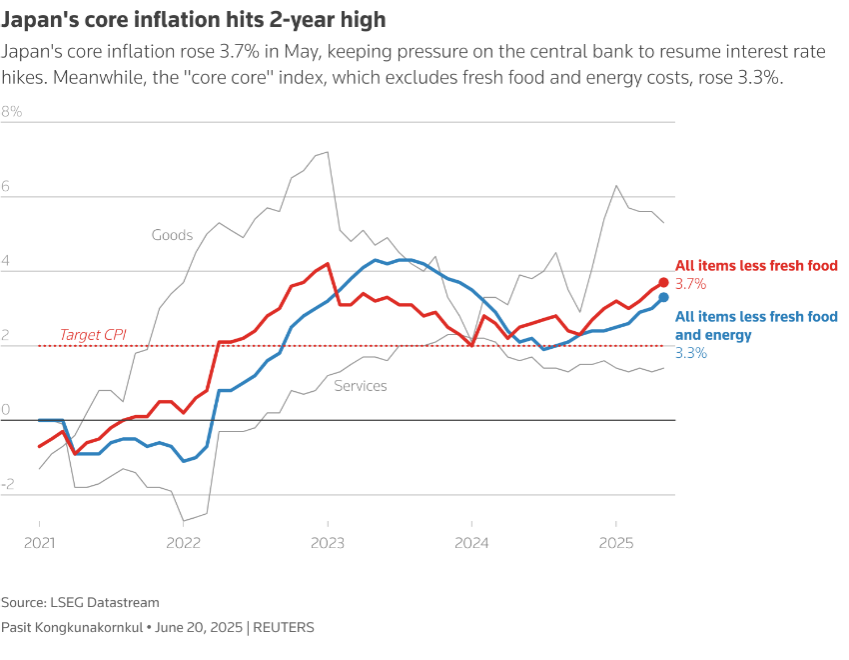
The Japanese authorities also tried to support the yen in the foreign exchange market. In July, they sold dollars to buy back yen, after which the yen recorded its biggest gain since February. At the same time, the Japanese economy is gradually picking up. Rising wages and higher corporate profits are stimulating domestic consumption and investment. With negative interest rates now a thing of the past and the yen slowly gaining strength, conditions are changing for investors who use the carry trade.
As mentioned earlier, a weak yen can generate additional returns for carry trade investors. However, this mechanism also works in reverse. If the yen strengthens or share prices fall, investors using borrowed money face margin calls (demands to post additional collateral). The value of their overseas investments then falls relative to the yen-denominated loan they must repay. They are then forced to sell stocks and bonds to meet their obligations. When they subsequently exchange their dollars for yen to repay their loans, this creates additional demand for the yen. That strengthens the yen further and accelerates the unwinding of the carry trade. In this way, even a relatively small rise in the yen can trigger a chain reaction, resulting in large fluctuations in international financial markets.