9.3
8.064 reviews

English
EN


Over the past few decades, the global gold market has undergone major changes. Whereas in the 1990s gold was mainly bought in the form of jewellery, since the financial crisis of 2008 investment gold has become increasingly important. Central banks have also made a U-turn, from selling gold to buying gold. The World Gold Council covers the most important trends in a new report. What do they write about the gold market?
Thirty years ago, the gold market consisted mainly of jewellery and the share of investment gold was marginal. That changed with the introduction of gold ETFs from 2003 and the financial crisis of 2008. The latter in particular unleashed a worldwide flight to physical gold. In the Western world, the precious metal became very popular from that moment on. The graph below shows how the composition of the gold market has changed in outline over the past thirty years.
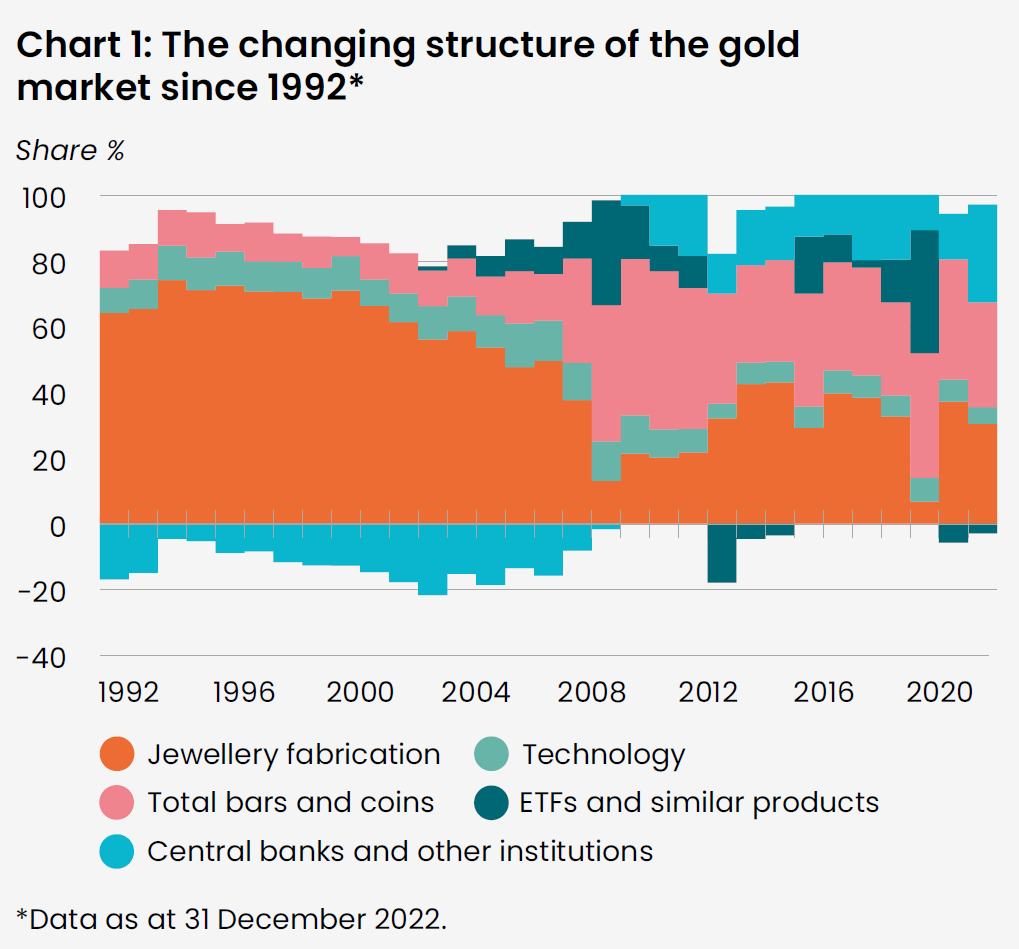
Composition of the gold market changes, center of gravity shifts to investment gold (Source: World Gold Council)
In 1992, China and India together accounted for about 20% of global gold demand, today it is almost 50%. Due to rapid population growth and increasing prosperity, the demand for gold in these two countries has increased sharply. In the culture of both countries, the precious metal is seen as a form of savings. Due to the economic growth of the past decades, people had more money left over and were therefore able to buy more gold. In 1992, the Asian market as a whole accounted for almost 45% of total demand, now it is almost 60%.
Especially in China, the gold market has undergone major changes, because for a large part of the last century it was not even possible for private individuals to buy gold. It wasn't until the 1990s that these restrictions were lifted, and since 2002 gold has been easier to trade there with the establishment of the Shanghai Gold Exchange (SGE). Since then, the demand for gold jewelry, coins, and bars in China has increased fivefold. In fact, since 2013, the country has been the largest market for physical gold in the world.

China and India have only become more important for the gold market (Source: World Gold Council)
As mentioned, the market for investment gold was still relatively small in the 1990s. The Gold price was in a downward trend, while other investments such as stocks and real estate yielded high returns. So there was little reason for private individuals to buy gold coins or gold bars. That changed due to a number of important events. For example, in 1999, gold was exempted from VAT throughout the eurozone, Buy gold became much more attractive to a large part of the European market. And that market exploded after the 2008 financial crisis, as the chart below shows.
From that moment on, the precious metal was in short supply, especially in Germany and Switzerland. It is no coincidence that these are the two countries where a lot of savings are parked. High-net-worth individuals began to worry about the stability of the financial system and bought gold. Demand for the precious metal fell somewhat in the years after the European debt crisis, but was boosted again by the corona pandemic. Lockdows, new fiscal and monetary stimulus and negative interest rates gave another stimulus to the gold market, especially in Europe. In fact, in 2022, 20% of all Gold bars and Gold Coins sold in Europe.

Increasing demand for coins and bars since financial crisis (Source: World Gold Council)
Another trend shift was seen in central banks. In the 1990s, central banks were still sellers of gold, but after the financial crisis they started buying again. The sellers were mainly Western central banks with relatively large gold reserves, the buyers from 2009 onwards mainly emerging economies with few gold reserves. Several thousand tons of gold have been exported from the West to various emerging economies in the past thirty years.
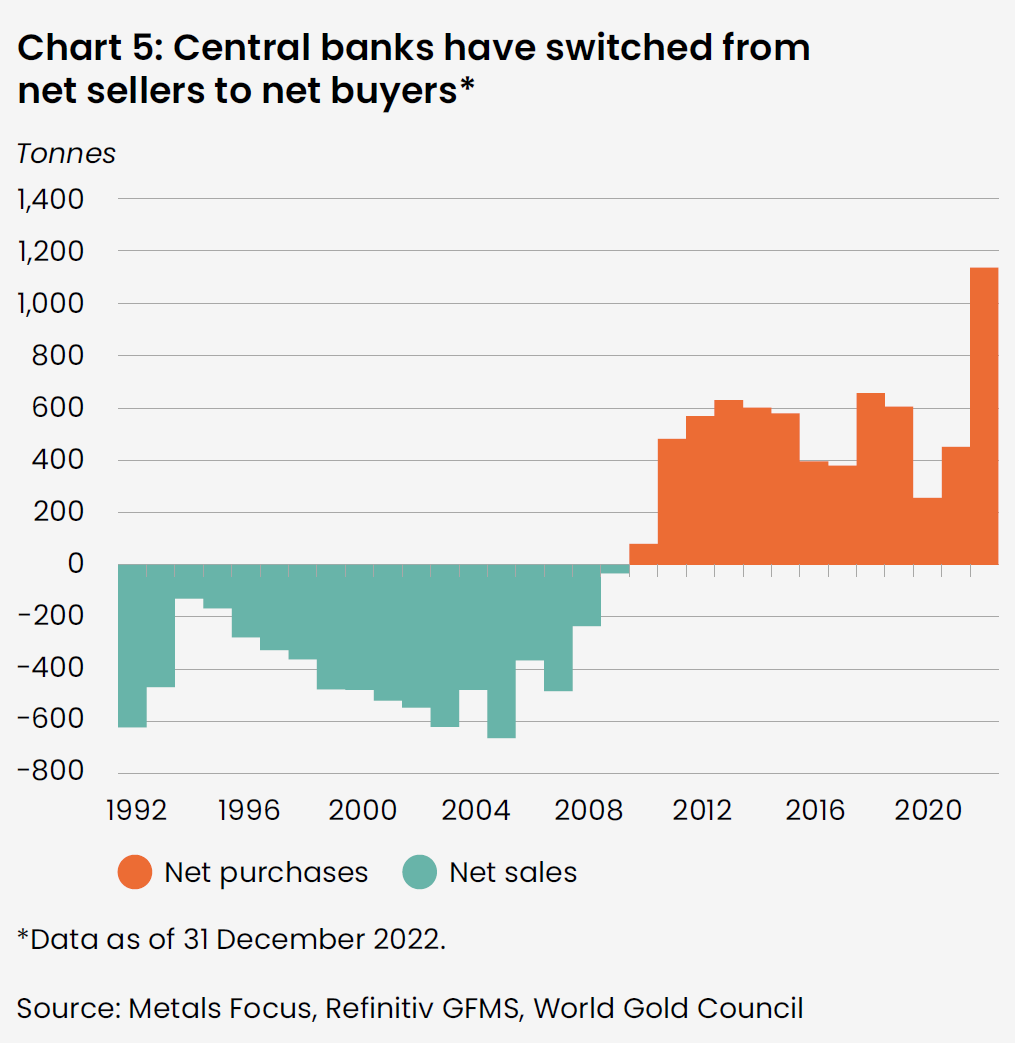
Central banks are buying gold again since the credit crisis (Source: World Gold Council)
The gold mining industry has also changed over the past thirty years. Not only is much more gold now being extracted from the ground (from 2,270 tons in 1992 to 3,612 tons in 2022), it is also coming from more and more different countries. In the 1990s, most of the gold came from South Africa and North America, but the construction of new mines has also led to further development of production elsewhere in the world. Especially in Asia and South America, much more gold is now coming out of the ground than thirty years ago. This geographical spread ensures more stability in the supply.

Gold mine production is more spread out across the world (Source: World Gold Council)
In the 1990s, the return on gold was nothing to write home about. The price was in a downward trend that only reversed after the turn of the century. But after that, the price also went up sharply. Over the past thirty years, the average annual increase has been almost 6%. That's less than stocks, but more than the average yield on bonds. The precious metal also outperformed a basket of commodities. Since 1971, the price of gold has risen by an average of almost 8% per year. This confirms that the precious metal is able to retain its purchasing power in the long term.
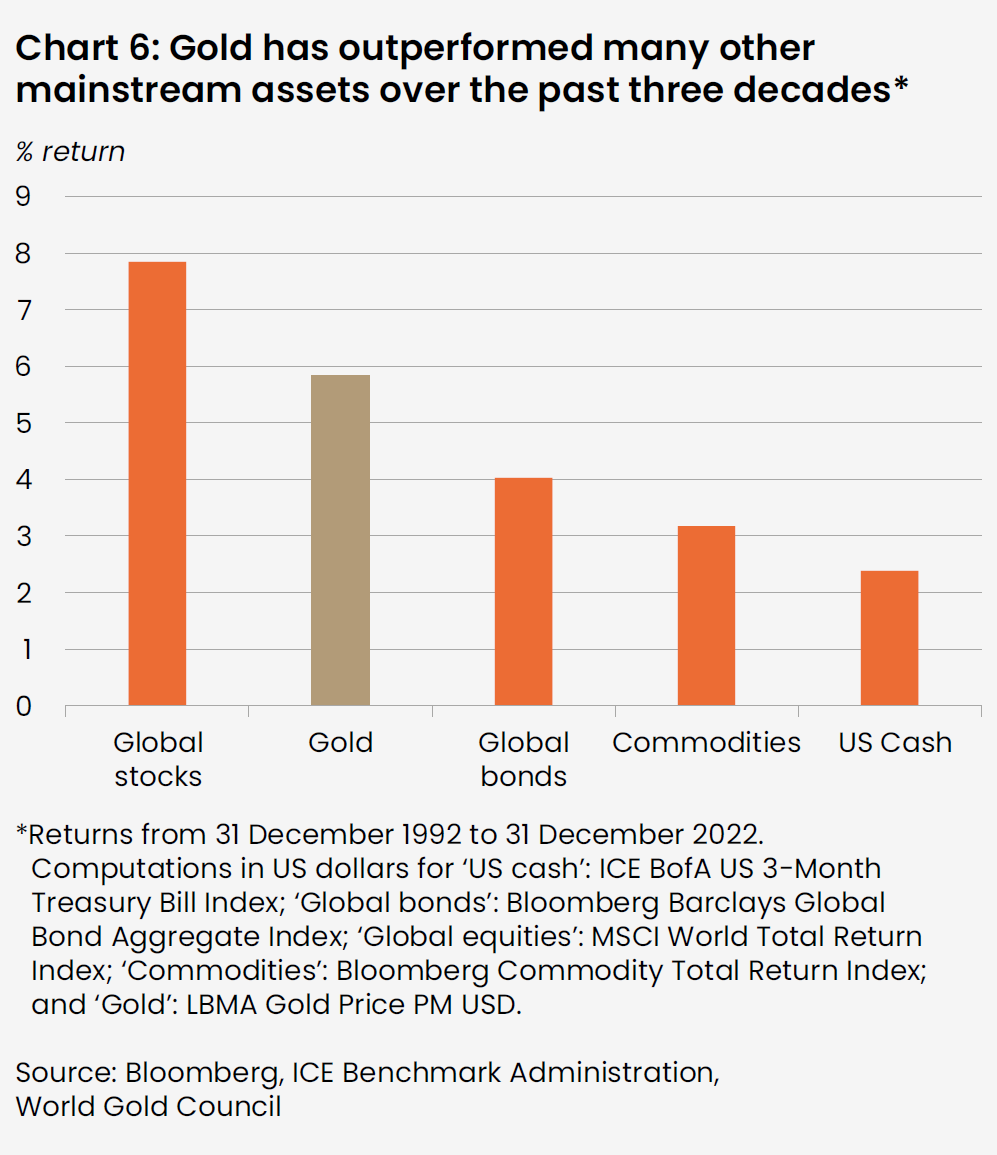
Gold has had a good return over the past thirty years (Source: World Gold Council)


