9.3
8.064 reviews

English
EN


In this episode, Paul Buitink and Joris Beemsterboer talk to Harry Geels, asset manager at Auréus and editor-in-chief of the Financial Investigator. Geels observes that society has changed in the last twenty years to a kind of corporate socialism, in which large corporations have gained more and more power and control. This is a worrying development, because there is no longer a level playing field. The large companies distort competition in the market, which also slows down the innovative power of the economy, according to him.
According to Geels, this climate has created the breeding ground for platforms such as the World Economic Forum, where a number of large companies are working together with governments on the idea of a makeable society. Various plans have emerged from this, such as the idea of central bank digital money and a digital euro. He explains that this is not a good idea as long as the euro itself does not function properly and outlines a number of future scenarios for the euro.
In the early 1980s, deregulation led to more economic growth. But in the last twenty years, corporate socialism has emerged. The power of large corporations has become so great that they are in a position to cooperate with governments. Their power is enormous. This has led to an economy that is no longer robust and is losing its innovative power. He calls it corporate socialism, Where governments and large companies think together about what society should look like.
At the same time, Geels sees a new kind of egalitarianism emerging with a Woke culture Neo-decolonization, expropriations, etc. As a counter-movement, there is also a movement that wants to restore the separation of powers and democracy and is trying to bring back the level playing field in the economy. But the Woke Currents seem to be the most dominant at the moment, also because governments and large companies often think and act in this direction.
Elaborating on this analysis, Geels also sees the necessary problems with the euro. This was mainly a political project, in which the population was not sufficiently involved. Also, before the introduction of the euro, there were many critical reports about the introduction of a European currency union, because the underlying economies were too different. From the outset, the euro did not meet the requirements of an optimal currency area.
If we then compare the pros and cons, then according to Geels ' analysis, the euro appears to offer more disadvantages than advantages. For example, according to him , the advantage of a common currency is less significant if payments are made electronically anyway and people no longer have to exchange coins and notes . That was still an argument at the time of the introduction of the euro, but much less so now.
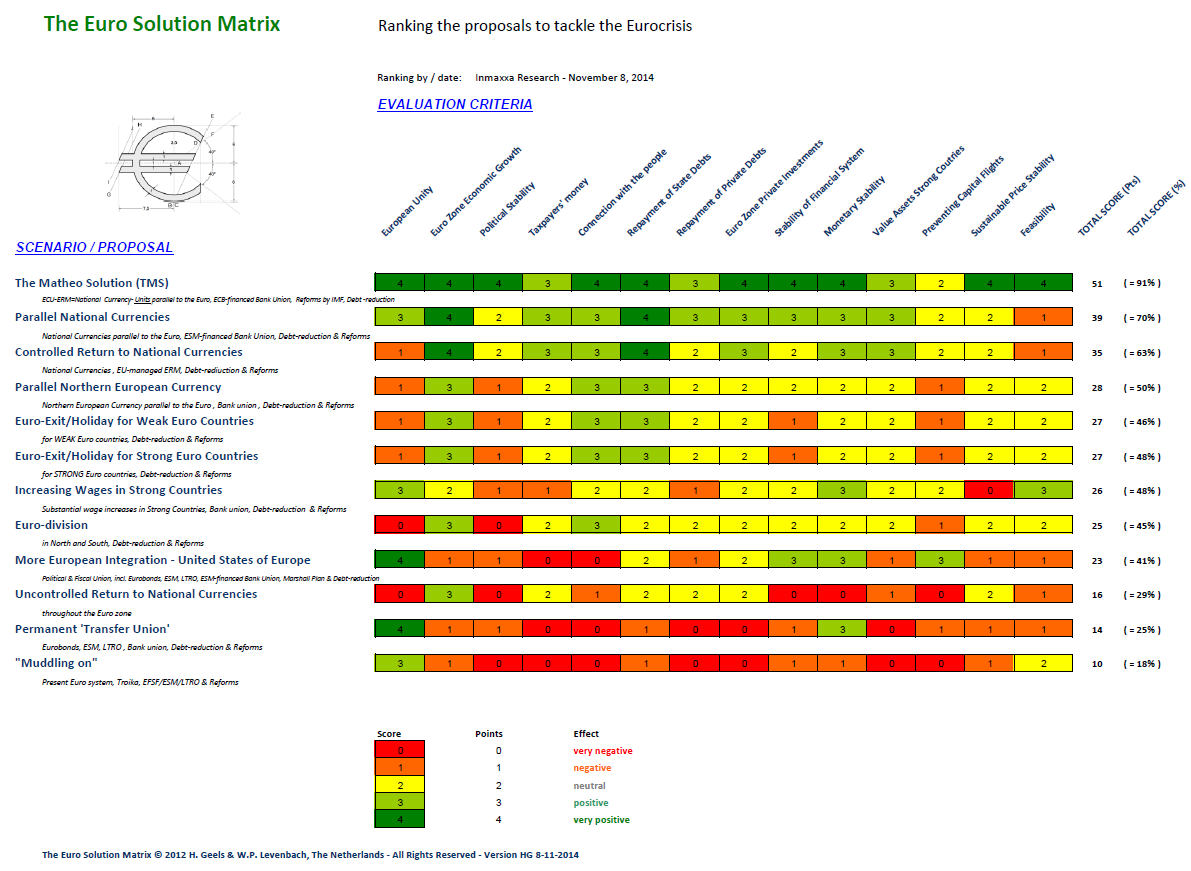
The euro solution matrix with the Matheo Solution
The promise of the euro was that countries would grow closer together, but the figures show that there is divergence in the euro area. Germany benefited from a relatively cheap currency, while the euro meant that the southern countries no longer had the opportunity to conduct their own monetary policy and devalue the currency. This is causing increasing divisions between euro area countries. See also the discussion on budget deficits and sovereign debts and the ECB's monetary policy aimed at supporting Italy at the expense of the more frugal northern euro countries.
According to Geels , it is important to build a currency union within a zone with equal economic growth. The biggest flaw is that the euro is a common currency for a very diverse economic region. On balance, he says, this is hampering economic growth. The currency is too expensive for some countries, too cheap for others. This also applies to interest rate policy. Interest rates should have been raised much earlier to prevent bubbles in the housing markets, stock markets and bond markets .
What Geels is trying to achieve with his overview of alternatives to the euro is that there will be a good substantive discussion about the pros and cons of the currency. This is in line with the Lex Hoogduin's point of view, which also believes that the costs of holding the euro versus the costs of leaving the EU should be critically examined.
The worst-case scenario is to muddle through or to set up a transfer union, because that would mainly emphasise the disadvantages of the currency union. What is part of a successful euro is common debt and a capital markets union. A United States of Europe, which also includes a fiscal union and a capital markets union. But then we also have to take that step. Countries that do not meet the criteria must face consequences. Either they should have the option to leave the currency union or they should be kicked out. This euro Exit Scenarios must be in place, either for the weak countries or for the strong countries. Without it, Exit possibly, it won't work and it will continue to muddle through, according to Geels.
History shows that it is not easy to make a currency union a success, because most currency unions have collapsed. There must be political unity and the economies must be similar. Otherwise, parallel coins are a better option. Or even better, according to Geels, is the Matheo solution, in which the euro remains the European means of payment and means of calculation, but in which the euro is converted to local currencies per country.
The advantage of this would be that countries would be able to devalue or revalue and pursue their own interest rate policy. The euro will then become more detached from the national currencies in the euro area. We then see two prices, those in euros and in the local currency. The question remains, of course, who will decide on this.
According to Geels , the discussion about the digital euro is too much ahead of the music, given the aforementioned problems with the current euro. These problems need to be solved before the ECB launches a digital euro. The need for a digital euro has also not yet been well proven. "Let's fix the euro first, before we create a digital euro."


