9.3
8.064 reviews

English
EN


The capital market in France is in turmoil as the political outlook becomes more uncertain. The European elections marked a shift to the right in France, as in other countries. The uncertainty is affecting the bond market, and several shares of major French banks lost sharply last week. What exactly is going on in France?
In the European elections, right-wing parties gained ground in several European countries. There was also a shift in France, as Marine Le Pen's party became the largest, while President Macron's party lost. The result was reason for Macron to immediately call national elections. In his view, the French president could not pretend that nothing had happened.
But now that right-wing parties also seem to be achieving good results in the national elections, financial markets are hitting Panicked. Last week, the exchange rate of the euro fell against currencies such as the dollar. Also the Interest rate spreads, the difference in government bond yields between different countries, also changed in response to the turmoil. French bond yields rose to 3.174 percent, more than 80 bps higher than what one pays on German bonds. The spread hasn't been this high since 2017. German bonds are therefore preferable to French bonds. The spreads between French and Greek bonds on the contrary, it fell. Greece, the cause of the euro crisis in 2012, now pays only half a percentage point more on debt than France, while the spread was previously 0.8 percentage points.
 The developments of interest rate spreads, the difference between the interest rates on French and German government bonds. (Source: Reuters)
The European Central Bank (ECB) has a tool at its disposal to reduce large interest rate differentials by buying or selling bonds in a targeted manner, the European Central Bank (ECB) Transmission Protection Instrument (TPI). Officially, the instrument is intended to prevent the effect of an interest rate hike from having a disproportionate effect in one country than in another. It is not an instrument for eliminating structural differences. However, the ECB has indicated that it does not intend to intervene at this time. The current movement in the market is not so 'disorderly', the ECB said. It is also questionable whether it would be appropriate to use the instrument for this purpose. If it is just a panic reaction, TPI could fight that reaction, but if the market reacts to structurally different policies in France, it could be argued that TPI should not be used.
Still, investors are uneasy about the situation. This was evident not only from the bond market, but also from various shares that lost sharply on the stock market. The country's three largest banks, BNP Paribas, Crédit Agricole and Société Générale, have lost between 12 and 16 percent of their value this week. It was the biggest drop in value since the banking crisis in early 2023. The CAC 40, Paris' main index, tumbled 6 percent. This move also affected other banks with dubious reputations in the Eurozone. Italy's Unicredit and Germany's Commerzbank also lost, 4.7 and 5.5 percent respectively.
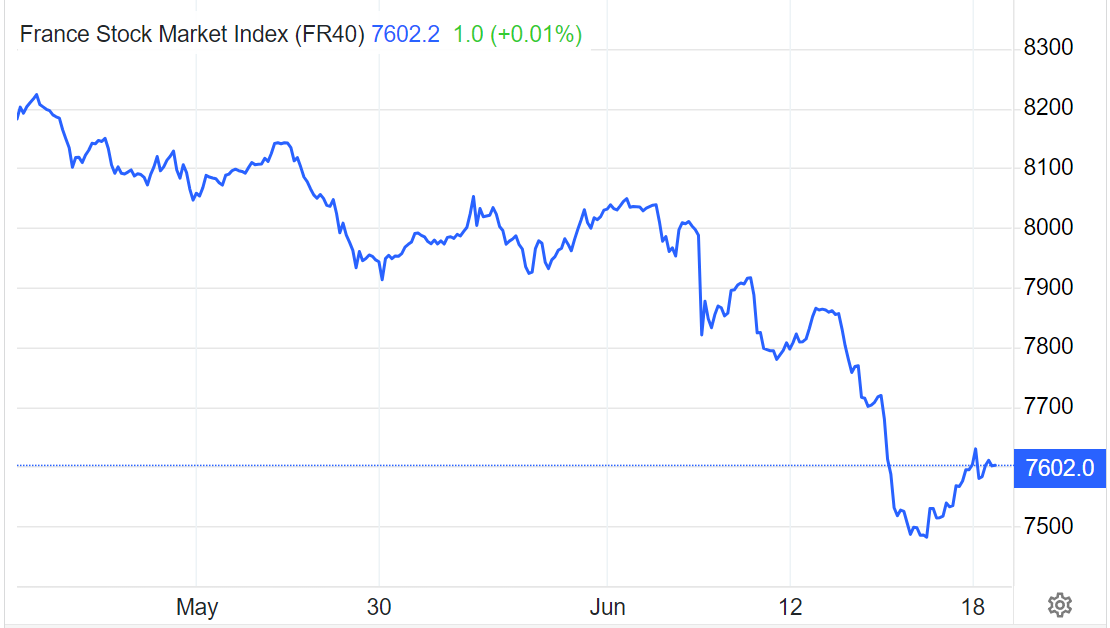 The French stock market has been falling for several weeks. The uncertainty is not doing prices any good. (Source: Tradingeconomics)
Investors fear that Le Pen's policies will lead to larger government deficits and higher debts for the French government. If Le Pen comes to power, it will in all likelihood lead to more public spending. Bruno Le Maire, the current French Minister of Finance, expressed his concerns about the state treasury under a possible Le Pen regime. According to Le Maire, a new crisis could even arise because of Le Pen's policies. Small side note: as a member of the current government, Le Maire obviously has an interest in saying that.
Nevertheless, the soup is often not eaten as hot as it is served. Le Pen has already made conciliatory statements to attract more moderate voters. It is therefore possible that Le Pen will present a more moderate program, he wrote BNR. In Italy, the arrival of Meloni was also viewed with suspicion. Yet Italy is still a member of the EU, despite the fact that Meloni wanted to leave in 2014 and she has been very critical of the EU on several occasions. When it comes to migration, Meloni is now very pragmatic and left the Chinese Silk Road Initiative. In doing so, she indicates that she is much more pro-Western than previously expected. Meloni's pragmatic attitude can be partly explained by the fact that she can make good use of the money from the corona recovery fund, for which strict conditions have been set.
Nevertheless, France must keep an eye on its public debt. For example, Le Pen is in favor of a lower retirement age and wants a reduction in the tax burden on individuals, measures that cost a lot of money. This could further increase the national debt. In order to prevent the national debt from rising too high, Le Pen plans to raise taxes on companies, but whether that will actually happen is always the question. In the Netherlands, we saw with ASML's statements how strong the lobby of large companies can be. Le Pen will also not want to take any risks with the big companies in France, especially now that the Strategic autonomy Europe is becoming increasingly important in the discussions.
France's public debt-to-GDP ratio is now around 110 percent and the budget deficit is 5 percent. Especially during the corona crisis, the public debt in France skyrocketed. In the years that followed, the national debt-to-GDP ratio fell slightly, but that may change with Le Pen's plans. S&P Global downgraded its rating of French government bonds last month. The French are by no means the only ones with a high national debt. In Italy, public debt hovers around 140 percent. Countries such as Spain, Portugal and Greece also go far beyond the EU standard.
America also has a debt-to-GDP ratio of 130 percent, although the Americans get away with it because of the dollar's status as a world currency. President Putin strongly criticized the position of the dollar, a day after the G7 countries decided to offer Ukraine a loan of 50 billion. That loan was secured by the interest income from Russian assets that were frozen after the start of the war in Ukraine. Normally, Russia would receive these assets, but with the freezing of these assets, the dollar is increasingly being used as a weapon. Putin called this act theft and even indicated that this action will not go without punishment. Russia has been in the process of switching to Alternatives to the dollar.
The Netherlands has a much lower public debt-to-GDP ratio of around 50 percent. In addition, the Dutch have accrued some 1500 billion euros in pension money. In the future, this pension pot will still be taxed. If that is a deferred tax claim, economist called it Han de Jong taken into account, the national debt in the Netherlands is even more small. On the other hand, the Netherlands does have a lot of private debt. Many households have high mortgage debts in the Netherlands.
Financial markets may remain unsettled due to political developments in France and the rest of Europe. While the rightward shift in the election has caused uncertainty and panic among investors, it remains to be seen how the policies of new governments will actually take shape.


