9.3
8.064 reviews

English
EN


The European Central Bank has cut its key interest rates again this week by 75 basis points Increased in an attempt to curb inflation. This means that it will become more expensive to borrow money, but also that the interest rate on savings can go up again. From now on, banks will also receive more interest on excess reserves that they hold with the central bank. In this article, we address five questions about the interest rate decision. What does this mean for the economy?
The ECB is raising interest rates in an attempt to curb inflation. The central bank's only mandate is price stability, and that is now under severe pressure. Although the central bank can do little about high energy prices and logistical problems, its monetary policy can influence lending and thus slow down the economy.
During the coronavirus crisis, the ECB pursued an exceptionally accommodative monetary policy, with the launch of the PEPP buyback program and a new round of Subsidised loans to banks through the third TLTRO programme. As a result, it became even easier and therefore cheaper for governments to borrow money, resulting in historically low interest rates. These low interest rates also had an effect on the rest of the economy and created bubbles in shares, real estate and cryptocurrencies, among other things.
Since the war in Ukraine, many of these bubbles have already burst. Interest rates are rising rapidly and central banks are taking accelerated action to stop the ever-rising inflation. At the same time, investors are seeing the value of stocks and bonds fall, while the House prices take a plunge. Consumer confidence in the Netherlands has already fallen to an all-time low, which does not bode well for the coming months.
By raising interest rates, the ECB is reinforcing the downward trend that has already begun. Normally, central banks lower interest rates in times of crisis, but now they are doing exactly the opposite. A risky strategy, as it could do more damage and push the economy into an even deeper recession. With this policy, the ECB can slow down inflation, but at the risk that it will tip over into uncontrollable debt deflation.
In recent years, negative deposit rates have been the main reason for banks to make savings rates negative. Banks had no destination for customers' savings and parked them in government bonds that also did not yield interest. Now that the deposit rate has risen to 1.5%, we should expect the savings rate to go up as well. The three largest banks in the Netherlands, ING, ABN Amro and Rabobank, will resume operations in December Pay 0.25% interest to small savers.
This interest rate increase is no more than a sweetener for savers, because the rise in market interest rates and deposit rates justifies a much higher interest rate than what banks currently give to savers. Moreover, the interest rate of 0.25% only applies to small savers, banks pay less interest on higher amounts. By not fully passing on the rise in interest rates to savers, the banks will make more money from your savings. And then we haven't even mentioned the high inflation, which is eroding the purchasing power of money in the bank.
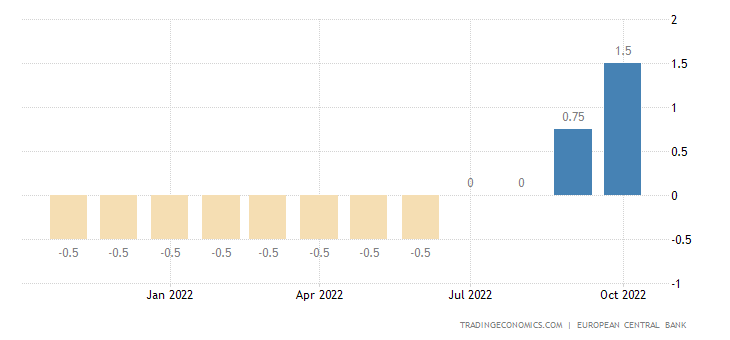
ECB raises deposit rate to 1.5% (Source: Trading Economics)
Banks will therefore earn more from savings and from the excess reserves they hold with the central bank. On the other hand, the ECB has not ratified the terms and conditions of its TLTRO III programme. austere. From 23 November, commercial banks will no longer receive money on these loans and the ECB's normal interest rates will apply again. Through this emergency window, banks were able to borrow money on very favourable terms during the corona crisis, which they could then park risk-free in government bonds. This additional source of interest income will therefore cease to exist.
On the lending side, banks will start to notice that demand for credit will decrease, as higher interest rates and the worsening economic outlook make it less attractive to borrow money. Mortgage rates had already risen sharply, but business loans with variable rates will also become less attractive as a result. Lending will therefore decline.
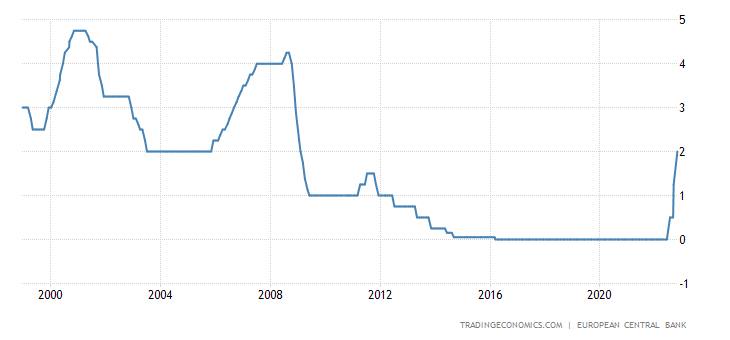
ECB raises policy rate again by 75 basis points (Source: Trading Economics)
Raising interest rates also has implications for central banks. Not so much for the ECB, but for the national central banks within the Eurosystem that are implementing the bond-buying programme. In September, DNB President Klaas Knot sent a letter to the Ministry of Finance to warn of a loss of around €9 billion as a result of the interest rate hike. And those losses could increase much further in the coming years, as Thomas Bollen of FTM recently explained at Holland Gold.
How does that work exactly? In recent years, the Dutch Central Bank has put a lot of Dutch government bonds on its balance sheet under the purchase programme, which yield virtually no return. On the other hand, there are obligations to commercial banks (bank reserves), on which central banks now have to pay interest. The ECB raised that interest rate to 1.5% this week, much more than the yield of all government bonds that the Dutch Central Bank has on its balance sheet.
If interest rates remain at this level or even rise further, it will mean a loss of billions for the Dutch Central Bank. This can easily exceed the interest rate that the central bank has earned in recent years with its negative interest rate policy. For some central banks, therefore, a technical bankruptcy is imminent. Technically, because a central bank can easily continue to function for some time with negative assets, as Han de Jong did in This article explanation. That wouldn't be the first time.
The ECB has indicated that it wants to raise interest rates even further to curb inflation. The only question is how far interest rates can go up before we end up in an economic crisis and the central bank has to completely change its policy again. If economic conditions deteriorate too quickly or if the current monetary policy is no longer sufficient to keep interest rates on Italian government bonds, for example, under control, we could well expect a 180-degree turn in monetary policy. This also happened during the European debt crisis, when the ECB Interest rate hikes of 2011 in one go.
 Have a look at us YouTube channel
On behalf of Holland Gold, Paul Buitink and Joris Beemsterboer interview various economists and experts in the field of macroeconomics. The aim of the podcast is to provide the viewer with a better picture and guidance in an increasingly rapidly changing macroeconomic and monetary landscape. Click here to subscribe.


