9.3
8.064 reviews

English
EN


Investors are very concerned about Credit Suisse's position, as the bank's share price fell more than 8% to its lowest level ever on Monday. Since the beginning of this year, the market value has even fallen by 60%. The bank has also closed the last three quarters with a loss, while other large European banks did manage to make a profit. What's wrong? Is there the threat of another banking crisis similar to the collapse of Lehman Brothers?
The fact that the financial markets are currently very concerned about Credit Suisse is also evident from the price of so-called Credit default swaps, derivatives that allow market participants to engage in Hedging against non-payment. The higher the price, the higher the market assesses the risk of default. At the beginning of this week, market participants paid a premium of 350 basis points to insure against a Credit Suisse default, the highest premium since the 2008 credit crisis. By comparison, after the corona crisis, that premium was around 50 basis points. So there are major concerns about the bank's creditworthiness.
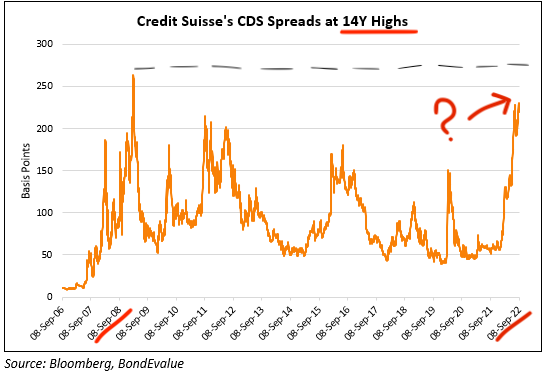
Insurance against bankruptcy Credit Suisse (Source: Twitter)
Concerns about Credit Suisse were further fuelled last Friday, when chief executive Ulrich Körner sent an email to all staff members to emphasize that the bank's solvency and liquidity are in order. He also said that the bank is focused on a 'Critical moment' in its existence and 'At a crossroads' state. He stressed that the share price is not a reflection of the bank's health, but of speculation in the financial markets. That speculation started more than a week earlier, when Reuters wrote on the basis of anonymous sources that the bank was looking for new capital.
If a bank manager needs to stress that there are no concerns about the bank's liquidity and solvency, then that's usually not a good sign. In 2008, the chief financial officer of Lehman Brothers also said that the bank's capital position was in order, while a few months later things went completely wrong. At the time, Lehman Brothers had a large exposure to the U.S. real estate market and ran into problems when house prices started to fall and market participants no longer trusted the bundled mortgage loans.
It doesn't look that problematic for Credit Suisse right now. Since the 2008 financial crisis, regulators have increased the minimum required liquidity and solvency ratios, so that banks hold more buffers to absorb setbacks. According to JP Morgan Complies Credit Suisse is still at these ratios and the bank's financial position was still healthy at the end of the second quarter with a CET1 ratio of 13.5% and a Liquidity Cover Ratio of 191%.
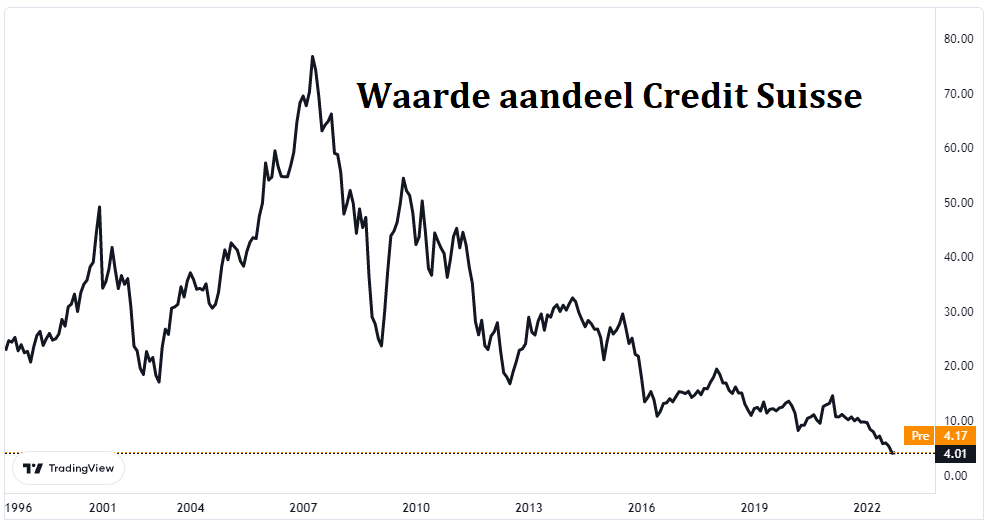
Value of Credit Suisse shares reached new low (Source: Tradingview)
It is difficult to say on the basis of this information how problematic the situation at Switzerland's second-largest bank is at the moment. What is striking is that on September 21, plans were leaked to invest the Swiss investment bank in three parts to be split, where they place the riskiest assets in a so-called 'Bad bank' and will sell a number of profitable parts. That does not sound like an improvement, certainly not against the background of the proposed Reorganization which the bank announced at the beginning of September. The bank is said to be planning to cut 5,000 jobs to cut costs, about ten percent of its workforce.
According to Deutsche Bank analysts, the Swiss investment bank is estimated to have acquired around €4 billion of new capital. The bank can raise that money by issuing new shares, but with the current low price, that means a strong dilution of the share. So that will put further pressure on the value of the stock. Another option is to sell the most profitable parts, but that undermines the bank's future profitability.
Credit Suisse's reputation has been under pressure for some time due to a series of scandals. For example, the bank lost billions due to exposure to U.S. hedge fund Archegos and financial services company Greensill, both of which went under. In February this year, the Organized Crime and Corruption Reporting Project (OCCRP) that criminals and dictators were able to make billions without any problems. stall at this Swiss bank, suggesting that the bank does not have its risk management and KYC policy in order.
The question is whether this is the harbinger of more problems. In 2016, for example, Deutsche Bank was also in dire straits, but those problems eventually faded into the background. But now, market conditions for banks are much more uncertain. The energy crisis and high inflation threaten to create a Severe recession, which is likely to result in banks taking more losses on their loan portfolios. That danger also hung over the market during the corona crisis, but then governments came up with major support measures to keep companies afloat.
The current energy crisis is different from the corona crisis for two reasons. Not only are the amounts involved now, but it is also not clear how long this energy crisis will last. And that makes it much more difficult for governments to restore the purchasing power of households and businesses. Also, the financial markets are now starting to doubt the creditworthiness of governments themselves, which limits their ability to keep banks afloat. A week ago, we saw how the financial markets made short work of it with the UK Government's proposed support programme.
To translate this to the banking sector, European banks have a lot of exposure to households and businesses through their loan portfolios, which means they have to set aside more money for any losses if the number of bankruptcies and defaults increases. Banks that have a lot of mortgage loans on their balance sheets can get into trouble if house prices start to fall and the collateral no longer covers the loans.
As with government bonds of different countries, investors will also differentiate between banks. The most vulnerable will be the first to get into trouble. Credit Suisse is currently in bad shape with a 60% drop in the value of the stock since the beginning of this year. But Deutsche Bank has also lost 40% of its market value this year, as the graph below shows.
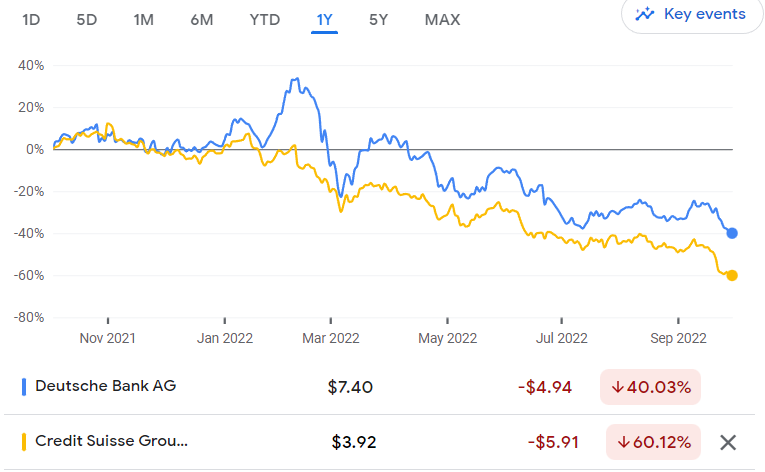
Deutsche Bank is also not in the best shape (Source: Google Finance)
Together, these two banks have €2,800 billion worth of assets on their balance sheets. That is more than four times as much as the €600 billion that led to the collapse of Lehman Brothers. That means these banks are too big to fail, but they may also be too big to be bailed out by governments. Especially now that interest rates on government bonds have risen so much. Will it soon be up to central banks again?
 Have a look at us YouTube channel
On behalf of Holland Gold, Paul Buitink and Joris Beemsterboer interview various economists and experts in the field of macroeconomics. The aim of the podcast is to provide the viewer with a better picture and guidance in an increasingly rapidly changing macroeconomic and monetary landscape. Click here to subscribe.
This contribution was made from Geotrendlines


