English
EN


Last Friday, the French ten-year government bond yield broke through the 5 percent threshold. According to economist Robin Brooks, France is now in a debt crisis. Where does France stand a week later? We look at the two French women playing leading roles.
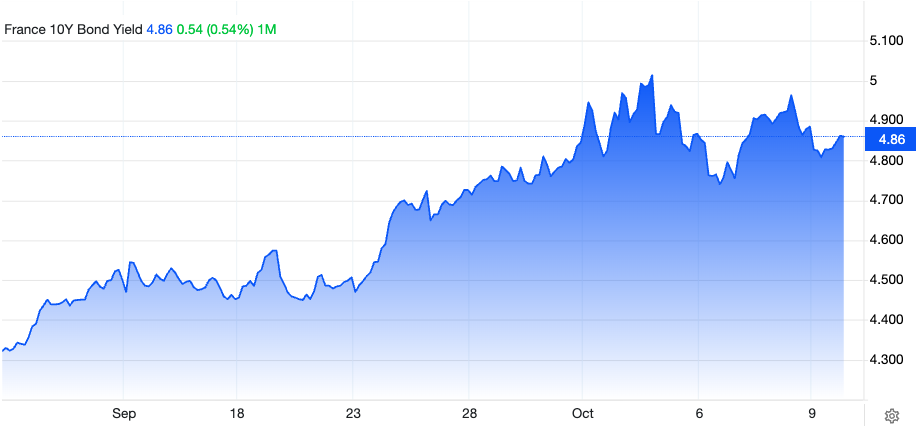 The French ten-year government bond yield over the past month (source: tradingeconomics)
Something has happened that, until just a few years ago, was considered highly unlikely. The French ten-year government bond yield was still just above 3.5 percent at the start of this summer but, as you know, has risen sharply since then. It is now significantly higher than its Italian counterpart: on Friday 9 October, the gap stood at around 30 basis points. Bond investors are therefore demanding the highest premium for holding French government bonds over Italian ones since the introduction of the euro. The spread between France and Germany has also risen sharply since the start of the summer: from around 70 basis points to approximately 138 basis points on Friday afternoon, 9 October.
Investors are punishing France because it does not appear likely to reduce its debt-to-GDP ratio of almost 120 percent. Italy, by contrast, is being rewarded for years of spending cuts. For a long time, that country was regarded as a textbook example of what not to do. In July 2012, at the height of the eurozone debt crisis, the Italian ten-year government bond yield was still more than 400 basis points above France’s. The roles have now reversed, and France increasingly appears to be cementing its position as the eurozone’s new problem child.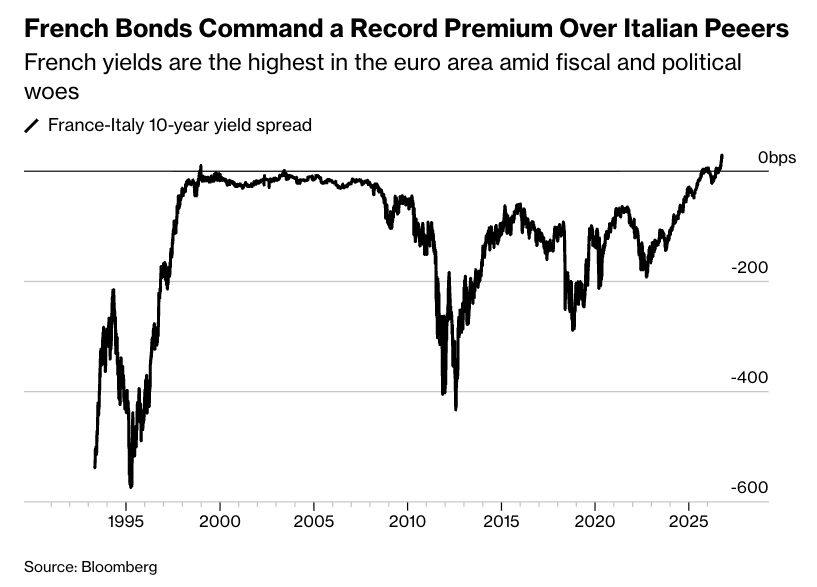
The spread between French and Italian ten-year government bond yields (source: Bloomberg)
The speed at which French bond yields were rising did make the market somewhat nervous. In our podcasts, including those with Han de Jong, we regularly discuss how the ECB does not want yield spreads within the eurozone to widen too far. The expectation is that the ECB will eventually come to France’s aid.
According to Han de Jong, the ECB will probably use the Transmission Protection Instrument (TPI) for this purpose. This allows the central bank to make targeted purchases of a eurozone country’s existing government bonds from investors. That additional demand supports bond prices and pushes yields down. According to the ECB, the instrument is designed to counter unwarranted, disorderly market movements that threaten the transmission of monetary policy within the eurozone. This may therefore come at the expense of efforts to combat inflation and the purchasing power of your savings.
Christine Lagarde, the president of the ECB and herself French, made the first verbal intervention on Thursday to cap French bond yields. During a meeting with eurozone finance ministers in Luxembourg, she reportedly said that the ECB has the tools to counter unwarranted, disorderly market dynamics. Such a message is, of course, not delivered without a reason. The first chart shows French bond yields edging down again on Thursday.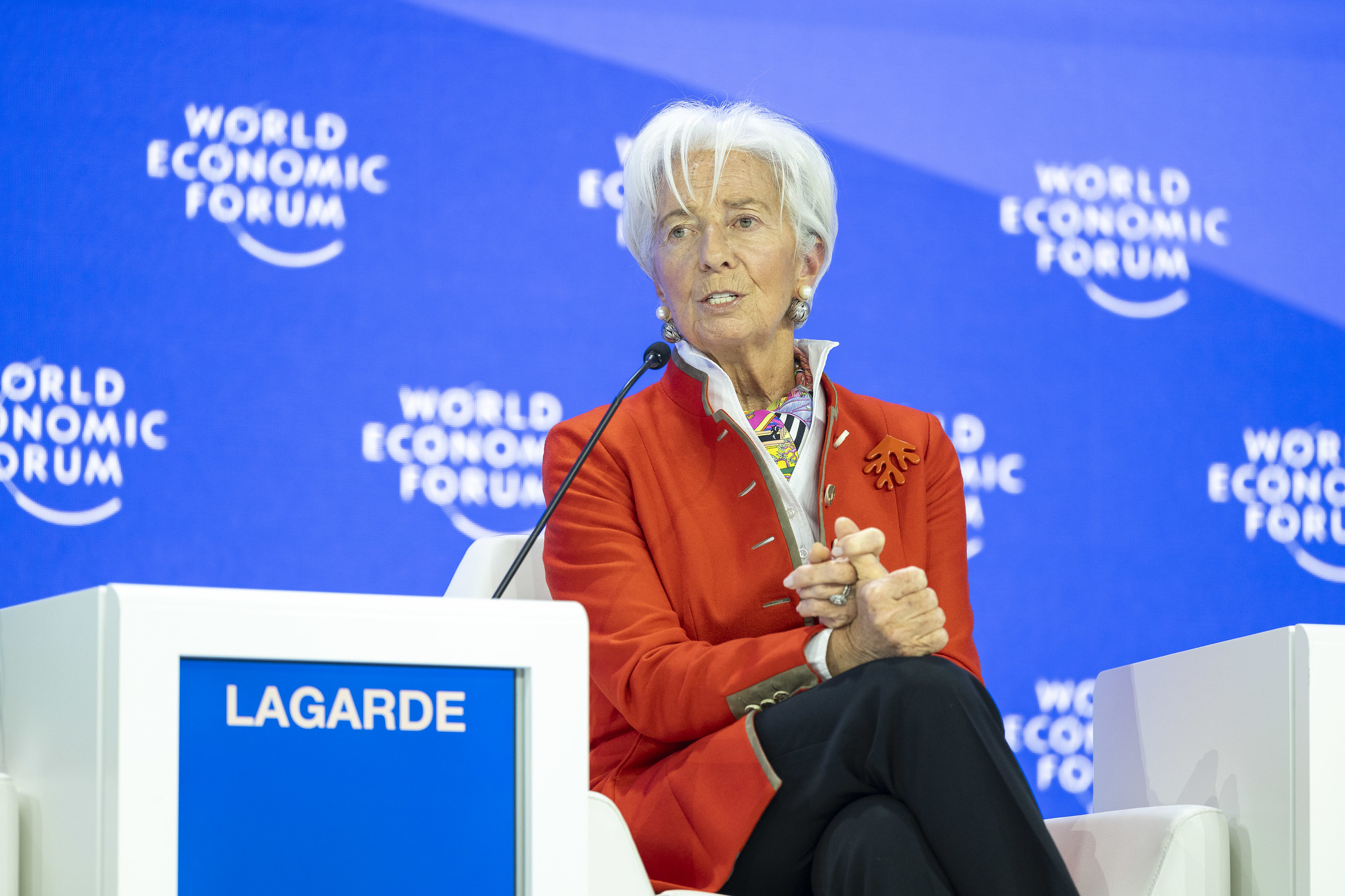
Christine Lagarde (source: WEF)
Robin Brooks is already drawing a comparison with the famous ‘whatever it takes’ statement by the then ECB president, Italy’s Mario Draghi. During the euro crisis in 2012, Draghi promised to do whatever was necessary to save the euro (and push Italian bond yields down). Brooks says he has no doubt that the ECB will intervene if yields rise further.
Brooks writes that the ECB considers preventing debt crises necessary for its own survival. That is why, in his view, the central bank will always cap yields once the situation becomes serious enough. In a blog post, he describes step by step how he expects the next eurozone crisis to unfold. According to Brooks, only a swift end to the war with Iran and a fall in oil prices can still prevent this scenario. But even then, of course, it remains to be seen whether the French will manage to implement reforms.
The right-wing presidential candidate Marine Le Pen is currently leading in the polls. If she becomes president, however, that does not automatically mean France will pursue right-wing economic policies with strict fiscal discipline. Despite her proposal to use a referendum to enshrine the reduction of the budget deficit in the French constitution, there are still grounds for doubt.
Le Pen also supports retirement at the age of 62 or even 60. This is despite pensions being an enormous expense for France. Almost a quarter of total French government spending went towards pensions in 2025. Pension expenditure amounted to €422 billion, or 14.1% of GDP. Le Pen has also indicated that she wants to make France climate-neutral before 2050. To be continued!