English
EN


Gold and silver rose sharply in the first week of August, marking a reversal from the downward trend of recent months. Disappointing US jobs data released today (7 Aug) provided an additional tailwind for gold. Meanwhile, the US and Japan have been coordinating their actions behind the scenes to strengthen the yen. Instead of dollars, euros were sold to buy yen, without the European Central Bank (ECB) being informed. Some view this as a blow below the belt in international monetary relations. What is going on behind closed doors?
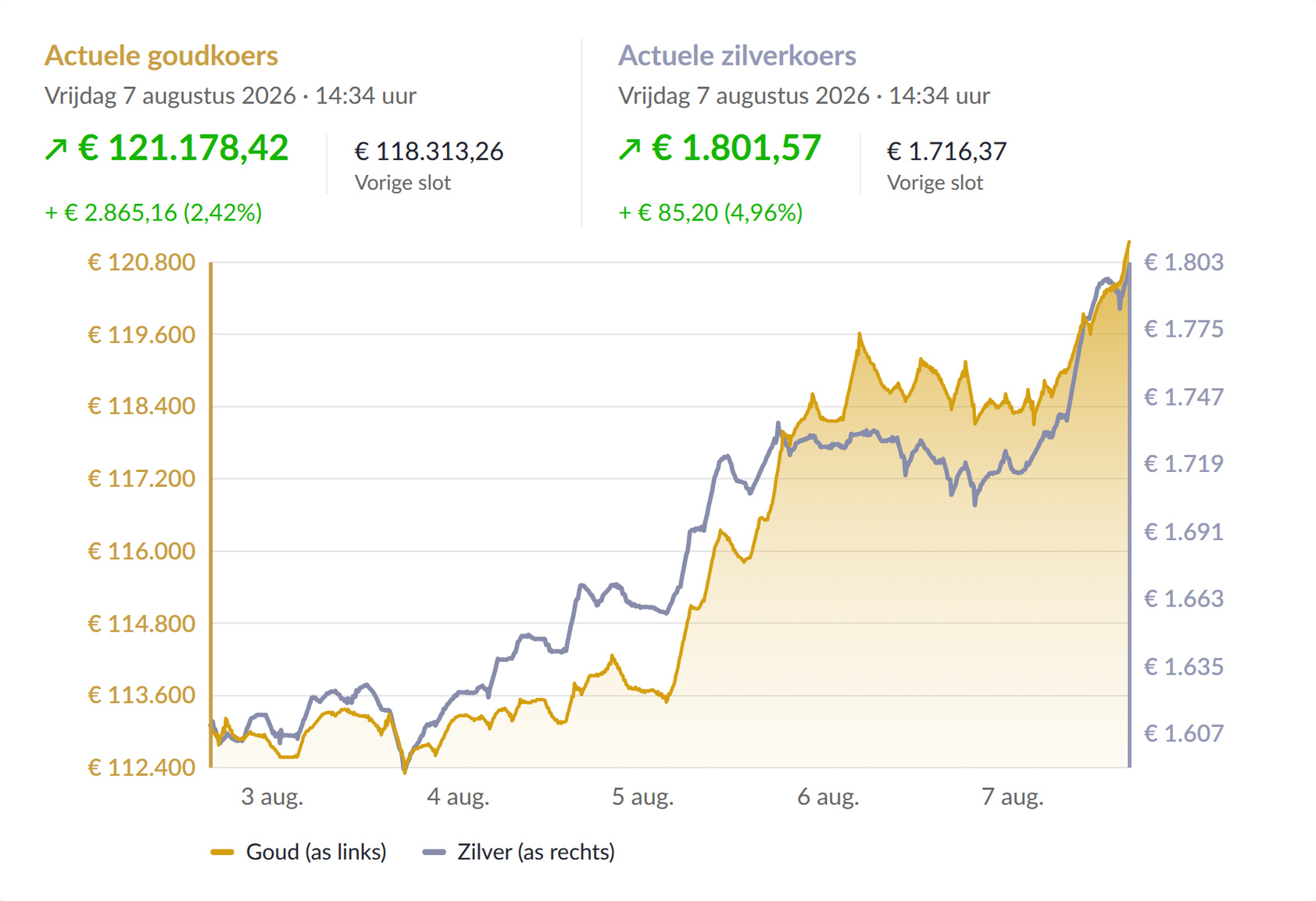 Gold and silver prices over the past week in euros per kg. (Source: Holland Gold).
By around 2:30 p.m. today (7 Aug), gold was up 2.24% and silver 4.96%. On a weekly basis, gold was up almost 7.5% and silver 12%.
Earlier this week, we wrote about how renewed hopes for the reopening of the Strait of Hormuz triggered a relief rally. Gold and silver moved unusually quickly higher. Iran and Oman are working on an agreement concerning the Strait of Hormuz and the conditions under which ships may pass through the strait. An agreement between the two countries does not yet mean an end to the war, nor does it mean that the Strait of Hormuz is actually open. Iran is imposing additional demands on the US, because America has not yet lifted its own naval blockade. At present, Iran is escalating the negotiations by denying access to US and Israeli vessels.
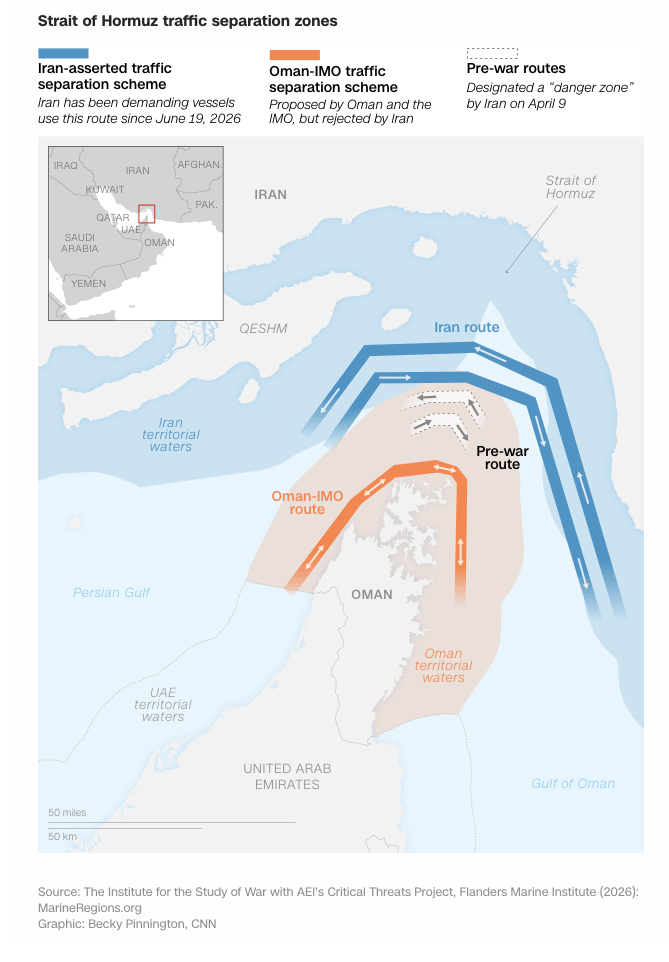 Proposed routes through the territorial waters of Iran and Oman. The pre-war routes run through the middle of the strait and are shown in grey. (Source: CNN)
Despite this negative news surrounding the negotiations, it appears for now to have little effect on gold and silver. In recent weeks, we often saw gold come under pressure when the war with Iran escalated, particularly when this affected the shipping of gas and oil through the Strait of Hormuz. This was because any bad news for gas and oil leads to higher inflation expectations. Higher inflation may prompt the US central bank, the Fed, to raise interest rates, which is generally a headwind for gold.
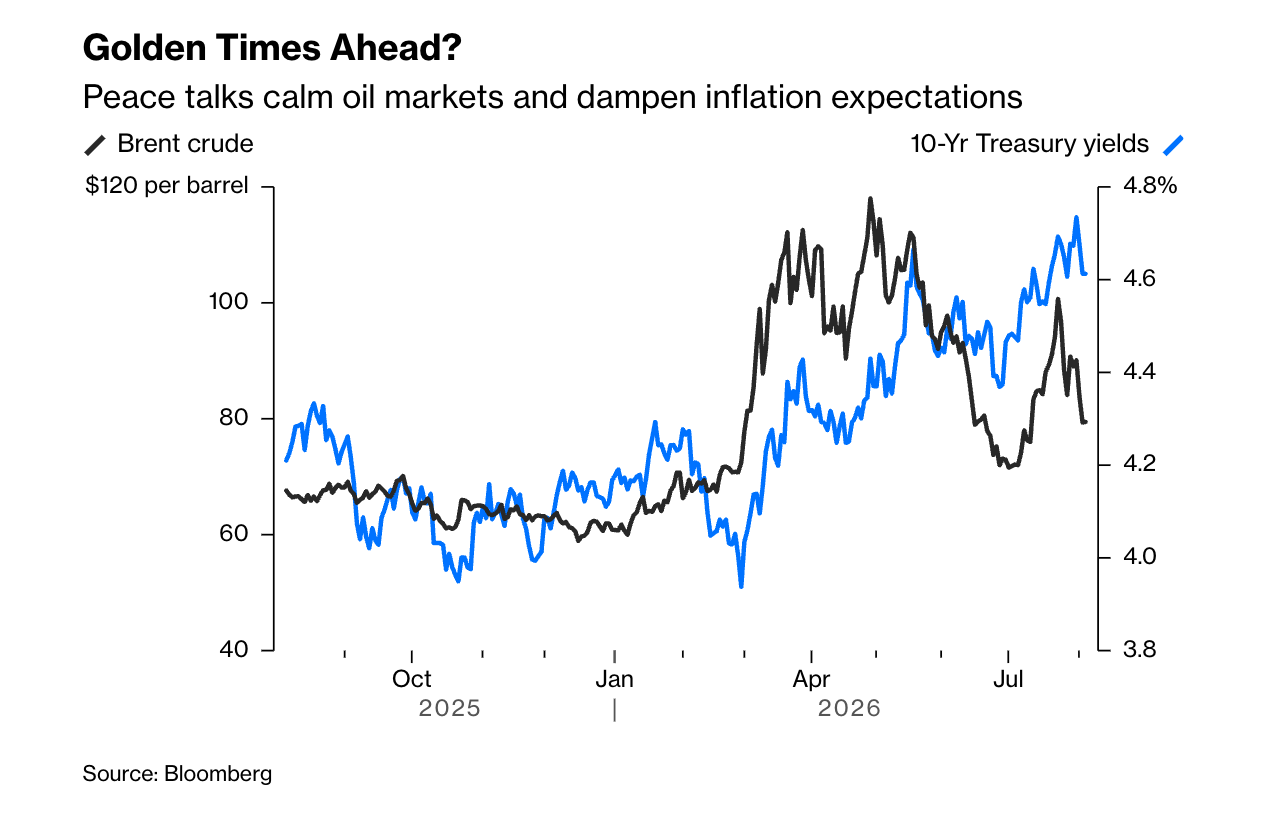 Oil prices and yields on 2-year US government bonds fall on news of a possible reopening of the Strait of Hormuz, resulting in lower inflation expectations. (Source: Bloomberg).
According to Justin Lin, an analyst at Global X ETFs, the fact that gold continued to rise this week is because the rally was not driven solely by de-escalation. “The initial price move looked mainly like a technical breakout, which gained some additional momentum from the negotiations with Iran and doubts about how hawkish the Fed really is,” he said. At this point, he believes it is “more about buyers regaining control than a direct reaction to the talks about the Middle East”.
A hawkish Fed refers to how strongly the Fed responds to high inflation: the more hawkish the Fed is, the faster it is likely to raise interest rates. Not only is there doubt about whether Fed Chair Kevin Warsh will follow through on his firm statements about fighting inflation, there are also renewed concerns about Trump’s influence. He and Warsh have spoken regularly by phone, and although it has been denied that Trump is pressuring him to lower interest rates, it remains unclear what the two discussed. This stands in stark contrast to Warsh’s predecessor, Powell, who issued reports on his meetings and discussions with Trump.
The latest US jobs figures for July were also released today. They came in 23,000 jobs below expectations. In addition, the number of newly created jobs for May and June was revised downwards. Disappointing jobs data generally means that the Fed will not raise interest rates, because it may instead want to stimulate the economy. This may soften the criticism Warsh previously received for not raising rates. If the Fed is confronted with high inflation on the one hand, which argues in favour of a rate increase, and a weak labour market on the other, which argues in favour of a rate cut, it is understandable why interest rates remain unchanged.
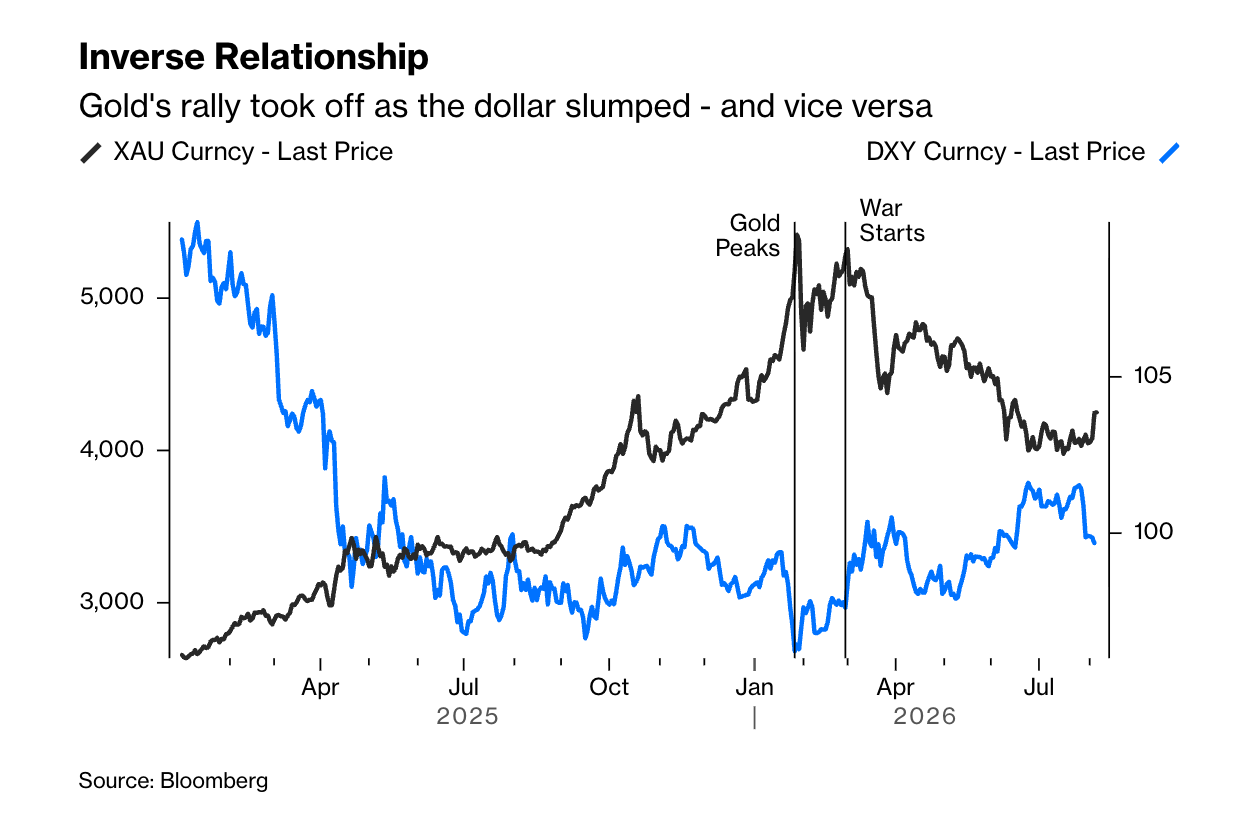 Inverse relationship between movements in the gold price (black line) and the dollar (blue line, DXY U.S. Dollar Index), an index that measures the value of the US dollar against a basket of six currencies. (Source: Bloomberg).
Another relationship that is once again coming to the fore is the one between gold and the dollar. A weaker dollar is favourable for gold. “Gold’s move today has less to do with interest rates and more to do with the US dollar, which has fallen to its lowest level since early June,” says Aakash Doshi, head of global gold and metals strategy at State Street Investment Management.
Another striking piece of news this week came from the monetary sphere. In recent days, it emerged that America and Japan had worked together to support the Japanese yen. The Japanese currency has suffered from a low valuation for some time. At the end of July, the currency fell to around 164 per dollar, its weakest level in four decades.
This has not only led to more tourism to Japan, as Japan has become relatively cheaper from a European and American perspective, but also to high inflation in Japan itself. The Japanese islands depend on imports for many goods and for their energy supply. In particular, since the Fukushima nuclear disaster, the country has increased its imports of oil and gas. Understandably, rising oil prices are giving Japanese inflation an additional boost.
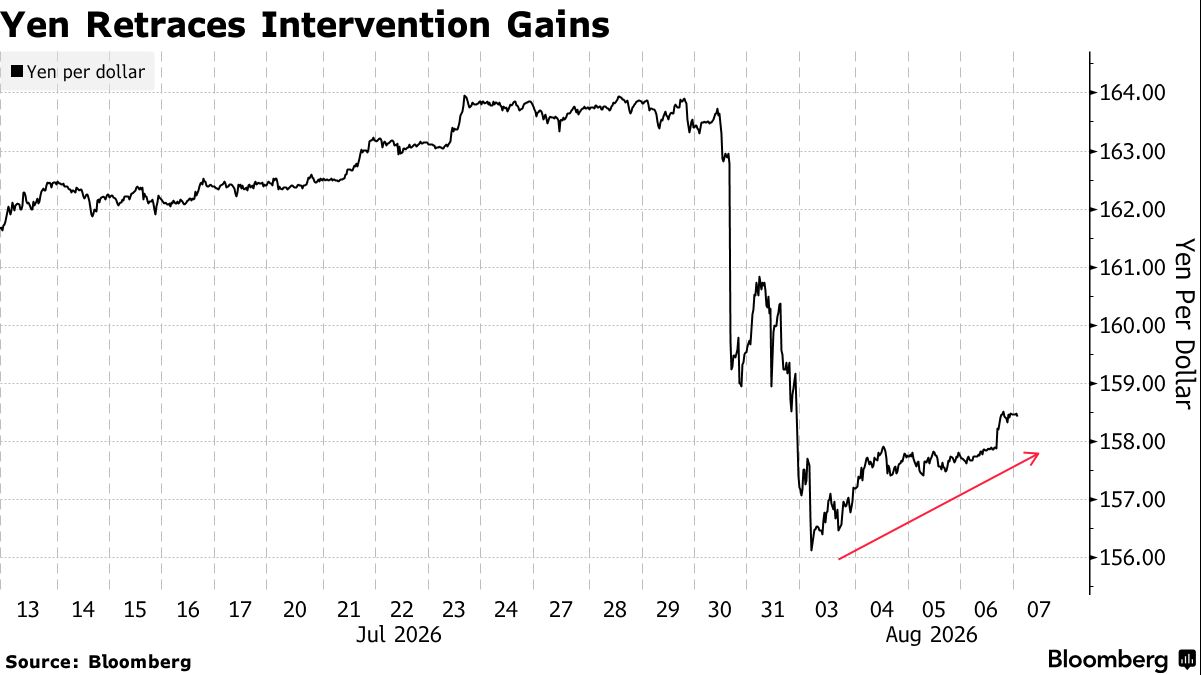 At the end of last week, coordinated currency intervention strengthened the yen. Since the intervention, however, the yen has once again been weakening against the dollar. (Source: Bloomberg).
To support the steadily weakening yen, Japan and the US intervened in the foreign-exchange market. Tokyo sold dollars to buy back yen; an estimated $53 billion was exchanged, making it Japan’s largest single-day intervention ever. On the other side of the Pacific, America bought yen.
But why did America help Japan in this secret currency intervention?
Japan is one of the largest holders of US government bonds. One way to increase the value of the yen is to sell dollars and buy yen. To obtain those dollars, Tokyo would have to sell US government bonds. A larger supply of bonds reduces their value and therefore pushes up the return investors demand: the bond yield. This, in turn, also increases the interest burden on US government debt. Washington wanted to prevent this at all costs. That is why the intervention was coordinated with Japan.
But America was clever enough to sell euros to buy yen instead, while keeping the European Central Bank (ECB) in the dark.
ECB President Christine Lagarde subsequently discussed the situation with US Treasury Secretary Scott Bessent. Several senior ECB officials regard this US action as an unprecedented breach of long-standing agreements and conventions between Western central banks. By selling euros and thereby devaluing the euro, America prevented too many dollars from entering the market. That could otherwise have triggered a sell-off in US government bonds, which, as described above, would have driven up the US government’s interest burden.
Despite the intervention by America and Japan, the yen once again appears to be weakening, raising the question of how successful the intervention really was. You may naturally wonder what all this has to do with gold. Further currency intervention by Japan could potentially put more dollars into the market, and we saw this week that a weaker dollar coincided with a stronger gold price. At the same time, rising bond yields represent an additional debt burden for America, making gold more attractive as a safe haven over the long term.
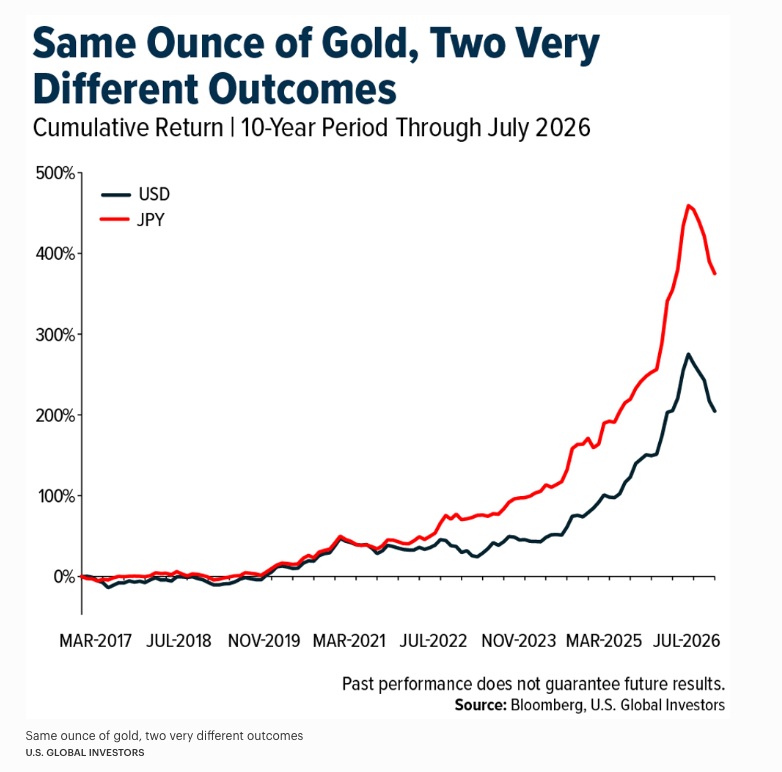 Percentage increase in the gold price in dollars (dark blue line) versus in yen (red line). (Source: Forbes).
This is also a perfect case study showing why gold can be an interesting investment if you are uncertain about the purchasing power of your own currency, such as the euro. Japanese investors would have been better off investing in gold in recent years, argues Frank Holmes in Forbes. Because of the falling yen and Japan’s heavy dependence on imports, Japanese citizens have seen their purchasing power decline significantly.
This quickly becomes clear when comparing the gold price in dollars with the gold price in yen. While the gold price in dollars rose by 205% over ten years, the increase in yen terms was 375%. The faster increase in the gold price when expressed in yen shows just how much value the yen has lost. Had Japanese investors invested in gold in 2017, they would have preserved their purchasing power far better than if they had kept their money in the bank.
(50% of tickets already sold!)
On October 8, Holland Gold will bring well-known podcast guests to Theater Figi in Zeist for Freedom & Wealth 2026. View the programme and reserve your ticket for an evening about the future of the Netherlands, Europe and your wealth.