English
EN


A week packed with developments. All precious metals are in the green: gold +3%, silver +6.8%, platinum +5.7% and palladium +1.6% over the past five days. Scott Bessent shakes up bond markets, Trump puts economic pressure on Iran with an “economic D-Day”, oil prices surge but leave gold unaffected, Bitcoin rises at its fastest pace in two years…
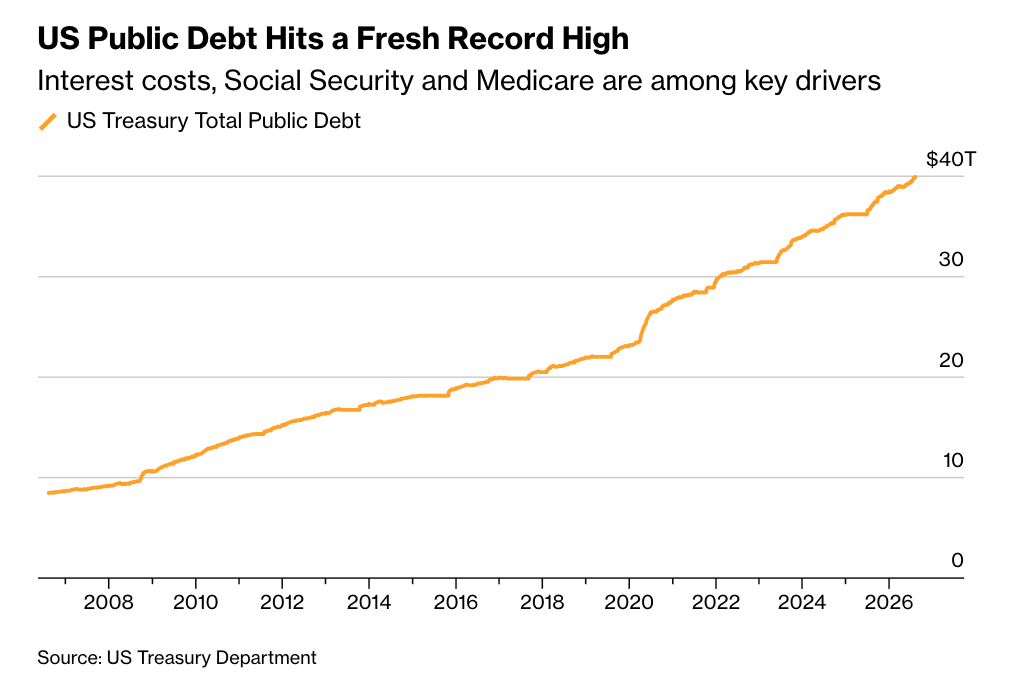 US national debt continues to rise steadily, with interest costs, Social Security and Medicare (health insurance programme) among the main drivers. (Bloomberg).
On Wednesday, news broke that the US Treasury Department would accelerate its purchases of long-term government debt. Scott Bessent has thereby become the most interventionist Treasury Secretary in decades, while markets are now warning about unpredictable policy surrounding US government debt. That debt passed the $40 trillion mark last week, equivalent to 125% of US GDP. This represents a doubling of the national debt under the Biden and Trump presidencies. This year, the country is heading for a budget deficit of $1.8 trillion, so the end is not yet in sight.
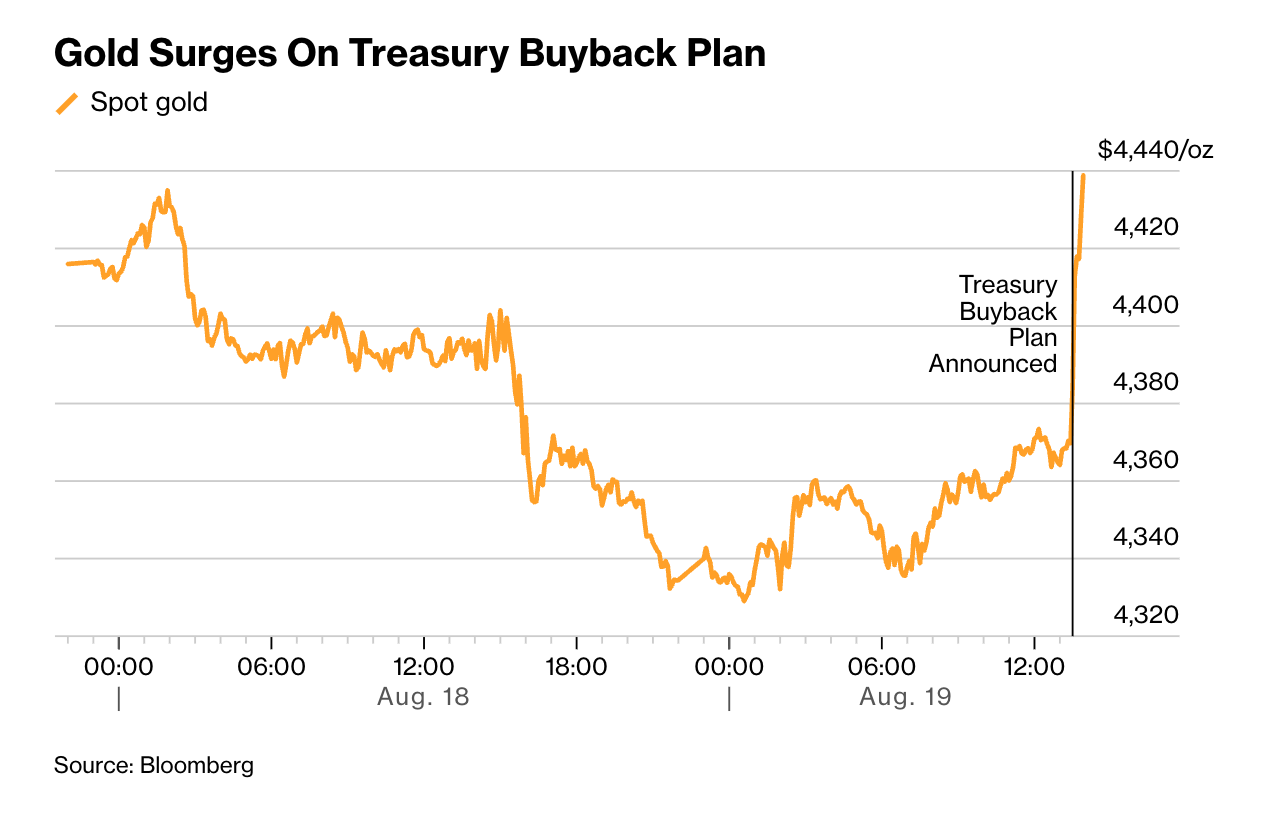 Gold surged on Wednesday after news of the buyback plans became known. (Source: Bloomberg).
What Scott Bessent wanted to achieve was to bring down the steadily rising yields on long-term government bonds. Put simply, the US is continually taking on new debt, and the interest on that debt weighs on the Treasury. Yields on 10- and 30-year government bonds have surged in recent weeks. By buying back long-term bonds itself, the government increases liquidity in that market and pushes yields lower. This is presumably financed with short-term debt instruments, such as T-bills with maturities of up to 1 year, on which yields are generally lower. On average, interest costs then come down, and those interest costs weigh on the national debt. Yet the intervention is causing considerable unrest. Koen Lauwers explained only yesterday how this is playing into gold’s hands.
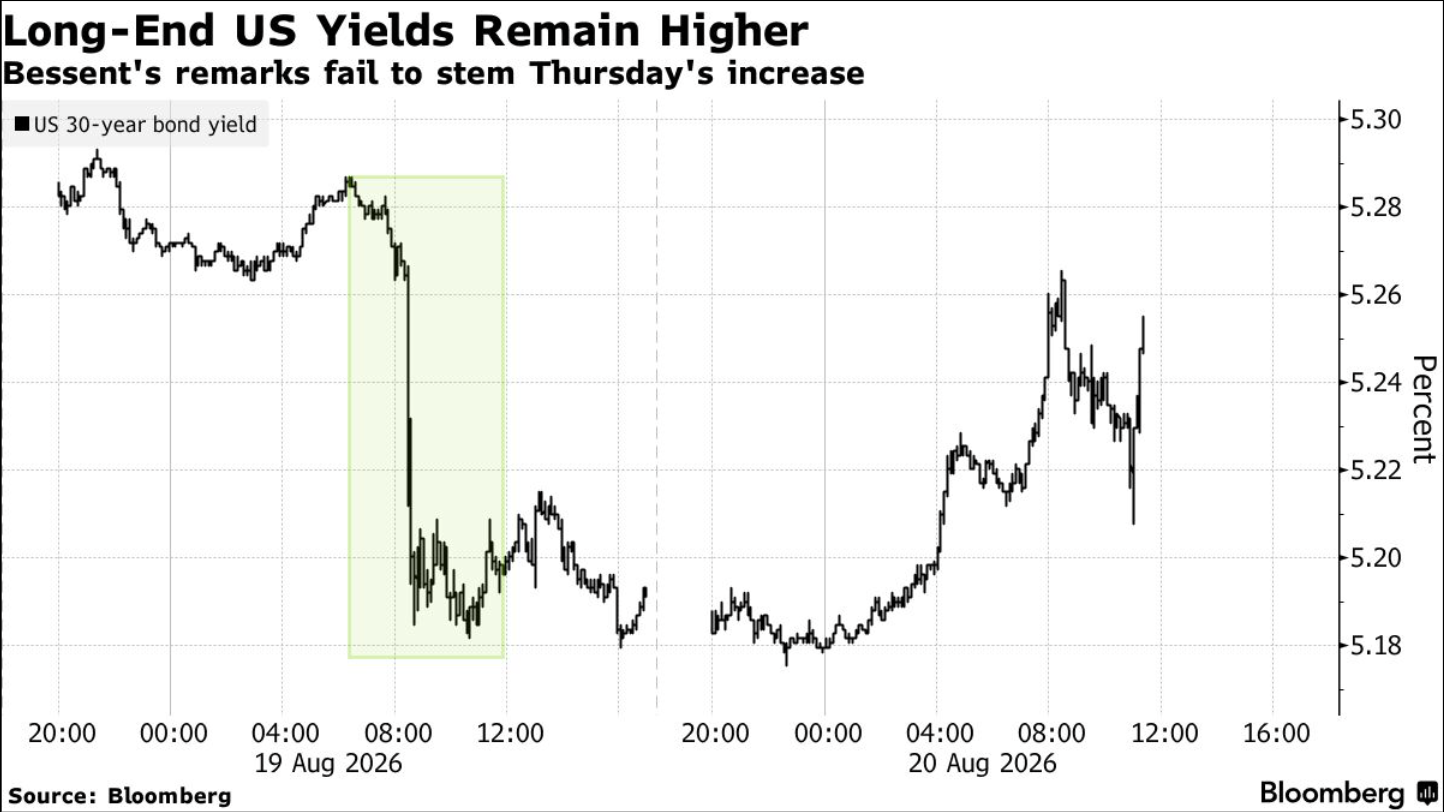 Yield on US 30-year government bonds plunges after news of the buybacks, but then quickly rises again. (Source: Bloomberg).
How difficult it is to tame the markets became clear the very next day, when yields on US government bonds began rising again. “Everything that happens within a 24-hour period is noise,” was Bessent’s comment in an interview with CNBC. But he stressed that the size of the buyback operation could still be increased to “more than $4 billion”, compared with the $4 billion currently indicated.
According to macroeconomist Edin Mujagić, Scott Bessent’s intervention in the bond market is creating a new source of tension with the Fed. The Federal Reserve is the US central bank that sets the policy rate, and that policy rate always has a major influence on yields on short-term government debt. Now that the US government is actively steering towards reducing long-term debt and taking on more short-term debt, US interest costs are becoming much more sensitive to Fed decisions.
This could also put new pressure on Fed Chair Kevin Warsh to keep interest rates unchanged or low. Mujagić is therefore looking forward to the upcoming Fed symposium in Jackson Hole next week, where Warsh will give a speech on August 28. This will be his first public appearance since Bessent’s intervention in the bond market, and markets will be watching closely to see what Warsh has to say about it.
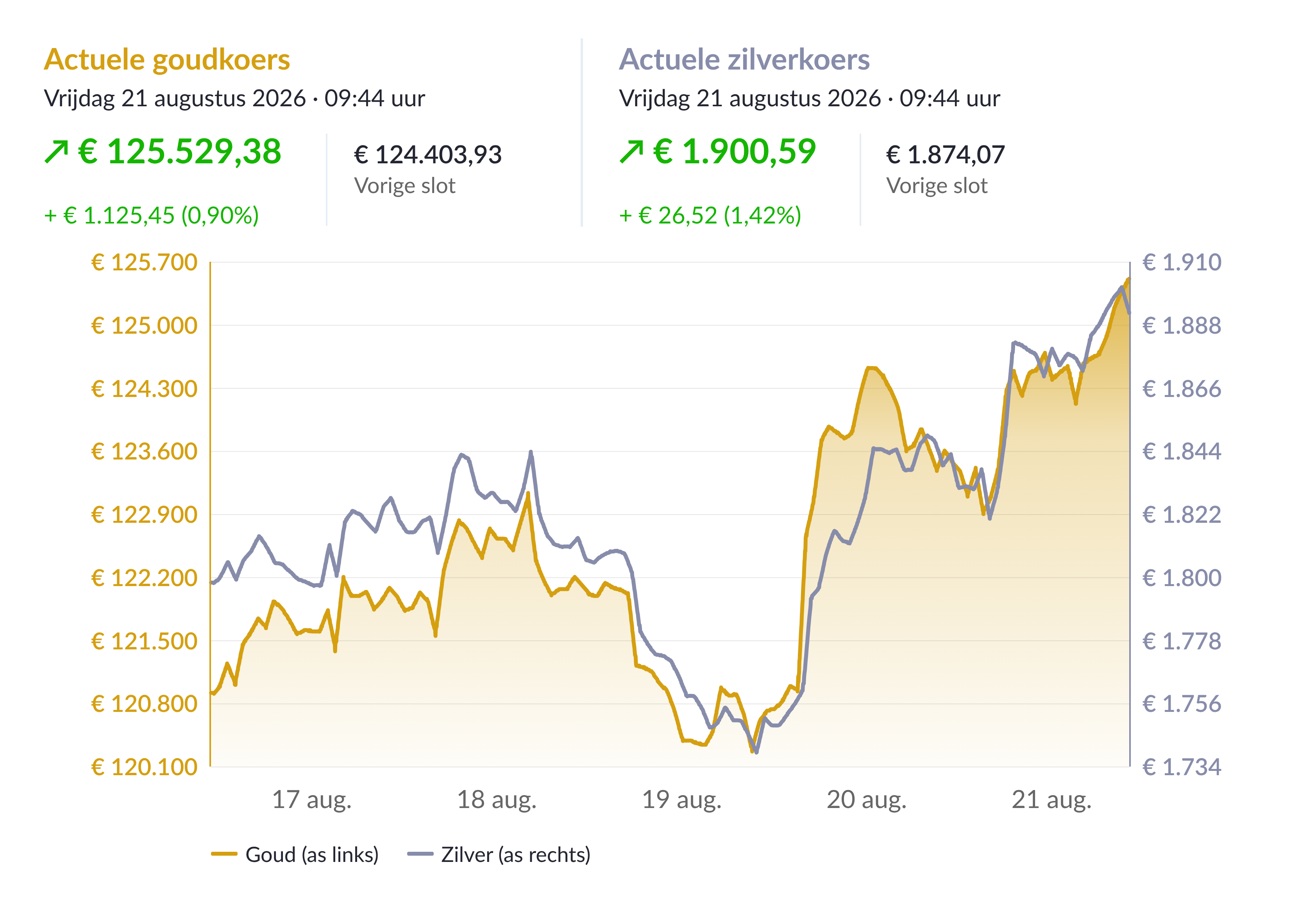 Gold and silver prices in euros per kilogram over the past seven days. Source: Holland Gold.
Silver is leading the way this week: with a strong recovery and a price increase of as much as 6.8%, the grey metal has climbed to a two-month high. Silver often moves more strongly in response to developments in the gold price. Both metals appear to have benefited from the debasement trade.
The debasement trade refers to investors buying assets such as gold and precious metals out of fear of inflation or rising government debt that may ultimately become unsustainable.
“We now expect the silver price to average $68 per ounce (€58.13) in the third quarter of 2026 and $74 per ounce (€63.29) in the fourth quarter,” wrote Ewa Manthey, commodities strategist at ING, in an update. Silver is trading today (21-8) at $69.77 (€59.61) per troy ounce and is moving rapidly within this range.
Alongside the debasement trade, we are seeing industrial deficits for the sixth consecutive year in the silver market, according to The Silver Institute. According to the research institute, the market is heading for a deficit of 46.3 million ounces of silver in 2026.
Other precious metals such as platinum and palladium are also benefiting from the current upswing in commodities and gold. These markets often receive less attention, because their price movements are generally driven primarily by industrial demand. However, since the sharp price increases earlier this year, investor demand has once again begun to play a larger role. An in-depth analysis and outlook for 2026 by CPM Group explains the dynamics behind these two metals.
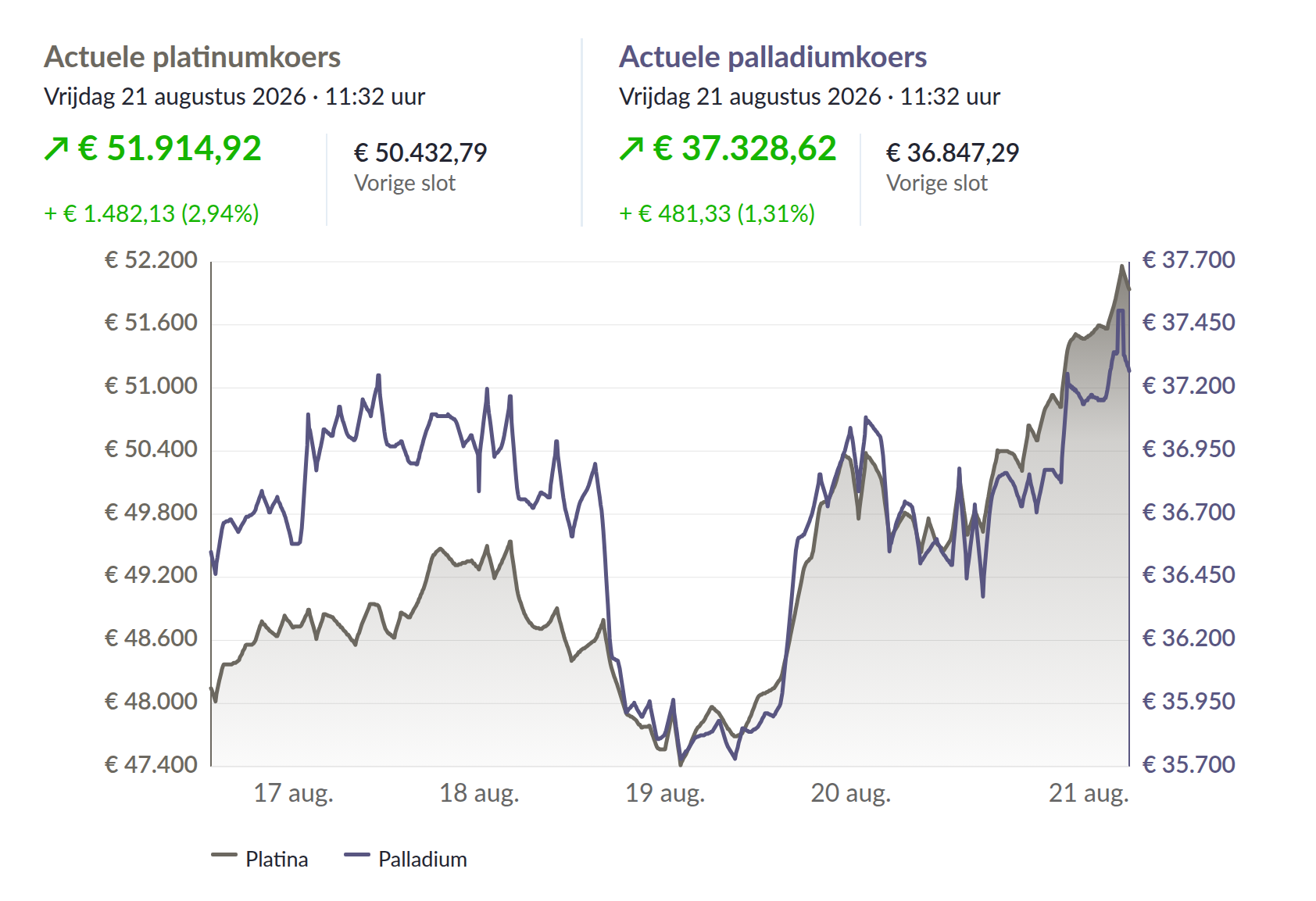 Platinum and palladium prices in euros per kilogram over the past seven days. Source: Holland Gold.
Jeffrey Christian of CPM Group is always very cautious in his forecasts for price movements, stressing the importance of keeping both the short and long term in mind. Over the medium term, he is positive on both platinum and palladium, for several reasons.
The fundamental platinum market is tight, but there is not yet a major shortage. The price increases are mainly being driven by investor demand and the price-boosting effect of production problems at South African mines. There are very few platinum mines in the world, and South Africa is one of the most important suppliers.
At an industrial level, CPM expects greater demand for platinum due to stricter emissions standards. Platinum is used in catalytic converters that filter emissions. Additional demand is also coming from the construction of data centres and AI infrastructure, as platinum is used in hard disk drives. CPM expects weaker demand from diesel vehicles, alongside a shift towards fully electric vehicles, which do not use platinum. It is also critical of developments in the hydrogen industry and sees overcapacity rather than new demand.
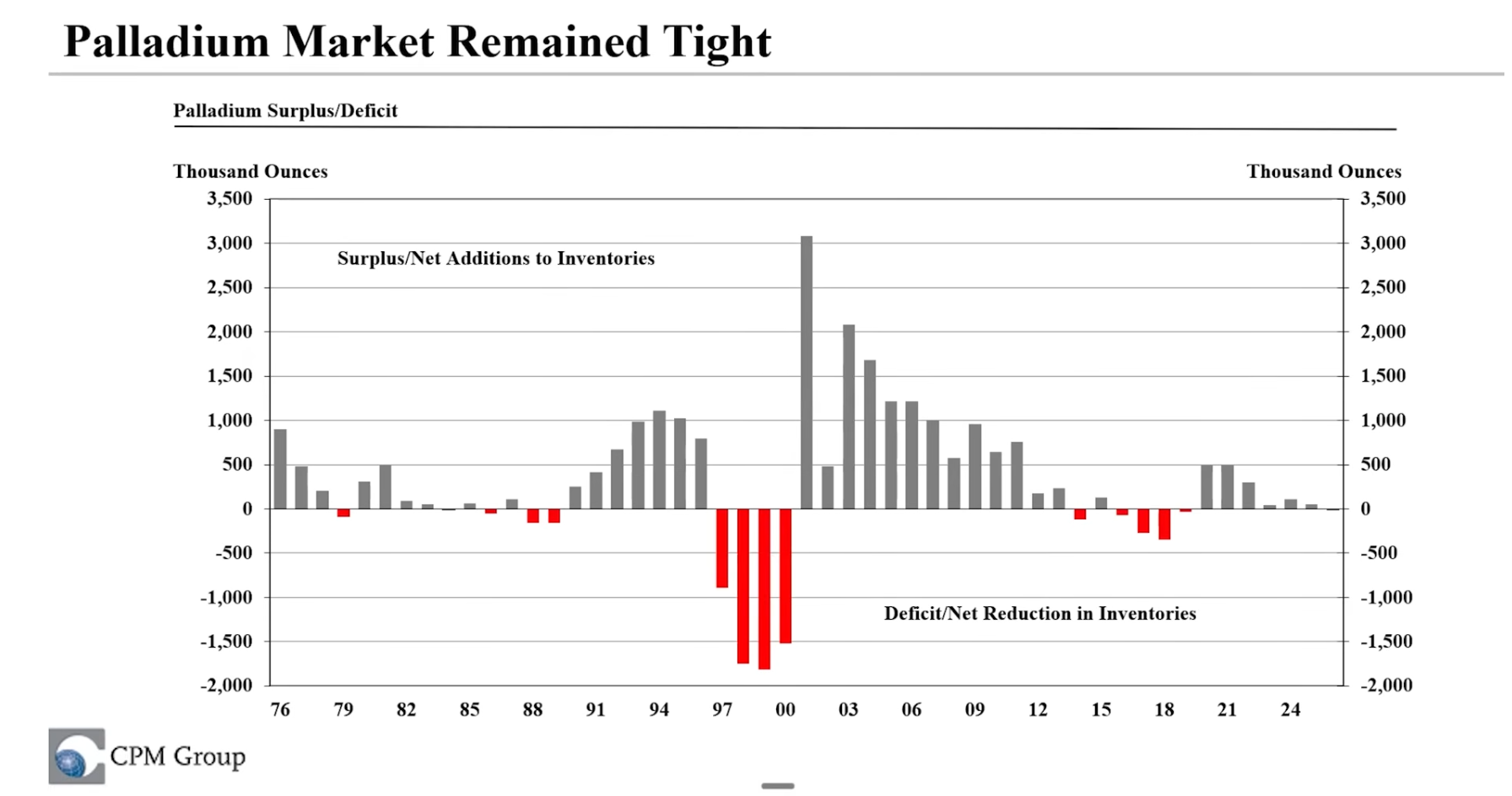 The palladium market is very close to a deficit. Figures in thousands of ounces. (Source: CPM Group).
In the palladium market, CPM sees an actual deficit approaching. The supply side is the main factor here, particularly its dependence on Russian mine production. If that declines, it cannot quickly be replaced. At the same time, palladium is mainly used in petrol cars. Depending on demand for those vehicles, demand for palladium may rise or fall. In the short term, consumers appear to be choosing hybrid cars first before moving away from petrol and diesel altogether. These hybrid vehicles use palladium in petrol catalytic converters and platinum in diesel catalytic converters.
Notably, Bitcoin has recorded its strongest rise in the past two years over recent days. This move is also being linked to Bessent’s announced government bond buybacks.
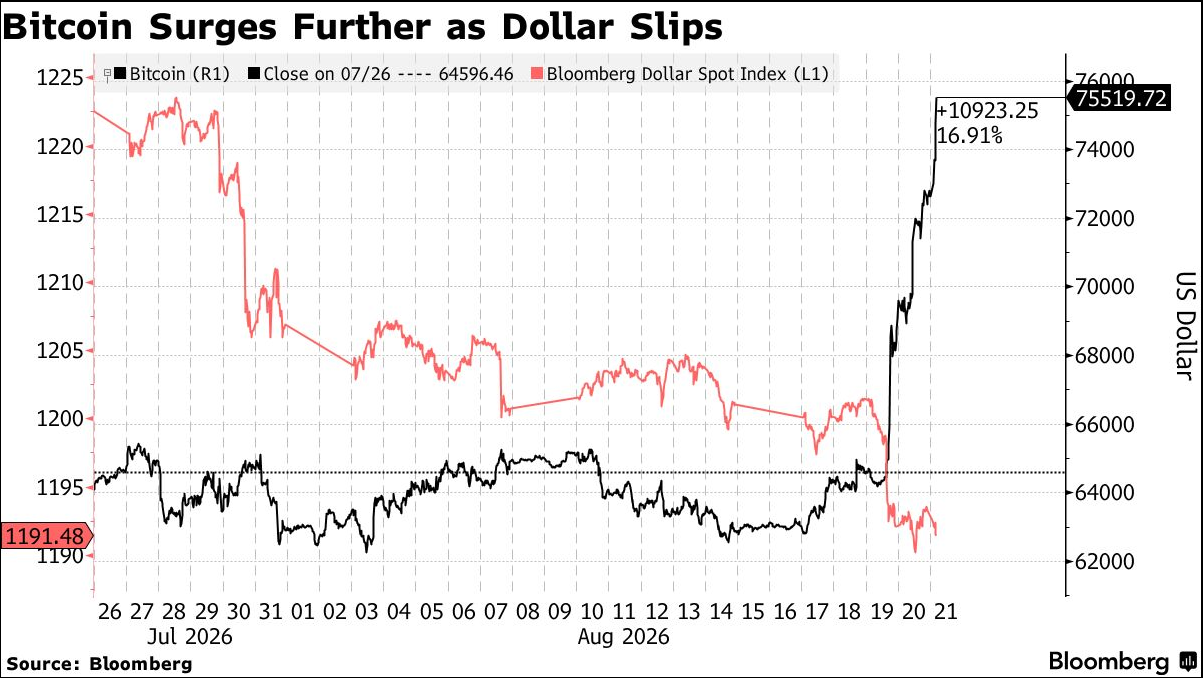 Bitcoin rises sharply while the dollar slides (Dollar Spot Index). (Source: Bloomberg).
Trump appears to be changing tack in his strategy towards Iran by shifting to economic warfare. He announced that economic measures aimed at hitting Tehran will be announced next Monday (24-8). According to Trump, it will be a true “economic D-Day”. For now, there is still no solution for the Strait of Hormuz, and the oil price has already risen 5% this week.
In recent months, we have seen rising oil prices act as a headwind for gold, but for now that relationship appears to have broken down. This is because in previous months a higher oil price was seen as a driver of inflation, which could prompt the Fed to raise its policy rate. Following Kevin Warsh’s most recent Fed presentation and renewed unrest in the bond market, the likelihood of an interest-rate increase is being priced increasingly lower. According to the CME FedWatch Tool, only one-third of the market now expects an interest-rate increase.
Holland Gold Event
|