9.3
8.064 reviews

English
EN


Just before the end of the year, a new bill adopted that will fundamentally reform our pension system. In the new system, pensions will move more in line with developments in the financial markets. It should also become clearer how much pension you have accrued as an individual. What exactly is going to change?
The most important change compared to the current system is that the benefit agreement will be amended. The guarantee that the pension benefit is always at least 70% of the average salary earned will no longer be available in the new system. Instead, the pension benefit will depend on the returns that pension funds make.
Instead of indexation in the event of good investment results, the pension benefit in the new system will move more in line with developments in the financial markets. This means that the expected pension benefit increases in the event of good returns, but can also decrease in the event of setbacks. As a result, the pension may also be lower than under the old system.
To reduce uncertainty for participants, these fluctuations become smaller as one gets closer to retirement age. Those who place their pension with commercial insurers can even arrange a fixed pension benefit. This will give these parties a Stronger competitive position compared to regular pension funds.
In principle, pension funds will continue to spread participants' contributions across different types of asset classes, just as they already do. But because pensions are becoming more personal, pension funds will have to invest with a shorter horizon in practice. For older participants, the funds have to invest with a very low risk, which in practice means investing more in low-yielding government bonds. They deliver Historically much less return than stocks.
In order to compensate for the loss of returns for older pension participants, pension funds will invest the contributions of young participants in the new system in a more risky way. The new pension law is based on assumptions such as an average return of 9% per year on shares, which can be further increased by investing with borrowed money. In the original bill, the Dutch Central Bank assumed a leverage of up to 15x the original deposit, which in practice would mean that there was a reasonable chance of losing all your investment in the pension fund as a young person.
When Pieter Omtzigt addressed As an irresponsible risk, the government decided to reduce the lending restriction to a maximum of one and a half times the deposit. With this amendment, the bill was eventually passed, which means that young participants in the new pension system will invest with borrowed money to compensate for the loss of returns of older participants. That borrowed money comes from the older participants in the pension fund. According to Carola Schouten, Minister of Pensions, this is already happening within the current system, but it is not yet so transparent.
As a result of the rise in interest rates, the funding ratio of pension funds has risen across the board this year. In November, the indicative funding ratio of Dutch pension funds was average 124%. Although stock and bond prices fell, higher interest rates caused future liabilities of pension funds to fall.
High interest rates are expected to make it easier for pension funds to achieve the necessary returns in the future. As a result, several funds have been able to apply indexation this year to compensate for part of the inflation. For example, ABP (11.96%), BPF Construction (14.52%), Care and Welfare (6%) and PMT (6.2%) will start indexing as of 1 January.
Higher interest rates are causing the funding ratio to rise, but that does not mean that pension funds are in good shape. Their investments have plummeted in value this year due to the decline in both stock and bond prices. At the end of last year, the investments of Dutch pension funds were worth more than €1,800 billion, but in the third quarter of this year, according to figures from the Dutch Central Bank, only €1,428 billion will remain.
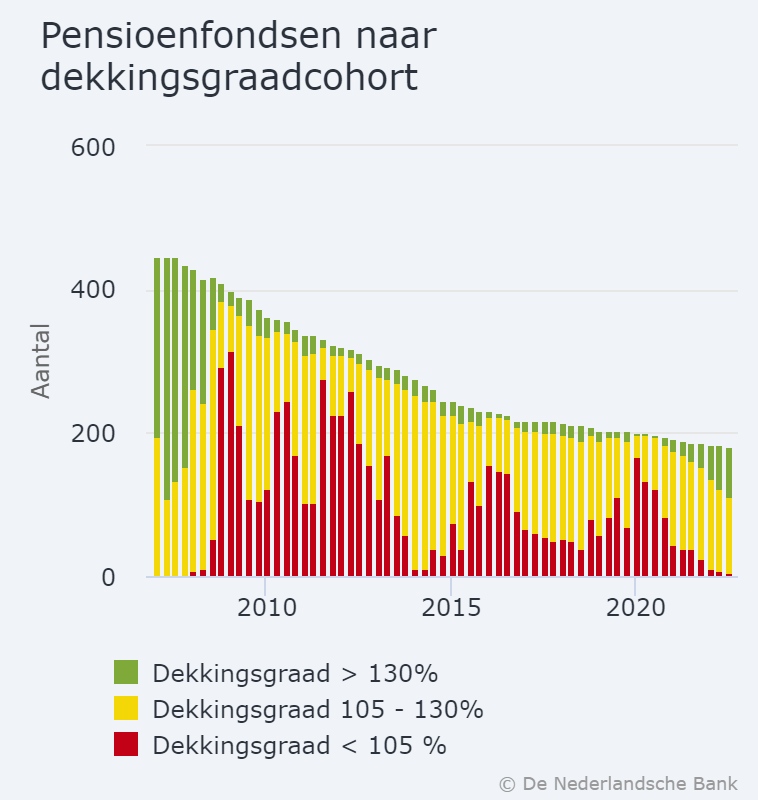
Funding ratio of pension funds has improved significantly (Source: DNB)
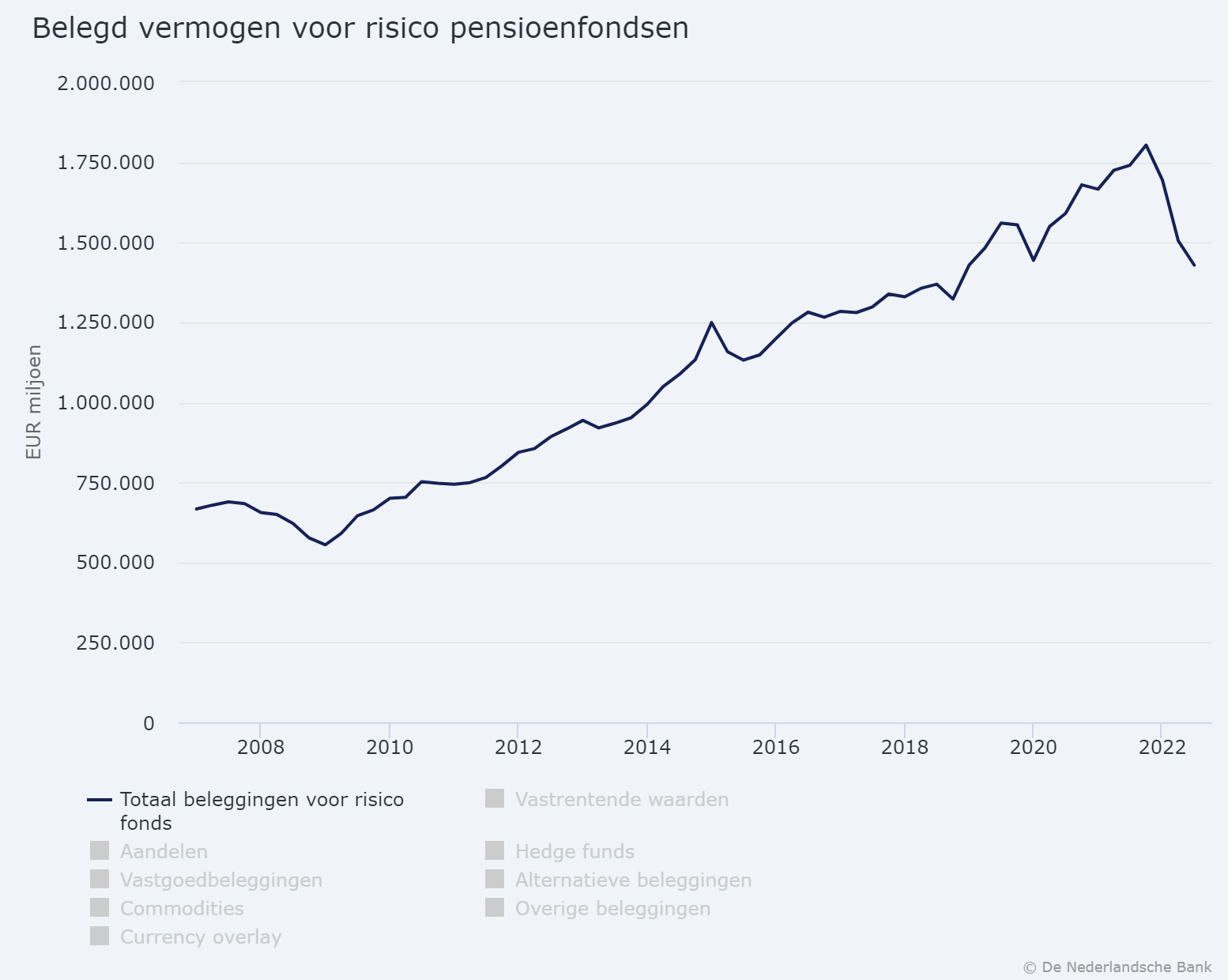
But the investments have fallen sharply in value this year (Source: DNB)
As a result of the rise in interest rates, not only did the future liabilities of pension funds decrease, but the value of their bond portfolios also decreased. According to figures from the Dutch Central Bank, the market value of all bonds fell from €907 billion in the fourth quarter of last year to €623 billion in the third quarter of this year. So this portfolio has fallen more than 30% in value.
From these figures, we can deduce that, on average, pension funds invest almost half of their assets in bonds. This is despite the fact that bonds have been yielding less and less return in recent years. It is therefore questionable whether pension funds can continue to meet their obligations under the new system if a large part of the assets yields a low return.
An important caveat to the sharp decline in the value of the bond portfolio is that pension funds hold most bonds for the entire term. This means that they will receive interest over this entire period and will get the full investment back at the end. Taking a loss on bonds only happens if a pension fund has to sell bonds during the term and the market interest rate has risen.
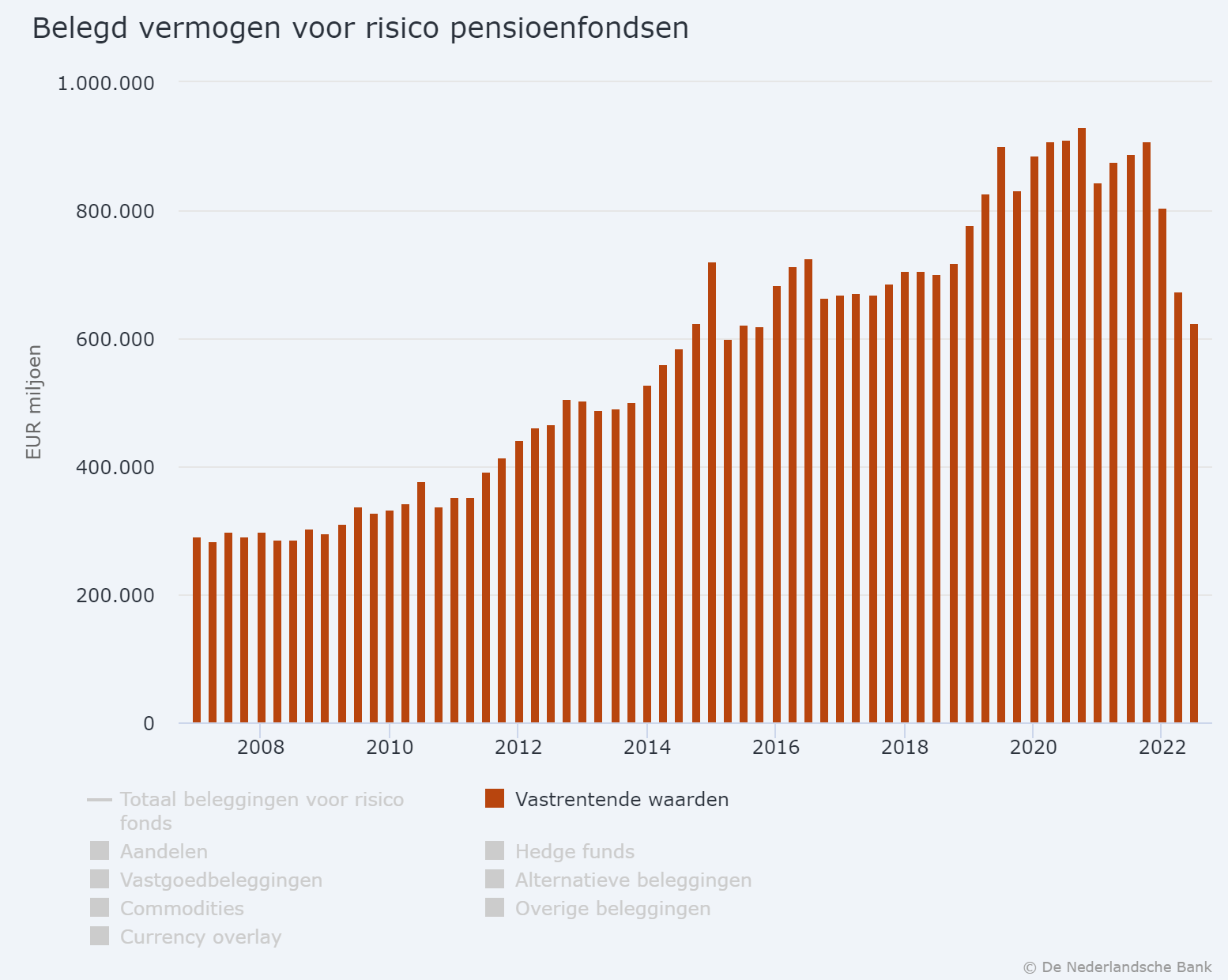
Depreciation of bonds in pension funds (Source: DNB)
The new pension system is fairer and, in a sense, more transparent than the old system, but it is likely to be detrimental to the pensioner. The certainty of 70% of the average salary has not been abandoned without reason. Due to demographic developments (more pensioners in relation to the number of people paying contributions), the old system had already become almost unsustainable. It could not provide the certainty that there would be enough pension left over for younger generations.
The new system is therefore fair in the sense that the pension will be determined by the actual return achieved. But that is not a nice message if we are facing a new economic crisis and premiums are going to go down. Especially if this is accompanied by persistently high inflation. On a positive note, the new system will give the option of having a one-off payment of up to 10 percent immediately at the start of retirement. That money can then be spent as you see fit.


