9.3
8.064 reviews

English
EN


After a number of lean years, raw materials are back in the spotlight. Over the past two years, commodities have delivered excellent returns, thanks in part to the rapid economic recovery from the coronavirus pandemic. In 2022, the S&P GSCI, a basket of different raw materials, even a return of 26%. This was mainly due to the sharp rise in energy prices, but also in a broader sense, the prices of raw materials rose. Especially in the first half of the year. Against the backdrop of falling stock and bond prices and falling real estate prices, commodities performed particularly well. Commodity prices came under some pressure in the second half of the year, but what will the coming years look like?

Commodities achieved excellent returns in 2022 (Source: S&P)
Commodity prices move in long upward and downward cycles and are influenced by a variety of factors. An upward trend is driven by strong growth in the global economy, which can cause demand to increase faster than supply. Inflation and monetary policy also play a role, as speculators are more likely to resort to commodities as a more tangible asset when inflation is high. In 2022, high inflation continued to cause a speculative wave in commodity markets, but what do market fundamentals look like right now?
As the chart below shows, the commodity market seems to be starting a new upward trend. Since its low point in the spring of 2020, valuations of commodity-related companies have risen much faster than the broader index of companies in the S&P 500 index. Rising energy prices and raw material prices gave a strong boost to the valuation of companies in the energy sector, but also to other commodity-related companies. However, these stocks are still not expensive, as measured by various value indicators such as the price/earnings ratio and the dividend yield. So there is still upside potential in this sector.
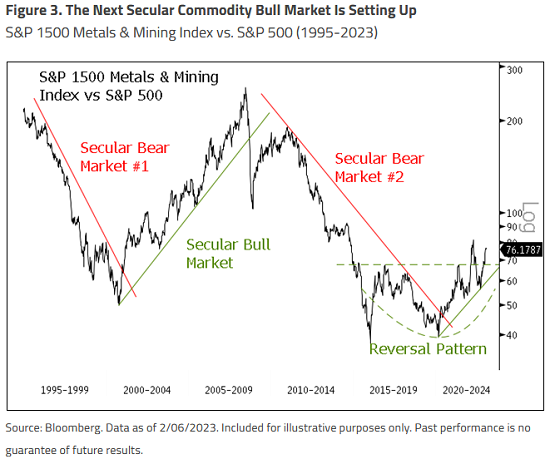
Commodity-related stocks outperformed the S&P 500 (chart via Jack Highland)
The fact that commodity prices often move in long upward and downward cycles is because it is not so easy to adjust production to increasing demand. For example, it takes years to develop new mines or exploit newly discovered oil and gas fields. It is also quite a capital-intensive sector, which means that money is also needed from investors to start projects. And that money only flows into raw materials after prices have already risen sharply. In recent years, technology stocks have been particularly popular and little capital has flowed into the commodity market. What also played a role was the policy of governments and institutional investors to phase out investments in, for example, the oil and gas sector. These would not be in line with the climate targets.
The result of this policy is years of underinvestment, leaving little spare capacity today to meet increasing demand. In the oil and gas sector, more investments are needed to maintain production, but that also applies to, for example, copper and other raw materials that are important for the energy transition that governments are trying to achieve. For example, the production of electric cars, solar panels and wind turbines requires a lot of metals, in which the mining sector will continue to play a crucial role in the coming years. And as long as the world is still dependent on oil and gas, investments in that sector will continue to be necessary to meet the increasing demand of a growing world population.
Mining company BHP writes in a Looking forward The combination of population growth, urbanisation and increasing prosperity in large parts of the world will continue to boost the demand for metals and other commodities in the coming decades.
Over the past two years, commodity prices have risen sharply due to the combination of rapid economic growth, lagging investment and high uncertainty surrounding the war in Ukraine. The economic outlook for the Western world appears to be deteriorating as a result of the war, but growth is still evident in large parts of the world. Even if the IMF's prediction that a third of the global economy may fall into recession this year comes true, there is still economic growth in much of the world. In many emerging economies, living standards are rising, creating more demand for mobility, for example, but also for goods such as white goods and electronics. This will continue to stimulate the demand for raw materials in the coming years.
 Have a look at us YouTube channel
On behalf of Holland Gold, Paul Buitink and Joris Beemsterboer interview various economists and experts in the field of macroeconomics. The aim of the podcast is to provide the viewer with a better picture and guidance in an increasingly rapidly changing macroeconomic and monetary landscape. Click here to subscribe.


