English
EN


Markets see a more than 90% chance that the Fed will raise interest rates tonight (16 September), for the first time since 2023. Fed Chair Kevin Warsh is under considerable pressure, as markets expect a rate hike while Trump absolutely does not want one. The US central bank (Fed) could surprise by keeping rates unchanged, but this would damage the Fed’s credibility. What will Warsh do with this devilish dilemma, and how will gold react?
The interest-rate decision will be announced tonight at 20:00 Dutch time, together with updated forecasts and interest-rate projections in the form of the ‘dot plot’. At 20:30, Fed Chair Kevin Warsh will hold a press conference. More than the question of whether rates will be raised, what matters is the explanation Warsh gives for the decision.
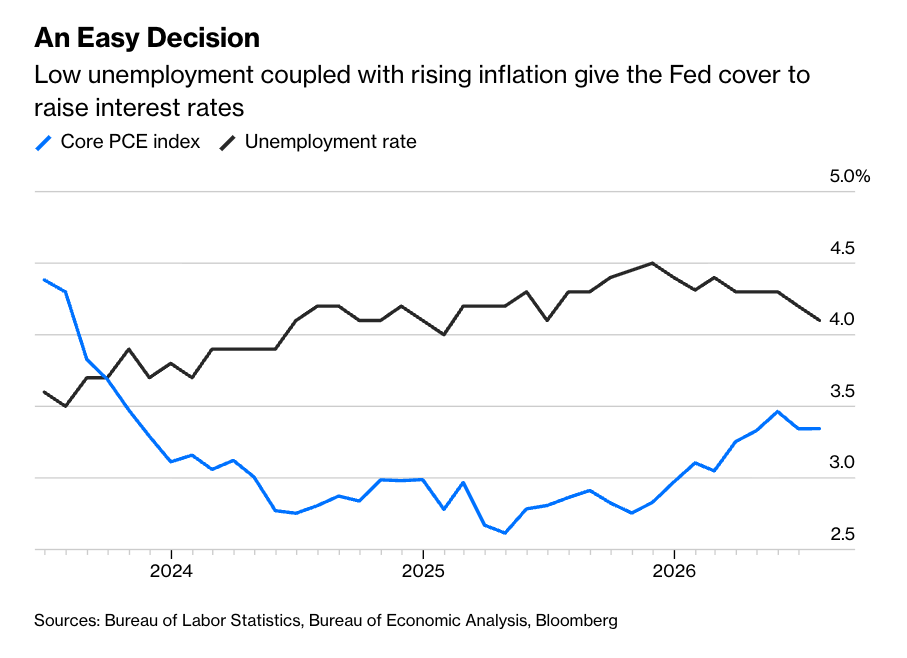 Economically, raising interest rates is an easy decision for the Fed; politically, far less so. Unemployment figures (black line) are falling while core inflation (Core PCE) is rising. (Source: Bloomberg).
“With markets already pricing in a high probability of a Fed rate hike this week, the key uncertainty is less about the rate hike itself and more about what comes next,” said Christopher Wong, strategist at OCBC. “If the Fed leaves the door open to further rate hikes, gold could become more vulnerable.” According to Wong, the gold price could then fall further towards $4,000 per troy ounce if the important support level of $4,250 is breached.
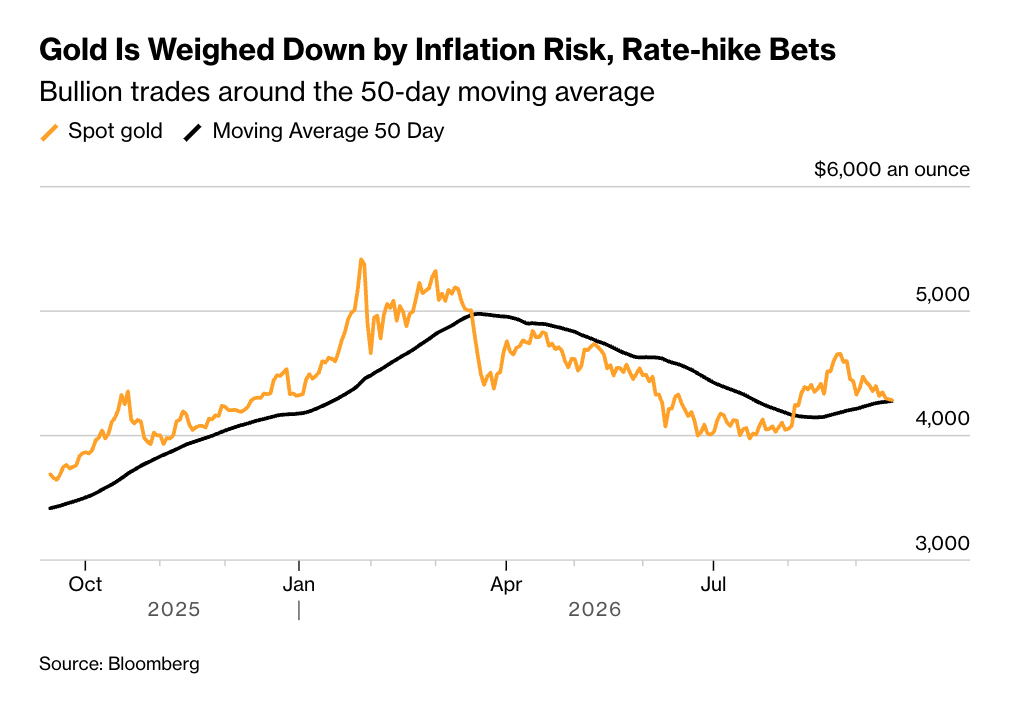 The gold price is hovering around its 50-day moving average and is under pressure from inflation risks and the expected rate hike. (Source: Bloomberg).
Jesse Colombo, independent precious-metals analyst and founder of The BubbleBubble Report, expects a possible rebound in the gold price after the rate hike is announced, as this would finally remove uncertainty from the market. However, if the Fed surprises by keeping rates unchanged, he expects the gold price could rise towards $5,000 per troy ounce in the coming months, provided gold closes above $4,400. One troy ounce is 31.1 grams, and $5,000 would correspond to €4,333 at current exchange rates.
In theory, a rate hike is a headwind for gold because interest-bearing bonds then become more attractive as a safe haven. We saw that headwind in action in September. After a strong August in which gold rose by 13%, the yellow metal has given up around 3% this month as rate expectations increased following new attacks on oil infrastructure.
However, that is not the whole story. Of the ten major rate-hiking cycles since 1972, gold was higher twelve months after the first hike in seven cases, with an average gain of 6.1%. The first month has historically been weak, however: an average decline of 0.7%, with a positive result in only four of the ten cases.
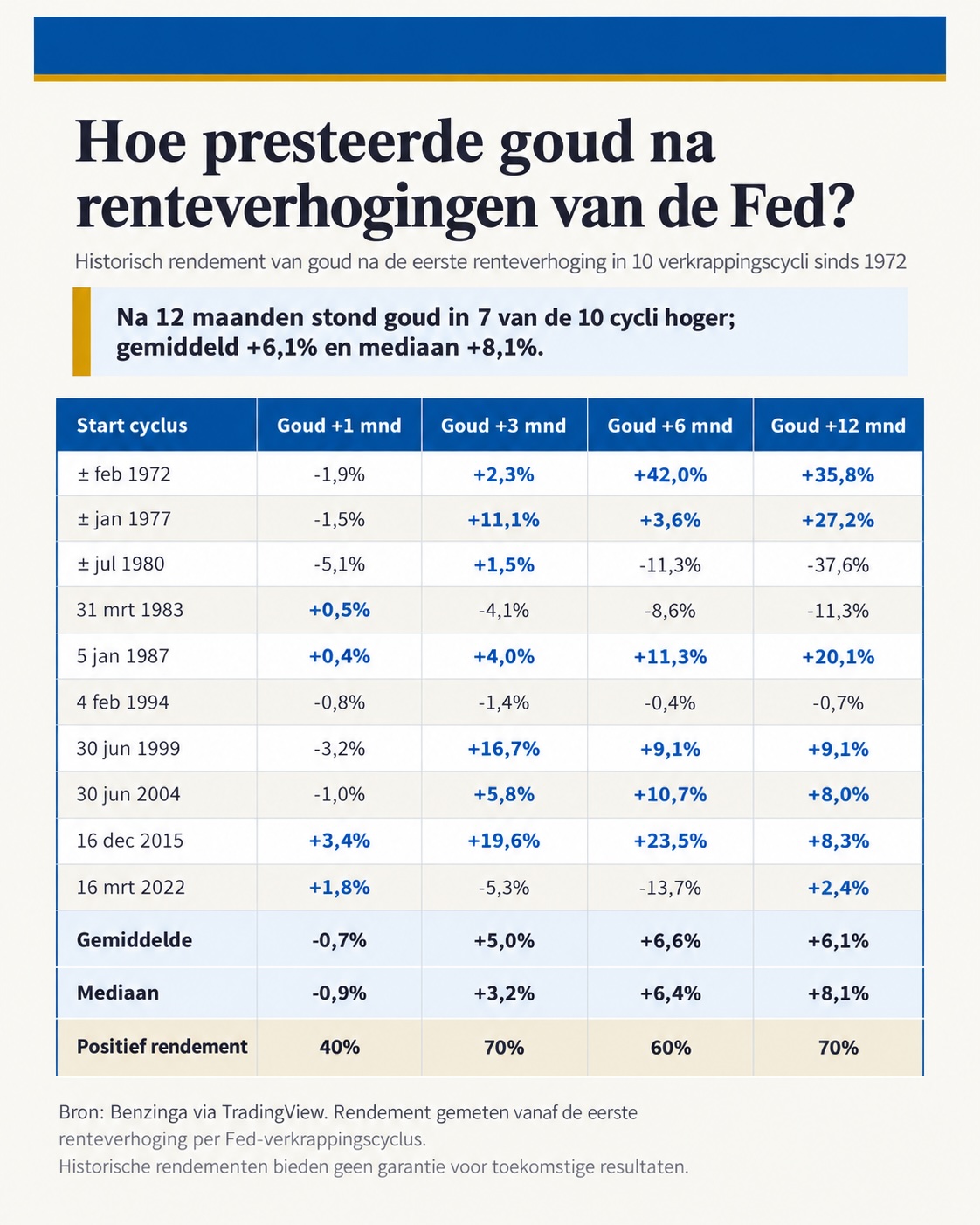 Historical performance of the gold price after the US central bank (Fed) started a new cycle of rate hikes. (Source: Benzinga via TradingView).
The explanation lies in the real interest rate. This is the policy rate minus inflation. With consumer price inflation (CPI) at 3.4% and a policy rate of 3.75-4%, that leaves a real interest rate of 0.35% to 0.6%. Gold has historically often performed well when real interest rates are this low. At the same time, we can see that bond yields in the markets are approaching 5%, giving investors a higher real return over the longer term.
What will be decisive for gold is the outlook for inflation. If Warsh fails to convince markets that he will bring inflation under control, or if the Fed does not raise rates, inflation expectations will rise further and the real interest rate will tighten.
Trump himself will not have a direct effect on the gold price, but his continued pressure on the Fed to keep interest rates low may well do so. This pressure is seen as undermining the independence of the central bank, often a bad sign for a country’s monetary and fiscal stability, and therefore a reason to turn to gold.
Last weekend, Trump told reporters that the US should actually have the lowest interest rates in the world. His reasoning is that, as the world’s strongest economy, the US is in the best position to repay its debt and therefore deserves the lowest interest rate.
Markets did not appear to fully agree with him. The US 10-year Treasury yield reached its highest level since 2007 on 15 September, after the 30-year Treasury yield had previously reached a similar level. These higher yields increase the interest burden on US national debt, a worrying sign for a country that already has $40 trillion in national debt.
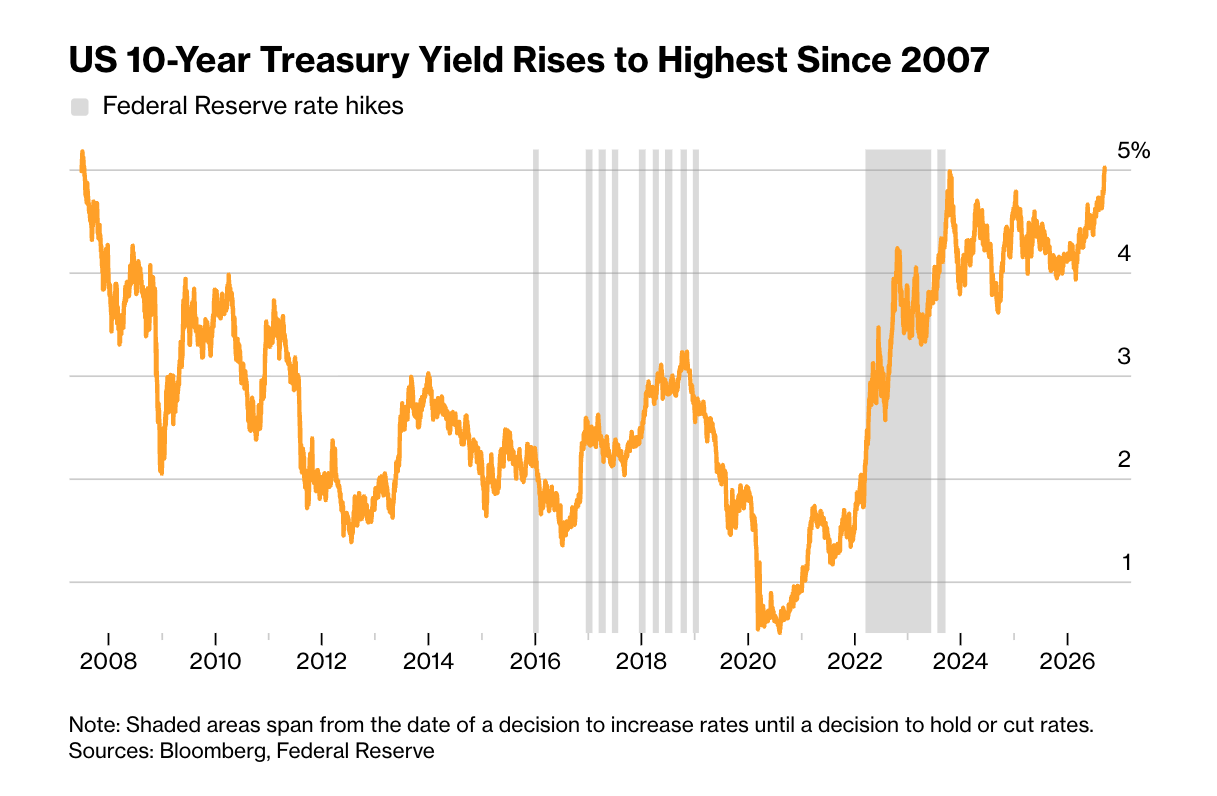 US 10-year Treasury yield rises to its highest level since 2007. (Source: Bloomberg).
Investors are demanding higher yields as compensation for persistently high inflation. Governments are also borrowing increasing amounts, meaning there is more supply of government bonds, which must compete with a wave of corporate bonds. The latter are being further fuelled by enormous investments in AI.
Markets expect a rate hike, which will probably trigger criticism of the Fed from Trump. Warsh does not make the interest-rate decision alone, however, but together with a larger committee (FOMC) of Fed members. The voting behaviour within this committee will therefore be closely watched. Much will also depend on what Warsh says at the press conference. Will he reveal anything about the future? Will there be further rate hikes? That could be a headwind for gold. If Warsh proves less strict in his approach to inflation, that could be favourable for gold. With a rate hike almost certain, the focus will mainly be on his explanation and the reactions from markets and Trump. The sting is in the tail…