English
EN


Over the past few weeks, gold and silver have appeared to be gearing up to retest the previous lows reached in June and July. Those lows were followed by a strong recovery in August, before the accumulated gains largely evaporated in September. So far, this trend has continued into the first half of October.
As a result, gold is down almost 5% in dollar terms since the start of the year. In euro terms, its return is roughly flat. The picture looks even less encouraging for silver, with a loss of 21% in dollars and 16% in euros.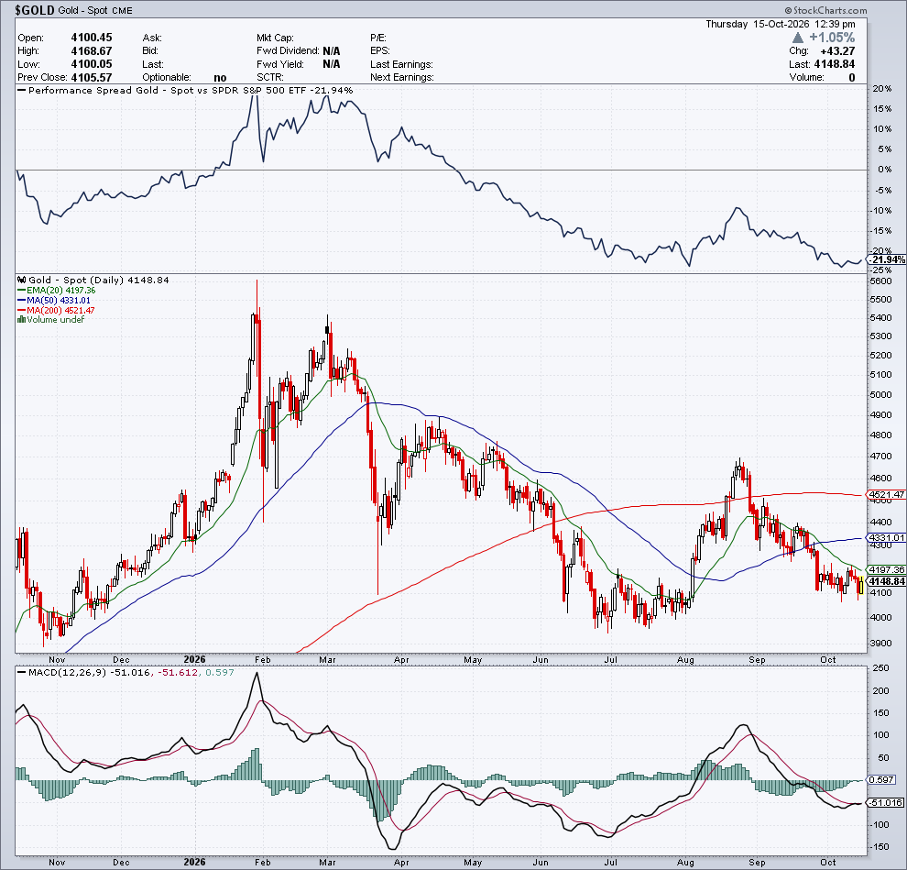
Chart: gold price over one year, with 50-day and 200-day moving averages (Source: StockCharts)
Meanwhile, gold remains under pressure from higher interest rates and a stronger dollar. A barrel of Brent crude continues to trade well above $100. Ever since the Jackson Hole meeting in late August, the market has been focused on interest rate hikes and, consequently, the rising opportunity cost of holding non-interest-bearing assets such as gold and silver. In gold’s case, this led to a price decline from almost $4,700 in late August to below $4,100 over seven weeks. The late-June low has not yet been reached, and gold attracted renewed buying during the Asian trading session.
The US inflation report for September was poorly received and initially pushed interest rates even higher. The Consumer Price Index (CPI) rose by 0.6% month on month in September, compared with 0.4% a month earlier. The year-on-year increase came in at 3.7%, compared with 3.4% in August. The consensus forecast was 3.6%. Notably, higher energy prices accounted for half of the increase. Core CPI, which excludes food and energy, rose by just 0.3%, the same as in August. On a year-on-year basis, however, the increase of 2.6% was slightly higher than a month earlier (2.4%).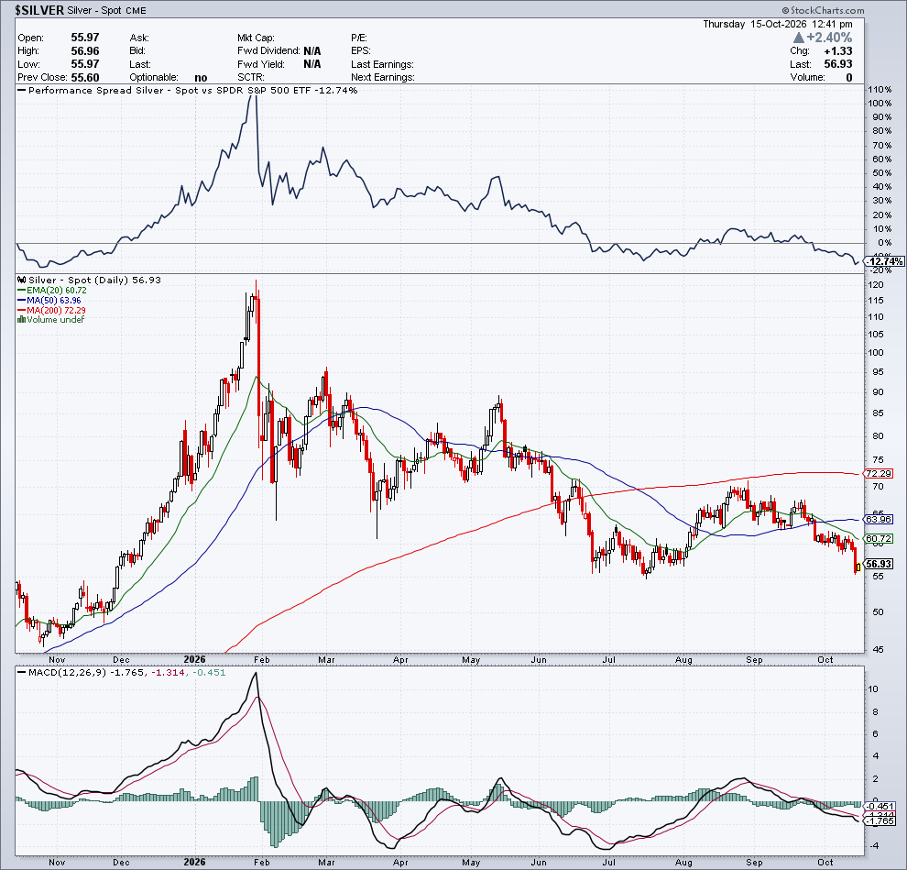
Chart: silver price over one year, with 50-day and 200-day moving averages (Source: StockCharts)
Silver has also fallen below its 50-day moving average, leaving the July low of just under $55 as the only remaining support level. This level was briefly touched, but, as with gold, a modest price recovery followed. Because silver is primarily used in industrial applications, the impact on physical demand is greater. In this respect, silver is more vulnerable than gold, as higher input costs in the form of more expensive energy and a rising cost of capital (higher interest rates) are detrimental to industrial activity over time.
Despite higher-than-expected inflation, a clear majority of 71% expects no change in interest rates from the Federal Reserve on 26 October. This is indicated by the CME FedWatch Tool. The midterm elections are scheduled for a week later, and it is unusual for the Federal Reserve to change interest rates so close to an election, in order to avoid any appearance of political bias.
It is a different story for the final meeting on 6 December. For that meeting, 91% expect an interest rate increase of at least 25 basis points. Just over a quarter even expect the Federal Reserve to raise rates by 50 basis points in one go. The minutes of the previous interest rate meeting on 16 September showed that the decision to raise rates was unanimous. Moreover, a majority of Fed officials expect at least one further rate hike later this year.
Despite all these headwinds, many investors still see opportunities in gold. This was evident from the World Gold Council’s latest ETF Report. Last month, inflows into physically backed gold ETFs amounted to 67.3 tonnes, equivalent to a nominal value of almost $10 billion. This brings the total for the third quarter to 211 tonnes and $31 billion.
North American ETFs attracted 27.7 tonnes of gold, worth $4 billion. This brings the third-quarter figure to 81.3 tonnes, or $11.7 billion. For the United States, this was the first inflow of the year, following net outflows in the first and second quarters. After the first three quarters of 2026, net inflows total 20.7 tonnes, worth $4.1 billion. Flows were also positive in Europe and Asia, both in September and over the third quarter as a whole.
The World Gold Council also calculated that central banks collectively bought 39 tonnes of gold in August. The People’s Bank of China bought 20 tonnes, bringing its total purchases between January and August to 80 tonnes. Poland is slightly ahead, with 98 tonnes following a further purchase of 8 tonnes in August. With holdings of 648 tonnes, Poland’s target of 700 tonnes is no longer far off. Other buyers included Uzbekistan, Kazakhstan and Turkey. For Turkey, this was the first purchase in four months. Russia sold 6 tonnes, bringing its total sales since the start of the year to 56 tonnes.
Meanwhile, it has emerged that China bought a further 23 tonnes of gold in September. This is the largest amount since October 2023.