English
EN


September is traditionally one of the best months for gold, with above-average returns, just like January, August and November. January and August followed this historical pattern perfectly, but September struck a discordant note with a price drop of 8.5% for gold and as much as 13.5% for silver. What does this mean for the coming months, and does the investment case for gold still hold?
Following a brutal sell-off on Monday, the year-to-date return for both precious metals has turned negative again. With three quarters of 2026 now behind us, gold is down 4% in dollar terms and 1% in euro terms. For silver, the figures are -15% and -12% respectively. On balance, the gold-silver ratio remained virtually unchanged.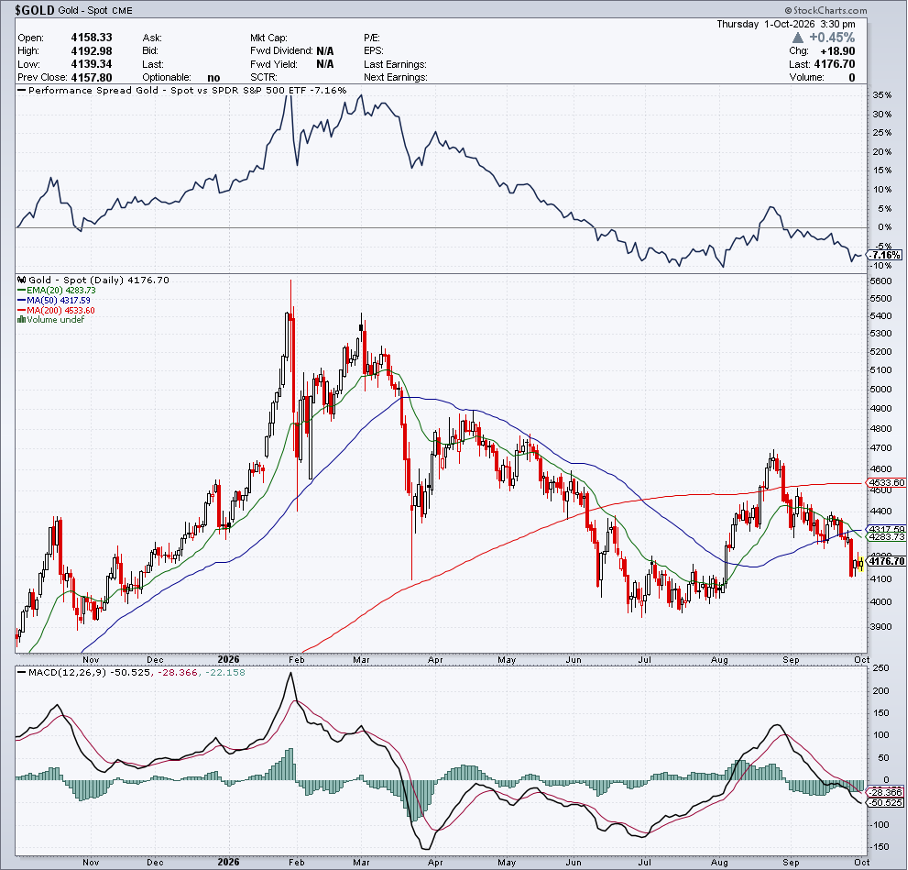
Chart: gold price over 1 year with 50- and 200-day moving averages (Source: StockCharts)
Long-term interest rates in the United States (10y Treasury yield) have now risen to more than 5.3%, the highest level since 2002. Long-term rates also reached multi-year highs in several European countries. This is exactly the opposite of what central banks are trying to achieve by raising (short-term) policy rates, and it also brings the tension between monetary and fiscal policy into sharp focus.
The higher price level, to which the rate hikes are a response, is linked to loose fiscal policy by governments and to supply-side bottlenecks. These in turn result from higher energy prices and other second-round price effects in the economy, caused by the numerous geopolitical conflicts around the world. Investor sentiment has meanwhile taken another sharp dive. Weekly figures from the Commodity Futures Trading Commission show a decline in open interest in both the futures and options markets. For the first time since mid-July, there was also a net outflow from gold ETFs. The sharp rise in the dollar further accelerated the correction in gold.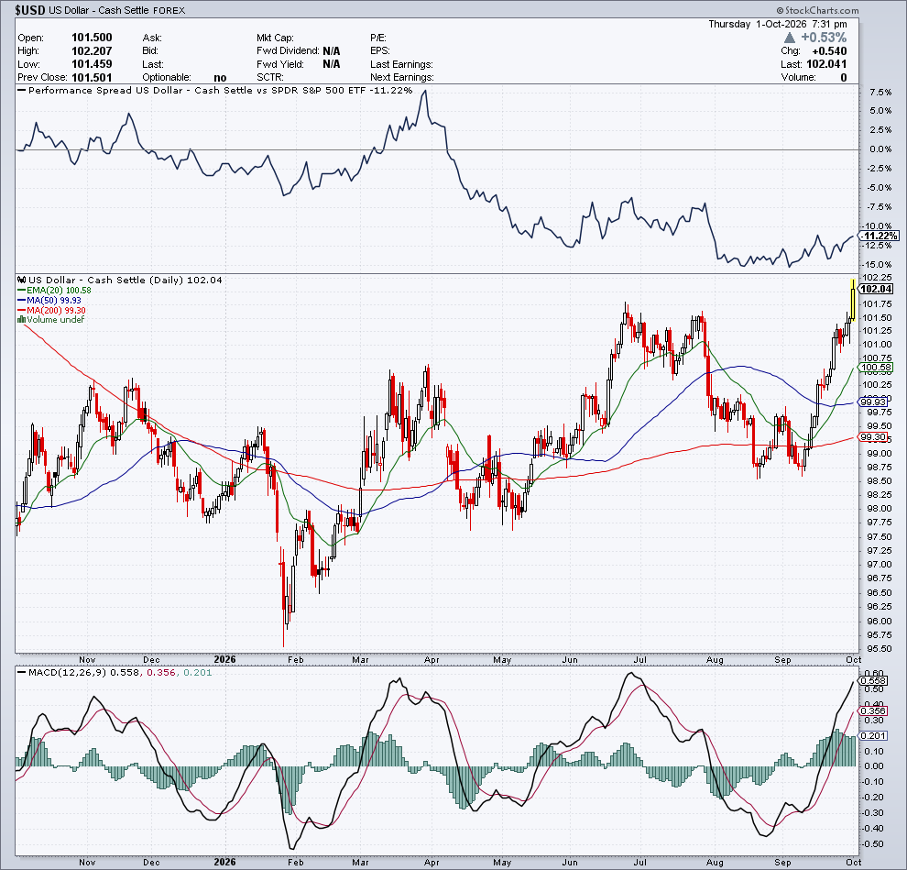
Chart: US dollar index (DXY) over 12 months (Source: StockCharts)
Another factor was the start of Golden Week in China, a national holiday week commemorating the founding of the People’s Republic. Public life largely comes to a standstill and the stock exchanges remain closed, which has a major impact on trading volumes, not least in gold, a market in which China has become one of the most important players, if not the most important. At the same time, the period after Golden Week traditionally marks the start of the season in which physical gold volumes in the jewelry industry and retail trade are at their highest. Gold is down 8% in yuan terms this year, and this price drop could be an incentive to buy more.
Following the first rate hike since July 2023, all eyes are now on the upcoming monetary policy meeting on October 28. Expectations are swinging in all directions, as the CME FedWatch shows. Macroeconomic indicators, combined with the day-to-day news flow, are causing large fluctuations.
After a lower-than-expected inflation figure for August (PCE), the probability that the Federal Reserve would raise rates again as early as later this month was estimated at only 33%. Barely a day earlier, it had been more than double that.
Several scenarios are possible in the short term. The most unfavorable one for gold would be a further escalation of the geopolitical situation in the Middle East, with oil prices remaining high. Under these circumstances, inflation would be unable to fall, and the Federal Reserve would have no choice but to raise rates further in order to preserve its credibility.
In addition, there is the risk that central banks hit by high long-term interest rates (dollar-denominated debt) and expensive oil will have to sell part of their gold reserves to support their own currencies and to pay for imports such as oil. That is the normal course of events when liquidity is needed quickly, but it does weigh on sentiment.
On the other hand, some easing of tensions in the Middle East hornet’s nest could quickly lead to the opposite movement. Lower oil prices and the unwinding of second-round price effects could bring inflation down, after which there would be no need for rate hikes, or there might even be room to cut rates.
Either way, the investment case for gold remains intact. Government deficits and debt will inevitably continue to rise, and this has a negative impact on the purchasing power of the paper money issued by central banks. Physical precious metals in your own possession offer excellent protection against this chronic currency debasement.