English
EN


Gold and silver surged on news of Democratic gains in both the Senate and the House of Representatives. The rally follows a volatile week for precious metals. In the Netherlands, investors have welcomed the news that the new Box 3 legislation has, for now, been pushed back. What does this mean for you as an investor? And how could the US midterm elections affect precious metals?
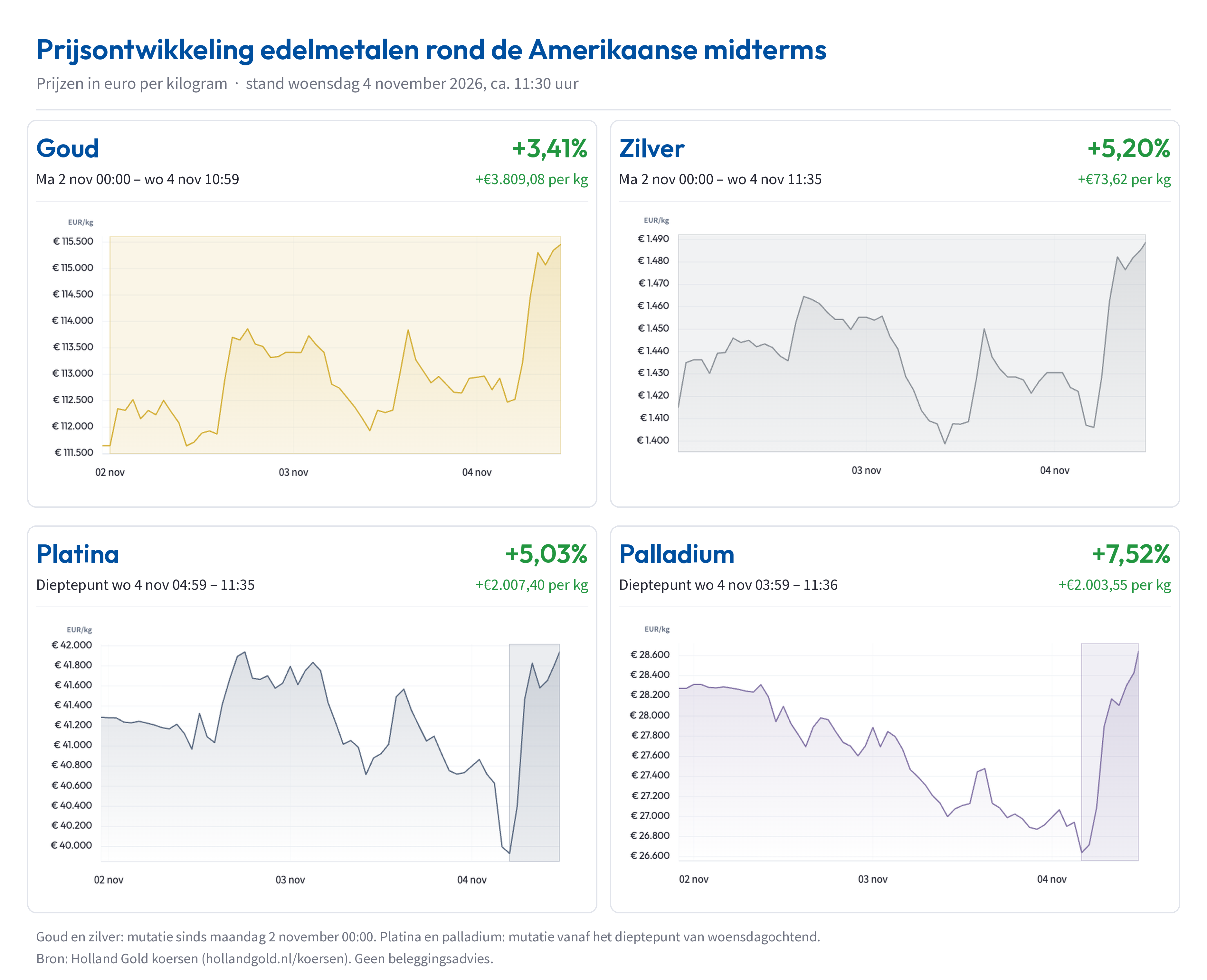
First, precious metal prices have been extremely volatile over the past few days. Below is an overview of the largest moves. All prices recovered on news surrounding the midterm elections, following a sharp correction late last week. The gold price has risen by around 3.4% since Monday, while the silver price is up as much as 5.2%. For platinum and palladium, the chart shows the price move from their lowest point, during the midterm election results on Tuesday night, through to Wednesday morning. The platinum price rose by 5%, while the palladium price gained 7.5%.
The new Box 3 plans have been postponed from 2028 to 2029. However, the path towards a lasting solution remains fraught with obstacles. For investors, nothing changes for now. The current system remains in place, with tax levied on a deemed return on your assets, alongside the temporary counter-evidence provision. Under the current system, a tax-free asset allowance applies. In 2026, according to the Dutch Tax Administration website, no tax is due on the first €59,357 of assets, or €118,714 if you have a tax partner. A previously proposed reduction in this tax-free allowance has also been scrapped.
The government has reached agreement on the tax plan, under which the Box 3 reform will take effect no later than 2029. The delay follows a damning assessment from the Council of State and the Dutch Tax Administration, which we covered extensively on Monday. According to the Council, implementation in 2028 is not responsible, and the government should not submit the proposal to the House of Representatives in its current form. The Council urged the government to reconsider the legislation more carefully and described the insufficiently substantiated distinction between shares and privately held physical gold or crypto as ‘vulnerable’. A temporary law in 2029 will be followed by “a proper law from 2030,” according to State Secretary Eerenberg.
Economist Bas Jacobs has described the plan as an ‘accounting scam’. To fund the delay, the government is temporarily lowering the tax rates in Box 2, which applies to entrepreneurs who own their own private limited company. This encourages them to distribute profits earlier, generating additional tax revenue during the current government’s term but less revenue afterwards. “So on balance, you lose out,” Jacobs said. According to the Ministry of Finance, not taxing unrealised gains through 2040 will cost €21.8 billion, of which only €4.2 billion has been funded.
Although the government has agreed on a tax plan, that does not mean it will necessarily be passed. The Jetten government is sending the proposals to parliament without a deal, leaving the decision to the House of Representatives and the Senate. The government is “putting it to the test”, according to the FD. “I hope all 150 members of parliament will consider it carefully,” Prime Minister Jetten said. Opposition parties are still weighing their positions, and the question is who will blink first. ChristenUnie and 50PLUS are positive, Pro and Volt remain opposed, while BBB is threatening to vote against the plan in the Senate unless action is taken on nitrogen emissions. According to EenVandaag, the government is ten seats short of a majority in the House of Representatives and sixteen short in the Senate. Confidence in the government is under pressure, according to BNR. The House of Representatives is debating the plans today, Wednesday 4 November, with a vote scheduled for 12 November.
According to projections, Democrats have won both the House and the Senate in the midterm elections. The midterms are congressional elections held halfway through a US president’s term. They are highly significant because they can have a major impact on a president’s ability to implement their agenda. Trump previously had Republican majorities behind him, giving him considerable freedom to pursue his agenda. That will change sharply once the new Congress is sworn in in January 2027. Trump will, however, retain his veto power. He can block legislation passed by Congress unless two-thirds of both chambers vote to override his veto. In the Senate, Democrats gained at least six seats from Republicans.
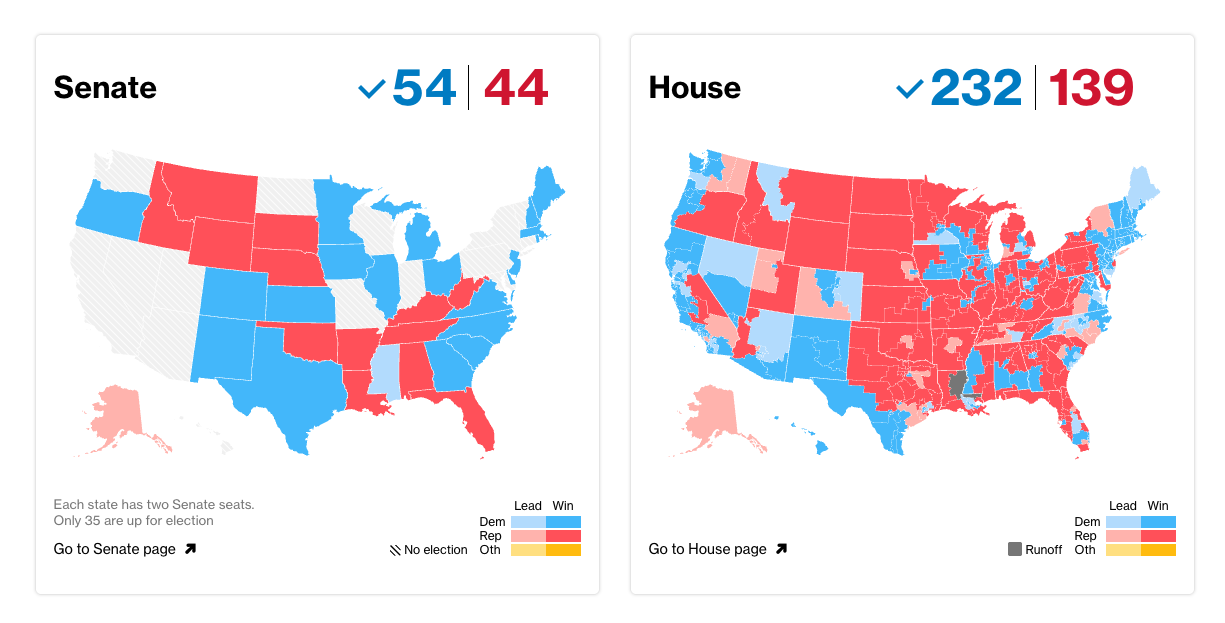 Interim results from the US midterm elections. Republican states are shown in red and Democratic states in blue. Democrats have secured a majority in both the Senate and the House of Representatives. (Source: Bloomberg).
Texas stands out in particular. A Democrat won a statewide election there for the first time since 1994. James Talarico defeated Trump ally Ken Paxton in the race for the Senate seat, while Gina Hinojosa is on course to defeat Governor Greg Abbott, Bloomberg reports.
Ahead of the election, there had been considerable concern over whether Trump would accept a defeat. For now, the US appears to have been spared such political turmoil. "I am absolutely prepared to accept that result," Trump told The New York Times, CNN reports.
On election day itself, strong US jobs data pushed yields higher, causing gold to fall by 0.6% on Tuesday and silver by 2.1%. As the results came in, the picture reversed. By around 10:00 on Wednesday morning, gold was up 2.7% at $4,034 per troy ounce, silver was up 4.0% at $51.67, platinum 2.6% and palladium as much as 5.6%. For gold, it was the largest one-day gain since August.
Why is gold rising so quickly? “Democratic control of Congress will make it harder for the White House administration to pass major partisan legislation,” David Chao, a global market strategist at Invesco Asset Management, wrote. “Less fiscal stimulus could reduce upward pressure on US growth, inflation and Treasury yields.”
Chao is referring to the possibility that additional government spending and tax cuts proposed by the Trump administration could be blocked in Congress. A Democratic majority could prevent these measures from passing. If the government therefore needs to borrow less, government bond yields could fall.
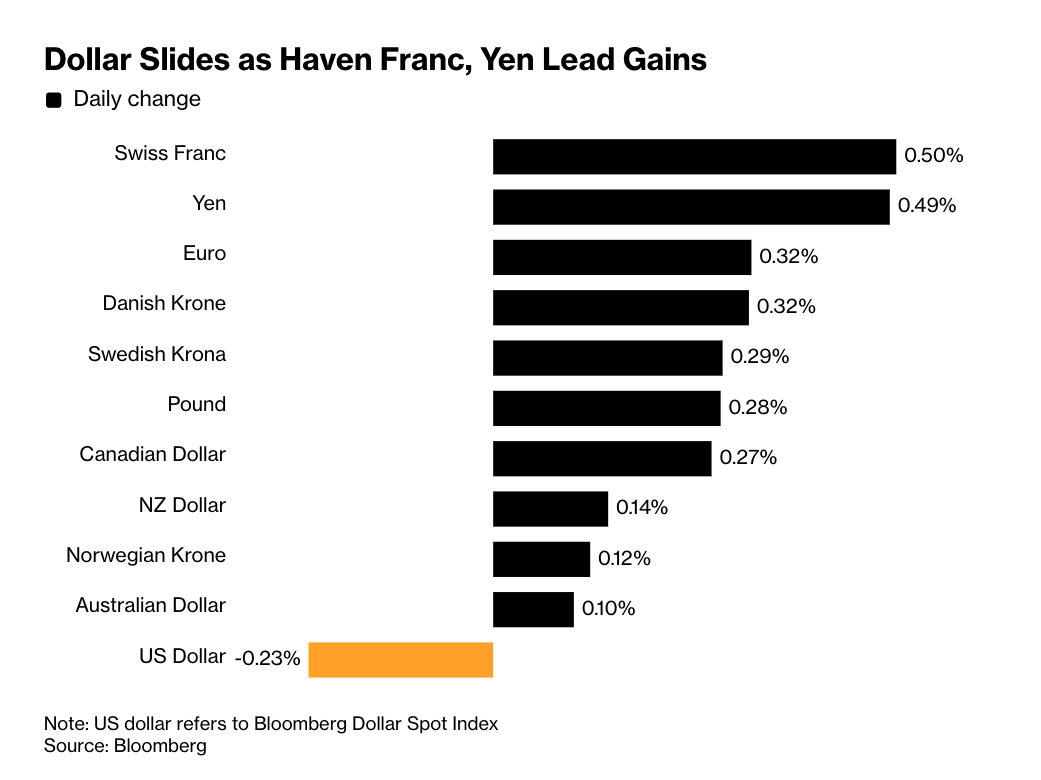 The dollar is falling against other currencies, with the Swiss franc and the yen leading gains among safe-haven currencies. (Source: Bloomberg).
The US 10-year Treasury yield fell to 4.90% on Wednesday, while the dollar also weakened. The dollar index, which measures the US currency against six other major currencies, has fallen to its lowest level in five weeks. Both moves are supportive for gold. Gold does not pay interest and therefore becomes relatively more attractive as yields fall. A weaker dollar also makes gold relatively cheaper for investors outside the United States.
Analysts are divided over how sustainable the recovery will prove. Christopher Vecchio of Tastylive sees a favourable environment through to spring 2027. Michele Schneider of MarketGauge expects investors to seek protection in government bonds rather than gold. The Fed remains the most important factor. Before the election result, markets were pricing in a roughly 76% to 79% probability of a rate hike on 9 December.
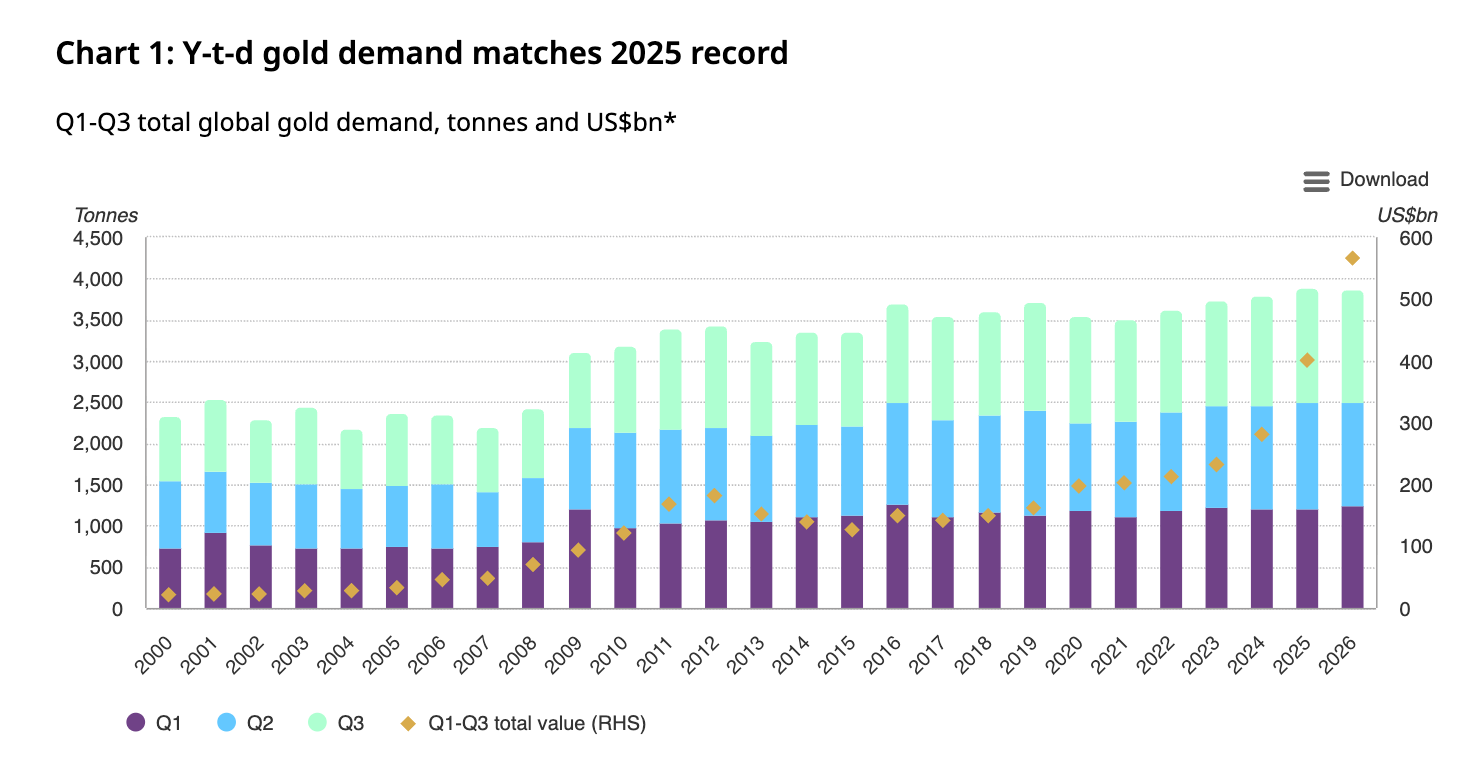 Global gold demand by weight, measured in tonnes, is almost level with the 2025 record. This chart compares demand over the first three quarters of 2026 (Q1 = 1st quarter, and so on…) with previous years: 3,881 tonnes, compared with 3,884 tonnes in 2025. In value terms, demand has comfortably surpassed 2025, reaching a record $566 billion (the yellow diamond shows the total value of demand from the 1st to the 3rd quarter). (Source: World Gold Council).
Beneath the surface, gold demand remains very robust. Central banks purchased 321 tonnes of gold in the third quarter, the strongest pace since late 2024, while gold ETFs, exchange-traded funds backed by physical gold, reached a record 4,256 tonnes, according to the World Gold Council.