English
EN


The rising number of copper thefts, increased media attention and copper’s record price show that the metal is all but impossible to ignore in 2026. At first glance, that hardly seems surprising. Electrification and the rise of AI data centers are driving demand higher, while investment in supply is lagging behind. According to the law of supply and demand, this should result in a higher price. Yet the Simon-Ehrlich wager shows that increasingly scarce commodities do not automatically lead to higher commodity prices. What can we learn from this wager? And can copper actually translate the expected scarcity into higher prices?
When biologist Paul Ehrlich published his book The Population Bomb in 1968, he predicted a demographic crisis. The global population would grow faster than the supply of food and raw materials, resulting in scarcity and sharply rising prices. Economist Julian Simon responded by proposing a wager on the inflation-adjusted prices of commodities over a ten-year period. If they fell, Simon would win. If they rose, Ehrlich would win. Ehrlich selected copper, chromium, nickel, tin and tungsten. Ten years later, the outcome was clear. Although the global population had increased significantly during that period, the real prices of all five commodities had fallen.
There were also other periods in which commodity prices did rise. The lesson of the wager is therefore not that real commodity prices must always decline over time. Above all, it shows that higher prices themselves bring about change. They give companies an incentive to use raw materials more efficiently, seek alternatives, invest more in mining and make recycling more attractive.
Copper is an extremely good conductor and therefore plays an important role in everything related to electrification. In January of this year, consultancy S&P Global published a report on the expected increase in copper demand. While the world required approximately 28 million metric tons of copper in 2025, S&P expects this figure to have risen to 42 million metric tons by 2040, an increase of around 50%. It identifies four major growth drivers: general economic growth, electrification and the energy transition, AI data centers and defense. Electricity consumption is expected to rise sharply worldwide. As a result, electricity grids will have to be expanded, requiring additional copper.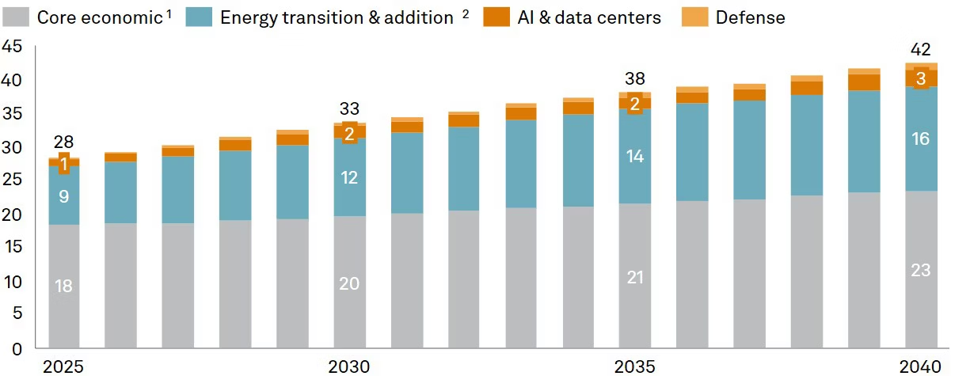
Copper demand (source: S&P Global)
A large share of this additional demand will come from Asia. S&P expects approximately 60% of the additional copper demand through 2040 to originate there. China and India in particular will play an important role. Economic growth, urbanization and rising incomes are driving rapid growth in electricity consumption in these countries. S&P also identifies Africa as a market with considerable potential, as a large share of its population still has limited access to electricity.
The energy transition is also increasing copper consumption. Electric cars contain approximately three times as much copper as cars with internal combustion engines. Solar panels and wind turbines also require large quantities of copper. On top of this comes the rise of AI data centers. Although AI is not the largest source of new demand according to S&P, data centers’ share of US electricity consumption could rise from approximately 5% to 14% by 2030. Defense is also generating additional demand, as modern weapons contain increasing amounts of electronics and technology.
With demand rising so rapidly, one would expect supply to increase sharply as well, but problems are emerging there too. Over time, existing copper mines produce less as ore grades decline. This makes it more expensive and complicated to extract the same quantity of copper from the ground. Without new investment, S&P expects production from existing mines to begin declining again after 2030. New mines may appear to be the solution, but it takes an average of approximately 17 years to move from discovery to production. Permits, regulations, environmental requirements and high investment costs make it difficult to expand supply quickly. Recycling can meet part of the growth in demand, but this will not be enough either. Without a substantial expansion of mining, S&P forecasts a shortfall of approximately 10 million metric tons by 2040.
Will Simon then be proven right that scarcity does not automatically lead to higher commodity prices? Copper once played an important role in telecommunications and was used, for example, in telephone lines. Rapidly rising data traffic made fiber optics increasingly attractive, creating an alternative to copper. Oil also clearly demonstrates how prices can drive change. Thanks to more efficient cars, machinery and production processes, less and less oil is needed to generate the same level of economic activity.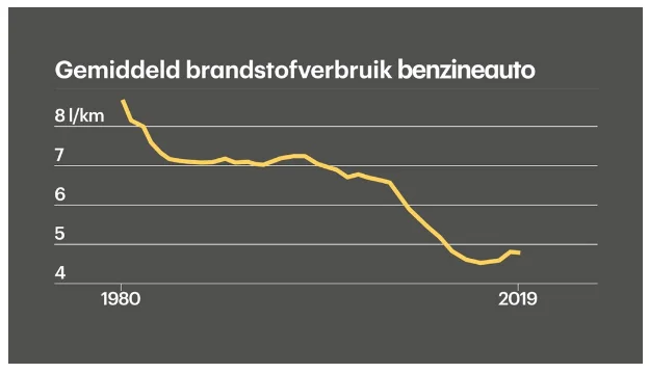
Fuel consumption of gasoline-powered cars (source: Autointernationaal.nl)
These examples illustrate what high prices actually communicate. Prices aggregate information about demand, scarcity and preferences, thereby signaling to entrepreneurs where additional capital and labor are needed. Entrepreneurs respond by producing more, working more efficiently or seeking alternatives.
The case for copper appears to have been handed to investors on a silver platter. Sharply rising global energy consumption goes hand in hand with additional demand for the highly conductive metal. Yet economist Simon shows that demand rising faster than supply does not necessarily result in higher prices. Entrepreneurs respond to higher prices by developing alternatives or using raw materials more efficiently.
For a private investor, physically storing copper is difficult. Due to its relatively low value per kilogram, even a small physical investment quickly takes up a considerable amount of space. In addition, copper is primarily an industrial metal. While gold and silver are also held as stores of value, copper is primarily a base metal used by industry. Copper is also used in much larger quantities than silver, platinum and palladium. This creates considerable scope for recycling, more efficient use and substitution.
On paper, copper is a logical investment for the coming years. However, its record-high price and strong dependence on industrial demand represent significant risks. Higher prices create new opportunities for entrepreneurs. And one thing is certain: the ingenuity of entrepreneurs should never be underestimated.