9.3
8.064 reviews

English
EN


Hedge funds and investors expect a further rise in interest rates in Italy and are therefore going to Massively short on Italian government bonds. Interest rates have risen sharply in recent weeks, due to political turmoil in the run-up to new elections and a deteriorating economic outlook. Italy's economy is heavily dependent on Russian gas, and the IMF warned last month that the country's economy would shrink more than 5% without Russian gas. Should the ECB intervene again?
According to figures from S&P Global Market Intelligence, the short position in Italian government bonds currently stands at €39 billion, the largest short position since January 2008. So, the market expects interest rates to rise even further. In the past ten days, the Italian 10-year yield has already risen from 3 to 3.6 percent, while a year ago the country was able to borrow for 0.67 percent. This rise in interest rates is not only the result of a tighter monetary policy by the ECB, but also of major economic and political problems hanging over Italy.

Italian interest rates skyrocket (Source: Tradingview)
In July, the Italian government fell under the leadership of Mario Draghi, ending a period of political stability. According to the latest polls, Euro-sceptic parties could win almost half of the vote in the upcoming elections on September 25. These parties are not only critical of the euro, but also of the €200 billion European recovery plan. This is causing more turmoil in the bond market.
Italy has a public debt of more than 150% of GDP, making it one of the most vulnerable countries in the eurozone. In good economic times, the level of public debt is not a problem, but now that a major energy crisis is hanging over the market, investors are more concerned about the future earning capacity of the Italian economy. Italy, together with Germany, is one of the largest buyers of Russian gas and is therefore already facing Sharp price increases.
Not only are Italian interest rates rising, but the interest rate differential with German government bonds is also widening again. In the space of a year, the difference doubled from 120 to 240 basis points. And this is despite the fact that the ECB has recently started to actively intervene in the bond market by reinvesting redeemed government bonds of 'strong' euro countries such as Germany and the Netherlands in government debt of the 'weaker' euro countries.
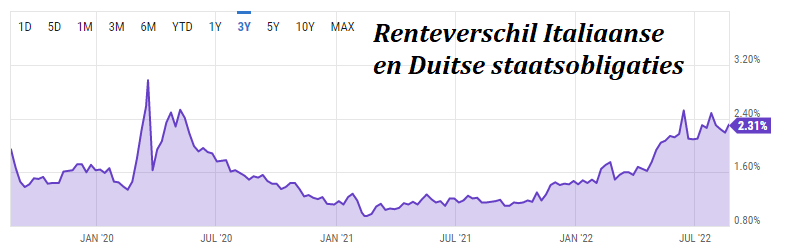
Interest rate differential between government bonds in Germany and Italy (Source: YCharts)
Due to high inflation, the ECB was forced to raise interest rates quickly and discontinue the Pandemic Emergency Purchase Programme (PEPP). The central bank has now stopped its bond-buying program, but is maintaining its balance sheet total by fully reinvesting all government bonds that are redeemed in new bonds.
Until recently, the central bank only did this in bonds of the same countries, so that the composition of the total bond portfolio remained the same. But when the interest rates of the southern countries skyrocketed, the central bank felt compelled to intervene. Christine Lagarde introduced flexibility in the bond-buying program, which in practice meant that she could reinvest the proceeds of repaid bonds as she saw fit. You guessed it, especially in Italian government bonds.
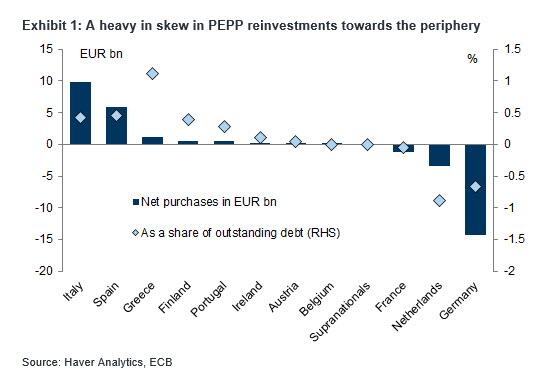
ECB buys more Italian and Spanish loans (Source: Haver Analytics)
The ECB has put itself in a vulnerable position by so ostentatiously supporting Italy's sovereign debt. As a result, there is loud criticism of monetary policy from various quarters. Former central banker Nout Wellink recently wrote a opinion piece for the OMFIF, in which he strongly criticizes the central bank's monetary policy. He warns that the central bank may find itself in a situation where it has to judge whether a certain interest rate hike is "justified" or not.
Hedge funds and investors smell blood and speculate on a further rise in interest rates. In doing so, they implicitly assume that the central bank will not succeed in bringing interest rates back down. The stakes are high, as the ECB's core task is to prevent fragmentation of the European bond market. If the capital market loses confidence in the government bonds of the southern countries, so does confidence in the euro as a safe and liquid reserve.
The ECB must therefore intervene in order to remain credible, but it is now faced with a dilemma from which it will not emerge unscathed. Allowing the market to take its course means a new euro crisis and possibly the break-up of the euro. If the ECB intervenes by buying even more Italian bonds, it will undermine its neutrality. Northern euro area countries will feel disadvantaged, which will put pressure on solidarity between euro area countries.
This contribution was made from Geotrendlines


