English
EN


On April 2, 2025, Donald Trump unveiled his so-called ‘Liberation Day’ tariffs: a sweeping package of import duties intended to reduce the persistent U.S. trade deficit and strengthen the domestic economy. A year later, however, the U.S. trade deficit remains historically large. Are import tariffs really the answer to the U.S. trade deficit? And can gold play a role in restoring balance to world trade?
Trade deficits have increasingly come into the political spotlight in recent years, especially since Trump’s rise. They are more and more often portrayed as a national weakness. Trump, for example, claimed that the United States would gain $1.5 trillion by stopping trade with countries with which it runs a trade deficit. Persistent deficits are increasingly seen not as an accounting outcome, but as evidence of exploitation by foreign countries or poor domestic policy. According to this line of reasoning, these deficits must then be corrected with import tariffs and subsidies.
In practice, countries do not win or lose at trade. Countries themselves do not trade; individuals voluntarily trade with one another because both benefit. A trade deficit is therefore not necessarily a sign of a weak economy. It can coincide with strong economic growth and high levels of investment. Nor is a trade surplus automatically positive: it may, for example, reflect low domestic consumption or capital leaving the country. Trade balances are the result of a broader economic process and provide signals about capital flows, individual preferences and underlying prices.
Although trade balances can remain out of balance for long periods today, they tended to correct themselves under the gold standard. The economist von Mises described how trade balances could not be viewed in isolation from monetary conditions. Under a full gold standard, gold flows into a country when it runs a trade surplus. Imagine buying a loaf of bread while on holiday abroad and paying in euros: the money flows abroad. As additional gold flows into the country, money becomes less scarce and prices and wages rise. This can make the country less competitive, reducing exports and increasing imports. The trade surplus is thus corrected.
The reverse happens when a country runs a trade deficit. A Dutch person buying bread abroad hands over his euro to the baker. As a result, there is less gold in the Netherlands and money becomes scarcer. When money gains value, prices fall and the country can compete more effectively with other countries. Exports then rise, imports fall and the deficit is offset. This is a continuous, dynamic process in which deficits and surpluses respond to changes in prices and capital flows.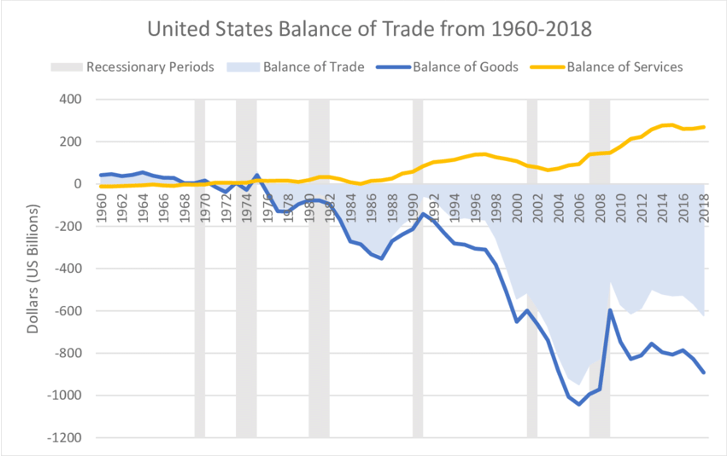
U.S. trade balance after the end of the gold link (1971). Source: ResearchGate.
This mechanism does not depend on central planning, but on monetary flows, individual choices and price signals. However, this automatic process does not work when central banks disrupt it by offsetting gold inflows or outflows through the creation or destruction of money.
Artificial monetary expansion can therefore lead to persistent trade deficits by disrupting the price signals on which this corrective mechanism depends. Artificially low interest rates encourage consumption and investment while reducing the incentive to save. When domestic resources are insufficient to finance this additional demand, more foreign capital flows into the country, allowing the deficit to persist and grow.
Today’s fiat currencies have no automatic monetary correction mechanism like the one under a gold standard. This is clearly visible in the United States. Its persistent trade deficit causes dollars to flow abroad. Because the dollar is the world’s leading reserve currency, those dollars are often held or reinvested in U.S. assets. This allows the United States to sustain a large trade deficit for much longer.
Persistent trade deficits can lead to political instability. When domestic industry comes under pressure, political pressure to protect it grows. Import tariffs may then seem like a logical solution.
Import tariffs do not restore competitiveness, however; they mask the underlying problems. They raise prices, lead to trade wars and distort the allocation of capital. They address the consequences without examining the causes of the problem.
Persistent trade deficits are the result of monetary meddling, such as artificial monetary expansion and low interest rates. The solution therefore lies not in ever-higher trade barriers, but in hard money such as gold, which allows prices, interest rates and exchange rates to adjust without monetary distortions.
(Trump cover photo: Gage Skidmore/Flickr)