English
EN


According to Jack Hoogland, cracks are beginning to show everywhere: rising interest costs are putting governments and businesses under increasing pressure. He expects central banks will soon have to intervene to prevent a severe recession.
This weekend, I saw an alarming article in De Telegraaf about the rapidly rising interest costs on Dutch government debt. The tweet below shows that these interest costs are indeed set to rise rapidly in the coming years, because the government has no longer been able to borrow money virtually for free since 2022. And, of course, because government debt is rising.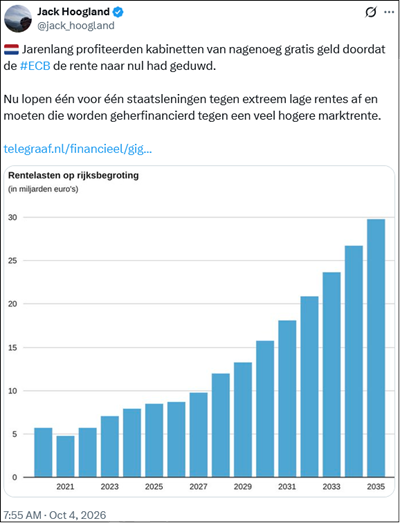
However, the pressure this puts on the Dutch budget is child's play compared with the pressure faced by countries such as France, Belgium, Italy, Japan, the US and a host of other countries with excessively high levels of government debt. On top of that come the rising costs associated with ageing populations.
The tweet below refers to a report by Moody’s, which warns of ever-increasing pressure on public finances from the rising costs associated with ageing populations.
Population ageing is a major problem in Europe, the US, Japan, China, South Korea and a host of other countries. It means that countries with excessively high levels of government debt are already caught in a vicious cycle of rising costs, rising interest expenses and government debt growing at an ever-faster pace. The only way to put off these problems a little longer is to bring interest rates down sharply.
The tweet below shows that businesses are also being hit hard by the rapid rise in interest rates.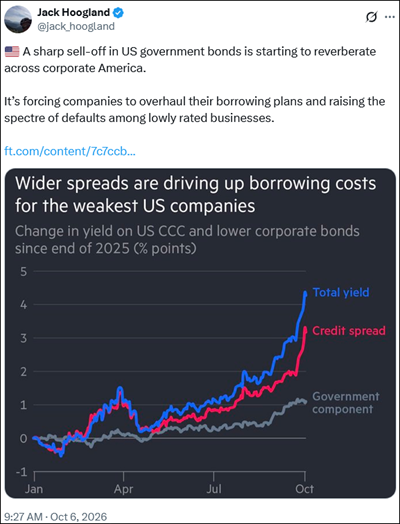
Companies are cutting costs and reducing investment, while financially weaker businesses face a sharply increased risk of bankruptcy. This leads to a significant weakening of the economy or even a severe recession.
Both central bank policy rates and yields on long-term government bonds need to fall sharply to prevent a severe recession. And the latter is only possible if central banks start printing large sums of money to buy government bonds. The ECB and the Federal Reserve will soon introduce monetary stimulus, causing the global amount of paper money in circulation to grow at an accelerating pace.
This gives us every reason to expect the next rally in gold, silver, copper and uranium to begin soon. And we expect that rally to be very strong indeed.