9.3
8.064 reviews

English
EN


In the Previous piece In the series on monetary history, the sensitive loss of the Dutch Central Bank (DNB) after the abandonment of the gold standard was discussed. This loss was not repaired until just before World War II. The war would have major consequences for the Dutch economy, but also for the guilder. How did DNB and its gold reserves fare during the war? And how was monetary policy conducted during the war?
Although the Netherlands was a plundered country in 1945, at the beginning of the occupation the Dutch economy entered a boom reminiscent of that of the 'roaring twenties', as can be read in the book 'De Nederlandsche Bank' by Wim Vanthoor. This was due to a larger number of orders from Germany, but also because the Dutch population purchased additional resources. In addition, the government expanded considerably. The Reichsmarks that the Netherlands obtained through exports to Germany were exchanged with the Dutch Central Bank, which also had more room to provide loans. This was due to the large foreign exchange portfolio, as described in a Earlier article.
Economically, things were actually going quite well in the years 1940 and 1941. Dark clouds appeared in the sky later, when our country was suffering from great shortages and destruction. On the monetary front, things began to rumble through the 'Reichskreditkassenscheine'. These were notes that looked like Reichsmarks and were distributed to German soldiers and civil servants. They were printed without restriction and were given the status of legal tender in occupied territories. In Germany, the notes were not allowed to be issued. The Dutch population did not get hold of the banknotes, because DNB immediately exchanged them into guilders, for fear of a confusing circulation of money. This did mean that the money supply increased considerably.
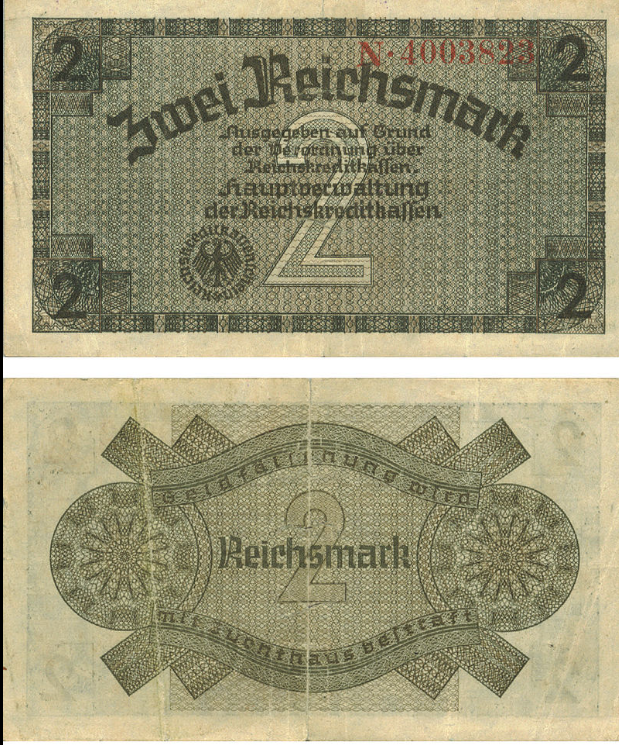 The Reichskreditkassenscheine. (Source: Wikipedia)
As the war dragged on, production in the Netherlands declined due to a shortage of raw materials and the forced employment of Dutch workers in Germany. Food and products were also confiscated by the Germans. The products that were still available went on the receipt. So, on the one hand, more and more money came into circulation, but at the same time production decreased. This type of practice normally leads to inflation, but this was prevented by price controls. As a result, the Netherlands had to deal with a floating purchasing power that amounted to as much as 50 percent at the end of the war; There was twice as much money available as there were products available.
However, the number of guilder banknotes at the Dutch Central Bank declined rapidly. This was due to the fact that the Bank had to exchange more and more German banknotes. In addition, in the last years of the war there was a shortage of fuel and paper. To prevent a shortage of banknotes, the National Socialist Rost van Tonningen proposed to print banknotes elsewhere or to declare the Reichsmark the official currency in the Netherlands. In large cities such as Rotterdam and The Hague, plans were also made to issue emergency money. If the Netherlands had not been liberated in May 1945, old banknotes would probably have been reprinted with extra zeros to solve the shortage of banknotes, according to the book 'A Financial History of the Netherlands'.
This inflationary policy would have been unthinkable at the pre-war Dutch Central Bank. In the period before the Second World War, DNB went down in the books as one of the strictest central banks. However, the German regime during the war turned the Bank into a state-owned bank that no longer had price stability as its primary objective. This process began with the appointment of a German Kommissar, who had a direct line to the Reichsbank. At the same time, the president of DNB also became secretary-general at the Ministry of Finance, which diluted the separation between the Bank and the state. Bank President Trip was very displeased with the state of affairs under German rule and resigned in 1941. He was succeeded by the infamous Rost van Tonningen.
In addition to this notorious NSB member, two more National Socialists ended up in the Bank management, which created a kind of conflict. On the one hand, the new board members followed German orders without protest, while the incumbent members resisted as much as possible. Proposals to strengthen the influence of the Bank President were blocked by the old directors, but they could not prevent DNB from actively contributing to the robbery of Jews. Eventually, the old directors also resigned.
After the loss of DNB in 1931, the gold that DNB possessed has been brought back to Dutch soil. Until 1937, almost all of the Bank's gold holdings were located in the Netherlands, but the increasing tensions on the European continent worried DNB. The gold was therefore spread over several foreign locations. In May 1940, more than 80 percent of Dutch gold was already in foreign vaults. At the beginning of the occupation period, the Dutch population was obliged to sell the gold to DNB for 2009 guilders per kilo. The gold that was not sold voluntarily was requisitioned. The gold was then sold to the Reichsbank against Reichsmarks.
During the war, 146,000 kilos of gold disappeared to Germany. After the war, a treaty was concluded that settled the gold question. To this end, the Tripartite Commission for the Restitution of Monetary Gold the commission that would deal with the gold claims. However, the Netherlands only got back part of the claimed gold. The committee had determined that countries would only get back the monetary gold, which amounted to 72,000 kilos of gold for the Netherlands; half of the gold that had disappeared from the Netherlands. In protest, the Netherlands refused the third allocation of 4,000 kilos of gold.
The Netherlands had come out of the war as a plundered country. Later calculations estimated the value of the products withdrawn from the Dutch economy during the war at 10 billion guilders, expressed in 1938 prices. Since the Gross National Product at the time was still 6 billion, this was a huge damage. In the next article, we will take a closer look at how the Netherlands was rebuilt after the war.
Have a look at us YouTube channel
On behalf of Holland Gold, Paul Buitink and Joris Beemsterboer interview various economists and experts in the field of macroeconomics. The aim of the podcast is to provide the viewer with a better picture and guidance in an increasingly rapidly changing macroeconomic and monetary landscape. Click here to subscribe.


