English
EN


New money creates winners and losers. Those who receive it first can still buy at the old prices, while others face higher prices before their incomes rise. How does this so-called Cantillon effect work, and what does it mean for our purchasing power?
Although the consensus today is that new money in an economy leads to a proportional increase in prices and therefore has a neutral effect, Cantillon argued that it enters the economy at specific points and consequently has an uneven effect.
Imagine that gold and silver mines are discovered in a town. Large quantities of gold and silver are mined. Just as owners, entrepreneurs and employees of ordinary businesses benefit from higher profits, so do those involved in the mines. This extra money enters the economy through spending or lending. In an economy where gold and silver are used as money, higher mining profits therefore lead to additional spending. These households begin consuming more and buying more luxurious goods. They eat more meat, drink more wine, buy higher-quality clothing and improve their homes. As a result, tradespeople such as butchers, tailors and carpenters also benefit. They receive more work and orders than before and consequently increase their own spending.
As these people consume more, less wine, high-quality clothing, meat and home improvement services remain available to the rest of society. Supply therefore decreases. This stronger-than-usual demand consequently drives up the prices of these goods and services. As prices rise, farmers, for example, begin using additional land to produce more meat or wool. This generates extra profits for them, and they too begin spending more. The first recipients of new money can therefore still buy these goods at the old prices, before the additional demand has driven prices up. As the new money spreads further through the economy, more and more people gain access to it only at a later stage, when prices have already risen. Ultimately, someone may therefore receive less new money than they need to keep up with higher prices. It now also becomes clear why new money can disadvantage people: those outside this chain or near its end receive the extra money later, if at all, but already have to pay the higher prices. Their share of the consumption of these goods therefore declines.
Cantillon therefore explains that people on fixed contractual terms, such as landlords and employees, are hit hardest by this additional consumption and the accompanying price increases. Landlords, for example, have limited scope to change the rent during the term of their contract, while the cost of paint or a plumber does rise. Once the fixed-term rental agreement expires, however, landlords can raise the rent in line with the higher prices and thus still benefit. Since rising prices mean they can consume less on the same income, landlords and employees will subsequently seek compensation through higher rents and wages. If this compensation falls short, some of them may choose to emigrate and settle elsewhere. As part of the population leaves, labour shortages may arise, which can push wages up further.
The creation of new money therefore produces winners and losers. This can also be seen in the recovery from the COVID-19 recession. Businessnow reported that approximately 20% of all dollars ever created were printed in 2020. Businesses that benefited quickly from this new money recovered quickly, while those adversely affected further down the chain are left behind and struggle with higher costs. The effect therefore shifts not only income but also demand within the economy. Sectors that receive the new money first experience additional demand and can consequently grow faster.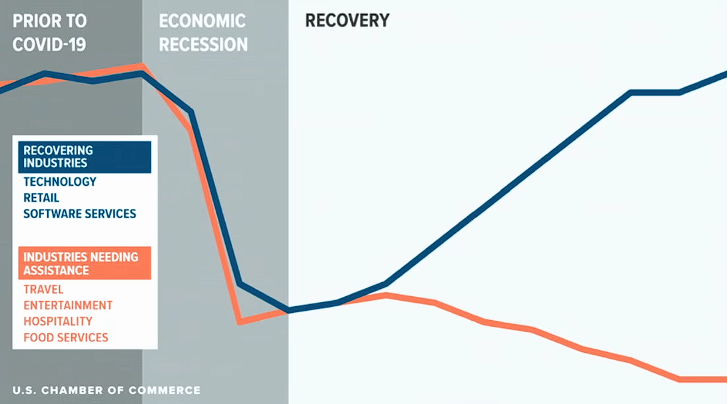
K-shaped economy: winners and losers. (Source: U.S. Chamber of Commerce)
Cantillon thus described how this effect can also occur under a hard money system. However, the consequences are on a different scale from those under fiat money. Producing gold and silver requires considerable time, labour and capital. For every kilogram of gold mined, the mining company must first cover all its costs before any profit remains. With fiat money, by contrast, the cost of creating new money is virtually zero. Gold and silver are also scarce: only a limited quantity is added each year, whereas fiat money has no natural constraint on its creation.
New money therefore creates winners and losers and can contribute to a K-shaped economy. Those who gain access to the new money first benefit, while savers, bondholders, employees and sectors outside the flow of money are left behind. Anyone who wants to be on the winning side of the K would therefore do well to focus on scarce assets and sectors that benefit from new flows of money. When it comes to money creation, the principle is ultimately: first come, first served.