9.3
8.064 reviews

English
EN


Since the collapse of Silicon Valley Bank in the United States, the US central bank has had to intervene again to restore calm to the financial markets. On 12 March, the central bank, in consultation with the US Deposit Insurance Scheme and the Treasury Department, decided to suspend all savings in these banks. guarantee. In addition, the Federal Reserve opened a new emergency window, which can provide liquidity to banks in distress.
Banks took full advantage of this, because within three days there was already more than $150 billion in liquidity Requested. What does this mean for the Fed's monetary stance? And what consequences does this have for the financial markets in general and the prices of precious metals in particular?
The task of a central bank is to safeguard the stability of the monetary system. To this end, she has various instruments. When money was still exchangeable for gold, the central bank could fulfill this role by providing temporary gold if a commercial bank did not have enough gold available to meet all its obligations.
Today, gold no longer plays an active role in the monetary system. The Federal Reserve can simply open its balance sheet to provide liquidity. She can do this in different ways. For example, by buying bonds through quantitative easing or by temporarily taking them over from banks through so-called Repurchase agreements. Banks then exchange their bonds for money at the central bank, promising to buy them back at a later date.
What is the purpose of these different instruments and what effect do they have on the Federal Reserve's balance sheet? And with the outbreak of a new banking crisis and the opening of the central bank's emergency window, is monetary easing again, as the graph below shows?
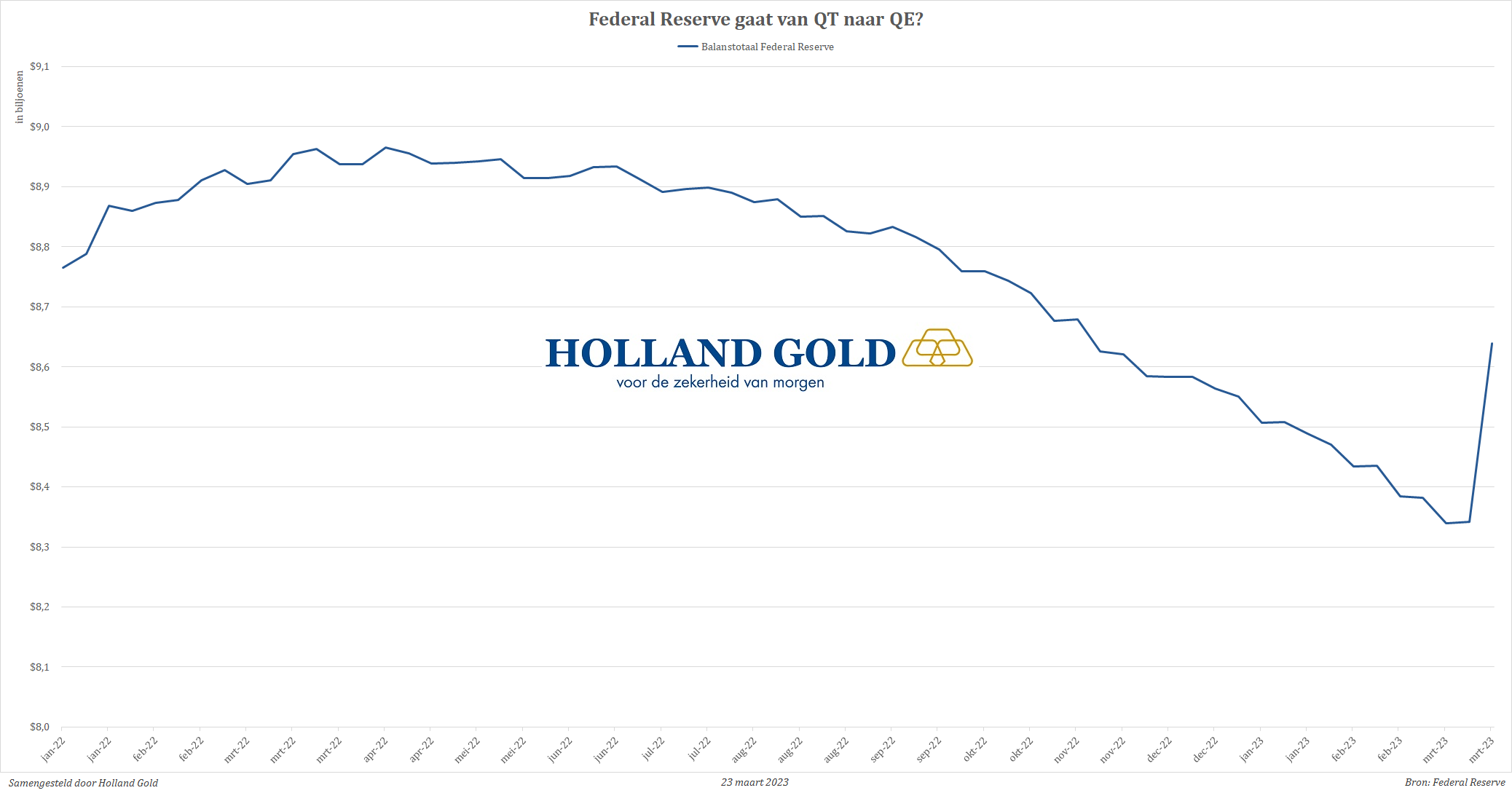
Federal Reserve's balance sheet total skyrockets (Source: Federal Reserve)
In recent years, the balance sheet of the Federal Reserve, as well as that of many other central banks, has grown sharply in size due to monetary easing. For years, the Federal Reserve bought government bonds and government-backed mortgage loans, with the aim of stabilizing the value of these types of loans and keeping interest rates low. An additional effect of this was that banks granted credit more easily and that the economy could grow again.
How addicted the economy had become to monetary easing became apparent in the autumn of 2019, when the reduction of the balance sheet caused a crisis in the repo market. Since April last year, the central bank has been trying to reduce its balance sheet again, but within a year this led to problems again. Bringing government bonds back on the market put further pressure on bond prices, causing problems for banks that now have to sell bonds.
As the chart below shows, the Federal Reserve's balance sheet total has only increased on balance since 2008. During the coronavirus pandemic, the balance sheet size doubled to nearly $9 trillion. In an attempt to bring inflation under control, the central bank began raising interest rates last year and reversing its bond-buying program, but that effort is now partly offset by the new support program for banks.
It is conceivable that the Fed will soon stop reducing its balance sheet and that it will have to buy bonds again with a new round of QE. However, this has not yet been the case.
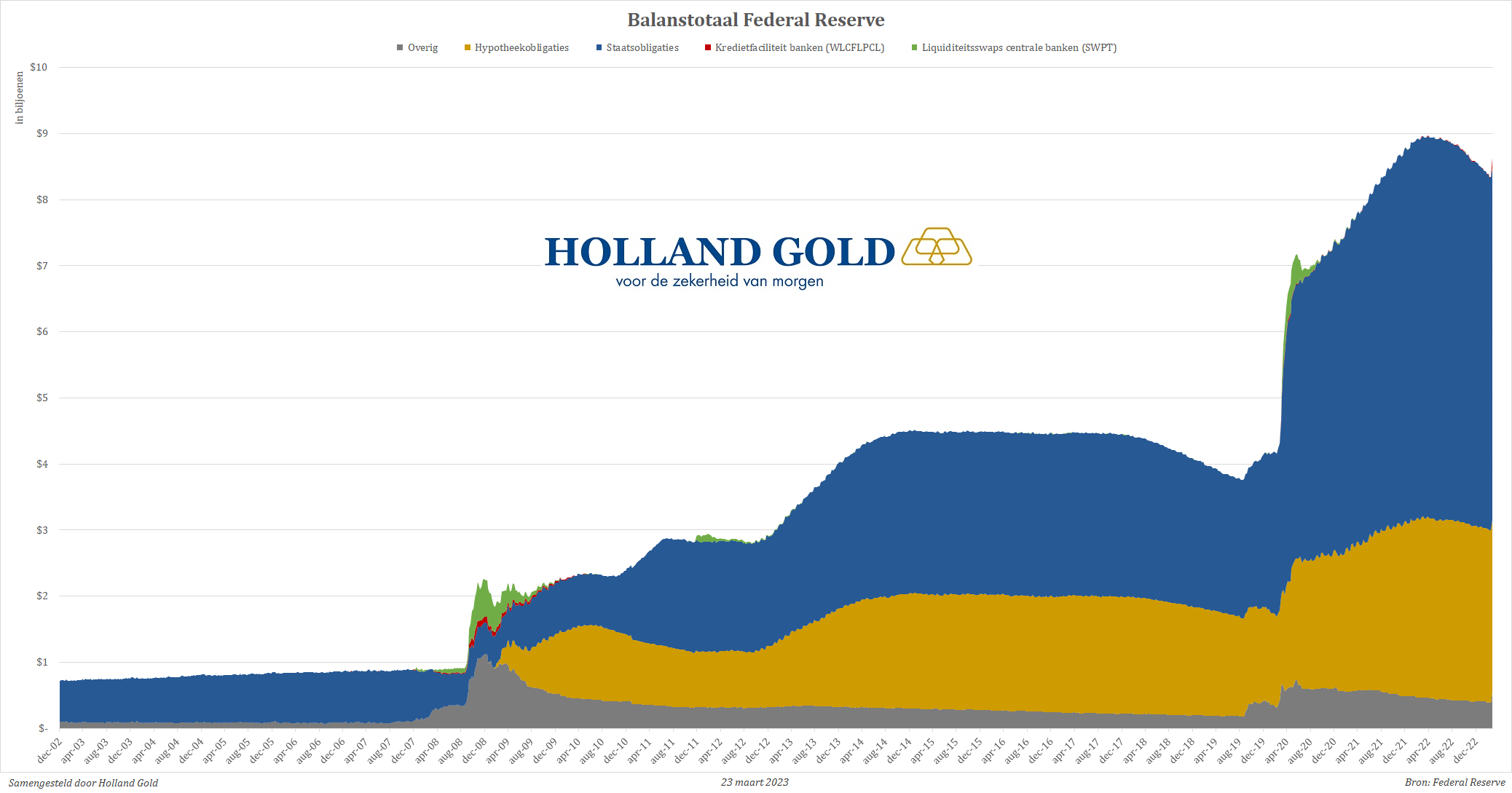
Federal Reserve balance sheet total (Source: Federal Reserve)
The last times the central bank lent money to banks via the emergency window was during the financial crisis of 2008 and the corona pandemic in 2020, as shown in the graph below Credit facility of the Federal Reserve. This is a credit program available to deposit-taking banks that the central bank believes are generally in a sound financial situation.
Primary credit is available in installments ranging from one day to a maximum of 28 days. When providing liquidity, the Federal Reserve must assess whether the borrower remains eligible for primary credit over the life of the loan.
As the graph below shows, the banking crisis of the past two weeks has caused a run on the emergency desk. As of March 15, banks needed $152 billion in liquidity, more than the peak of the 2008 financial crisis. A week later, things seemed to calm down a bit, because on March 22, the total amount had already dropped to $110 billion.
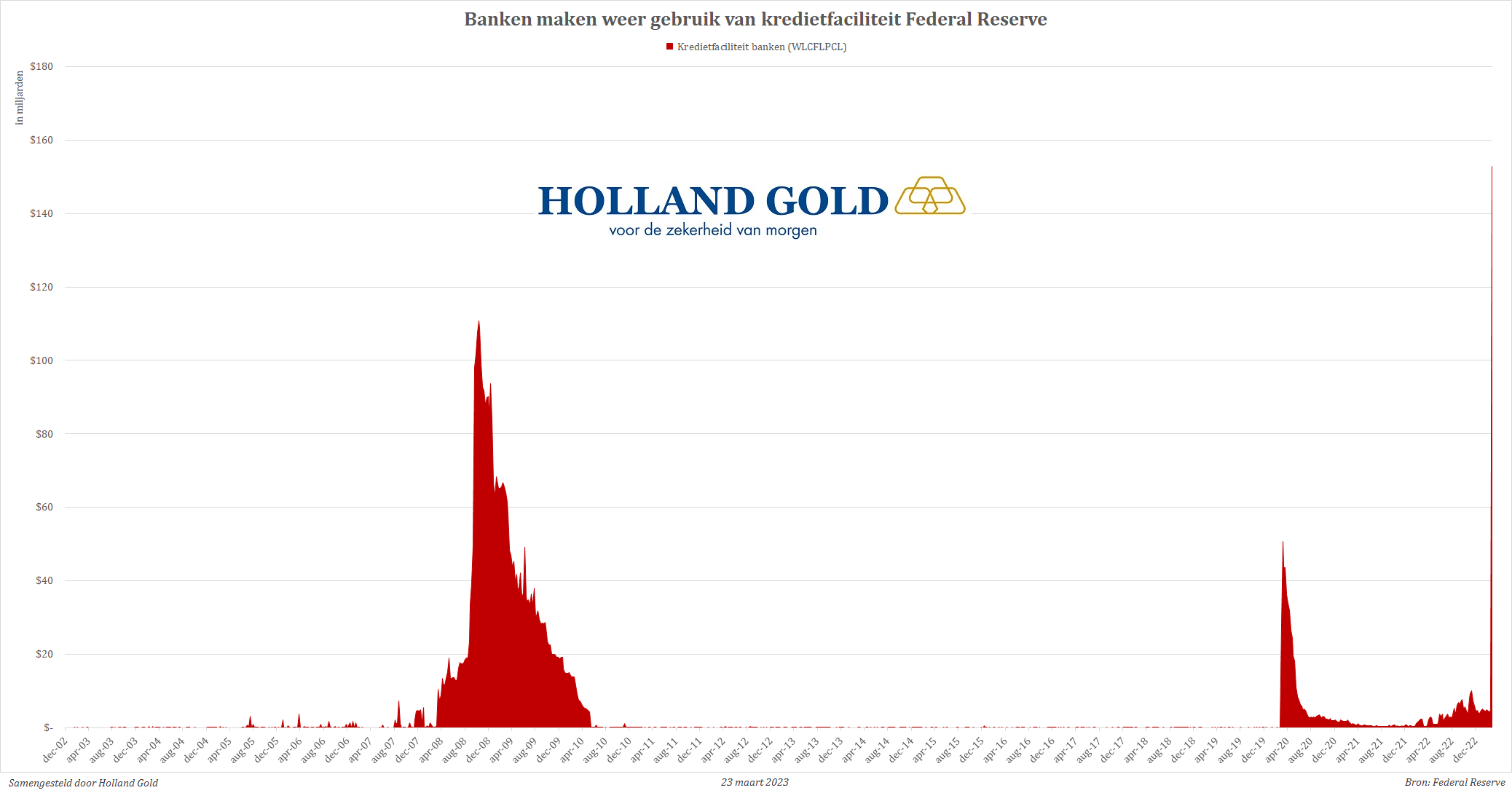
Banks are again using the Federal Reserve's emergency window (Source: Federal Reserve)
It is still difficult to estimate whether the use of this emergency desk will increase further in the coming weeks. After the rescue of Credit Suisse last Sunday, the financial markets seemed to calm down for a while, but on Friday the prices of bank shares were back under pressure. In the United States, the share prices of regional banks such as First Republic Bank and PacWest fell again this week. So it is still too early to conclude that everything is back under control. If the Federal Reserve has to support more banks, the overall balance sheet will increase further.
On March 19, a week after the opening of the emergency window, the Federal Reserve came up with a new press release outward. The U.S. central bank announced that other central banks, such as those of Canada, the United Kingdom, Japan, Switzerland and the Eurozone, will now have daily access to dollar liquidity from the U.S. central bank. This facility already existed, but under normal circumstances it can only be used on a weekly basis.
This one facility has an effect on the Federal Reserve's balance sheet. As the graph below shows, this facility was mainly used in 2008, when the banking crisis spread from the United States to other parts of the world. Central banks in other countries then urgently needed dollars to support their own banking sector, dollars they borrowed from the Federal Reserve.
In 2011 and 2012, this desk was also used at the time of the European debt crisis. During the coronavirus pandemic in 2020, central banks also made use of this window, but not yet at the time of writing. If the banking crisis spreads from the US to other countries, the number of dollar swaps could also increase and so could the Fed's balance sheet.
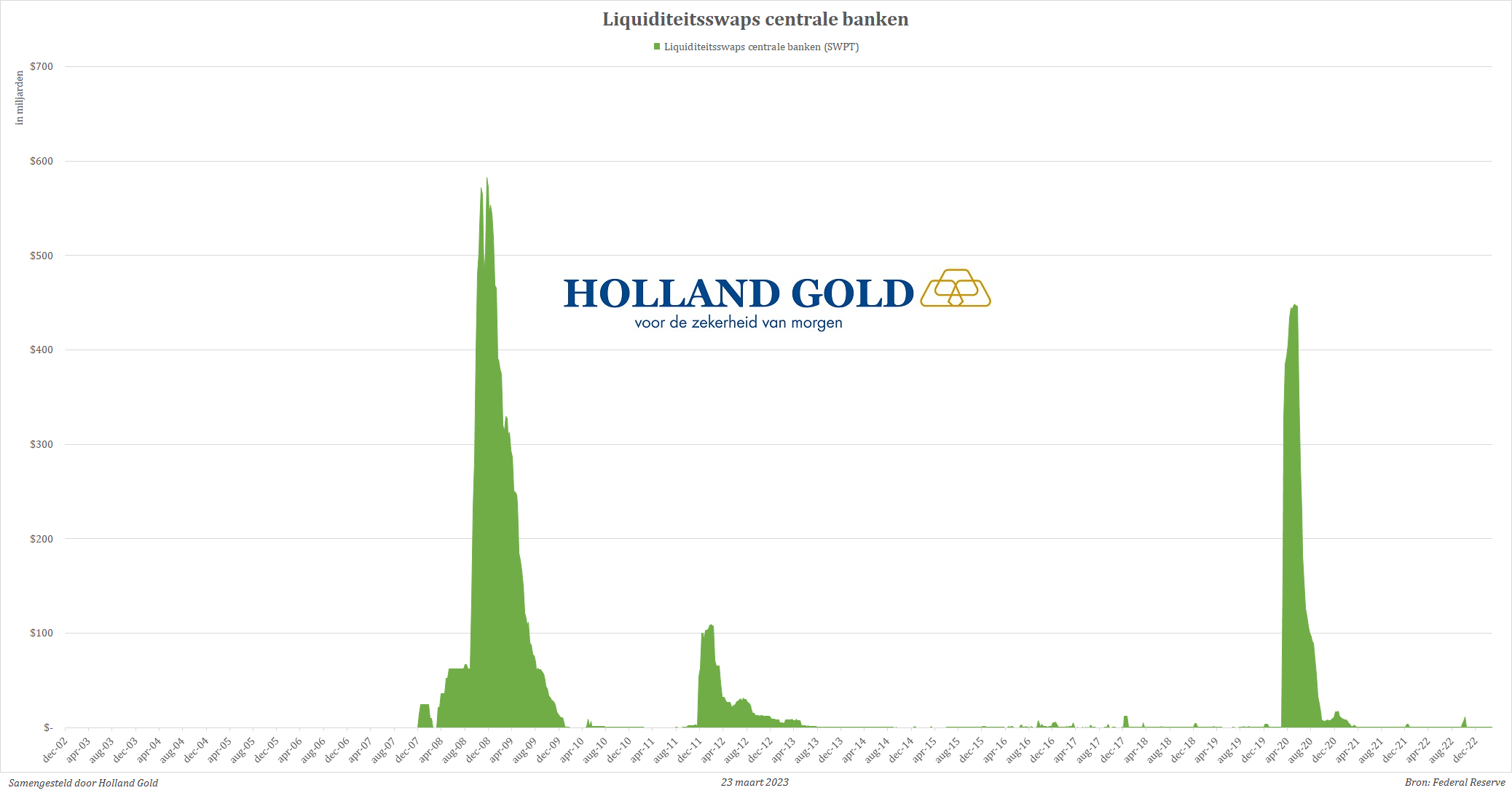
Central bank liquidity swaps (Source: Federal Reserve)
A common misconception is that a growing central bank balance sheet automatically means more money in the real economy. That's not always the case. When the Federal Reserve buys government bonds and mortgages, banks get reserves in return. Reserves that banks cannot lend out and that they cannot use to buy shares, for example. So it doesn't come into the economy as money.
The bank bailout facility is also not inherently inflationary. Banks temporarily exchange their bonds with the central bank for liquidity, but eventually have to return this money. The QE purchase programme did have an indirect effect on inflation, as it made borrowing more attractive and thus stimulated lending.
The fact that the central bank has to intervene again is in itself a much stronger signal for the financial markets. It is a confirmation that our financial system is not so robust after all and that a new crisis is imminent. The fact that in the U.S. all savings are guaranteed instead of a maximum of $250,000 also shows that the authorities are very concerned about a possible bank run.
Due to the central bank's emergency measures, savers and investors are increasingly seeking refuge in precious metals such as gold and silver. We saw the Gold price in response to the developments at Credit Suisse even rise to more than €60,000 per kilo. If the Federal Reserve's balance sheet expands further because it has to support more banks, it will only intensify the flight to precious metals and cause the gold price to rise further.
Do you want toBuy gold by means of Gold bars or Gold Coins? We are happy to help you with your order.


