9.3
8.064 reviews

English
EN


The European Central Bank had to draw more than €1.6 billion from its reserves last year to end the year without losses. The central bank had to write down heavily on the value of all government bonds on its balance sheet, because they have become less valuable due to the rise in interest rates. The central bank also paid much more interest on bank reserves, a side effect of monetary policy. But how exactly did that loss come about? And what does this mean for the ECB's creditworthiness?
These figures come from the Financial statements presented by the ECB at the end of February. These results did not come as a surprise, as the central banks of the Netherlands, Germany and Belgium had previously warned of financial setbacks as a result of rising interest rates. As a result, interest income has fallen, while interest charges have risen at the same time. As the chart below shows, it took a transfer from the reserves to compensate for these losses by the ECB.

The ECB withdrew more than €1.6 billion from its reserves to absorb losses (Source: ECB)
In recent years, the ECB has significantly expanded its balance sheet to include bond purchases. In the spring of 2020, the central bank announced the Pandemic Emergency Purchase Programme (PEPP) to support financial markets during the coronavirus crisis. Together with the ongoing Public Sector Purchase Programme (PSPP), the ECB's own balance sheet grew to almost €700 billion. To be clear, the balance sheet of the Eurosystem - all the central banks in the currency union combined - has been €8 trillion much bigger.
In recent years, the ECB has bought a lot of government bonds at increasingly lower interest rates. Since the corona pandemic, in many cases even against Negative interest rates. Many of these bonds on the central bank's balance sheet have maturities ranging from a few years to even more than a decade. This means that a large proportion of the bonds on the balance sheet yield relatively little interest.
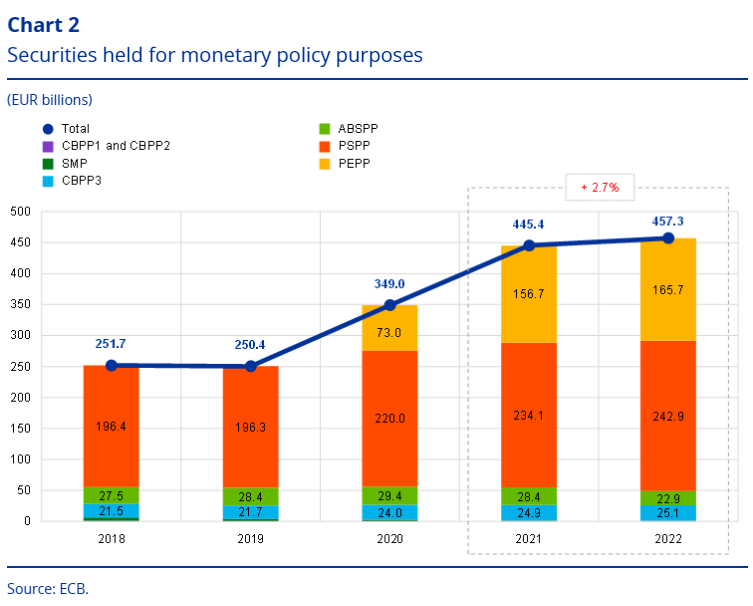
ECB has bought a lot of bonds in recent years (Source: ECB)
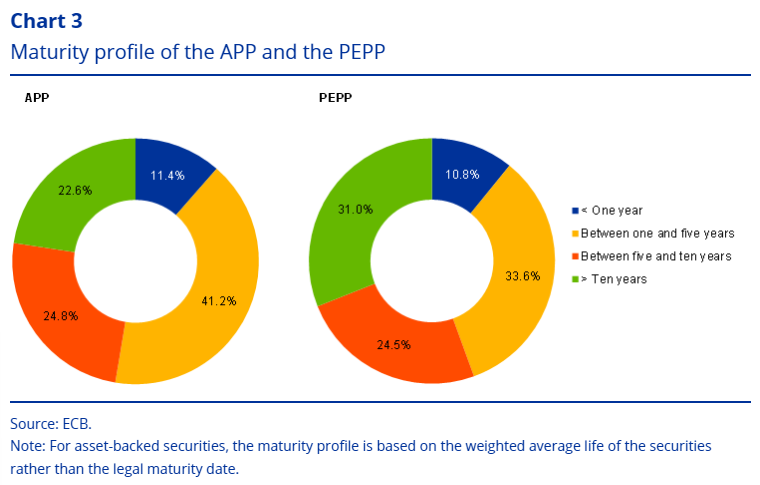
ECB bought bonds with mostly long maturities (Source: ECB)
These bonds that the ECB has placed on its balance sheet are also offset by liabilities, namely bank reserves that commercial banks have received in exchange for these bonds. During the coronavirus pandemic, the ECB applied a deposit rate of -0.5% for these reserves, which meant that commercial banks had to pay interest to the central bank on these reserves. As a result, the central bank's asset purchase program has even been profitable in recent years.
That situation was completely reversed from the summer of 2022. In July, the ECB raised interest rates to curb skyrocketing inflation. Interest rates went up by 50 basis points, only to rise by another 75 basis points two months later. This was followed by more large interest rate jumps, as a result of which the deposit rate now stands at +2.5% interest. This means that the central bank is now paying much more interest on these reserves.
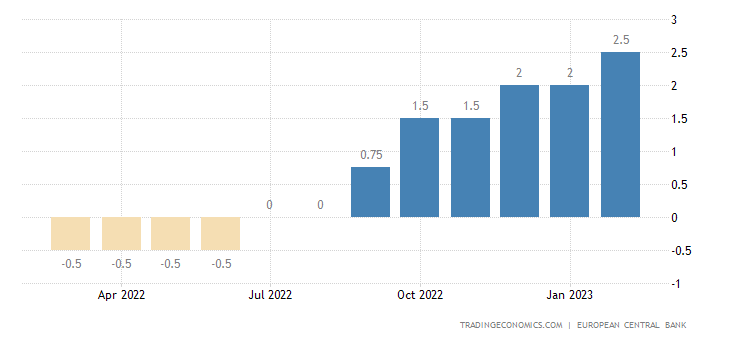
ECB deposit rate has risen sharply since July 2022 (Source: Trading Economics)
This mismatch of lower interest income and higher interest costs will be reduced in the long run, because the central bank will be able to roll over the repaid government bonds at a higher interest rate. But this year, the ECB recorded a large loss, which meant that it had to draw on its reserves to wipe out the loss for accounting purposes.
As the first graph shows, the loss for 2022 is mainly the result of write-downs on the bond portfolio. Due to the rapid rise in interest rates, governments are now paying much more to borrow on the capital market. New bonds offer a much higher interest rate than those of two years ago, which has made those old bonds much less interesting. For example, Germany now pays 2.66% to borrow for ten years, compared to -0.2% at the end of 2021.
Rising interest rates mean that the market value of these bonds is falling. For 2022, this amounts to a write-off of €1.84 billion, as shown in the graph below. The largest part of this is accounted for by bonds issued by euro area countries, a smaller part by bonds denominated in foreign currencies. These write-downs are only accounting losses, because they are only realized when the central bank has to sell the bonds prematurely. If the ECB leaves them on its balance sheet, it will get the full amount back at the end of the term and there will be no loss.

ECB has had to write down a lot on its bond portfolio (Source: ECB)
Central banks have a different function in the financial system than commercial banks. Where a commercial bank is profit-oriented, a central bank can operate at a loss or even with negative equity for a longer period of time. continue to function. That's because, unlike commercial banks, a central bank doesn't have assets on demand. A central bank can also proverbially 'print money' to meet all obligations in its own currency.
As a rule, central banks build up buffers in the years they make a profit, so that they can draw on them when there is a loss. If the losses persist for longer and exceed the financial buffers, a central bank must raise new capital. The central bank then has to call on governments for a capital injection. At a time when interest rates are rising and public debt is skyrocketing, this could also put pressure on public finances.
An alternative route that central banks can take is to upgrade the gold supply, for example by buying gold on a large scale and increasing the Gold price to increase the number of people who want to move on. In that case, the increase in the value of the gold stock can compensate for the loss of value on, for example, government bonds.
Also Read:


