English
EN


While all attention is focused on government debt, a much larger mountain of debt remains largely out of sight: household debt. In the Netherlands, this private debt is considerably higher than government debt. De Nederlandsche Bank has previously warned that excessive debt poses a risk to the economy, and with interest rates remaining high, more and more households are feeling the financial squeeze. How significant is this risk, and what does it mean for households and the economy?
The Netherlands has relatively stable government debt compared with other countries. It is one of the few countries that remain within the European Union’s agreed fiscal rules, with government debt at 44.4% of GDP. On the other hand, Dutch households have one of the highest levels of private debt. De Nederlandsche Bank writes, for example, that the Dutch are among the leaders in mortgage debt. Total mortgage debt exceeded €890 billion at the end of 2025. DNB identifies the overheated housing market as the main reason for these high debt levels. Households are taking on increasing financial risk to finance a home: first-time buyers are also the most likely to borrow the maximum amount permitted relative to their income. Although borrowing limits apply, some households are still left with little financial room for manoeuvre.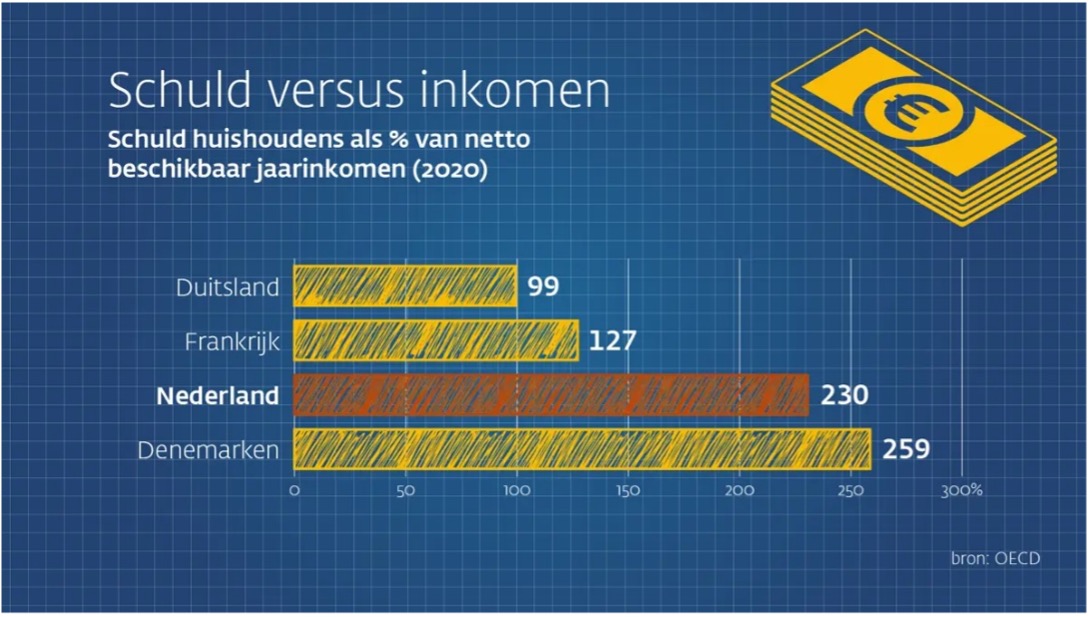
Debt versus income. (Source: De Nederlandsche Bank)
This creates economic risks. Households that borrow heavily and spend a large share of their income servicing that debt are less able to absorb financial setbacks, such as unemployment. DNB also reports that falling house prices pose a risk when households borrow the maximum amount. A home can quickly fall into negative equity, with the outstanding debt exceeding the value of the property. If the home has to be sold during that period, a residual debt remains. The impact also extends beyond households to the wider economy. Because borrowing is so extensive, our economy and house prices fluctuate more sharply than those in other countries. During good economic times, we can borrow substantially more, and house prices rise. This also creates the so-called wealth effect: people spend more when their assets, such as shares and homes, increase in value, even if their income remains unchanged. As people save less and spend more, the economy grows faster. This effect also works in reverse: when share prices or house prices fall, people spend less, and the economy can suffer an additional blow, as it did during the eurozone crisis of 2009–2013.
Interest rates have also risen sharply in recent years. The mortgage interest rate stood at just 1.05% in 2021 and has since climbed to around 4.1%. De Hypotheker conducted research into the impact of higher interest rates on monthly payments. Although 76% of borrowers opted for a fixed-rate period of 16 years or longer between 2016 and 2021, they will face higher monthly payments once that period ends. De Hypotheker calculated several scenarios. For a mortgage of €450,000 (€250,000 on an annuity repayment basis and €200,000 interest-only), with an interest rate rising from 2.4% to 4.05%, gross monthly payments increase from €1,375 to €1,805, while net monthly payments rise from €1,116 to €1,322. For now, the additional mortgage interest tax deduction helps keep net payments down.
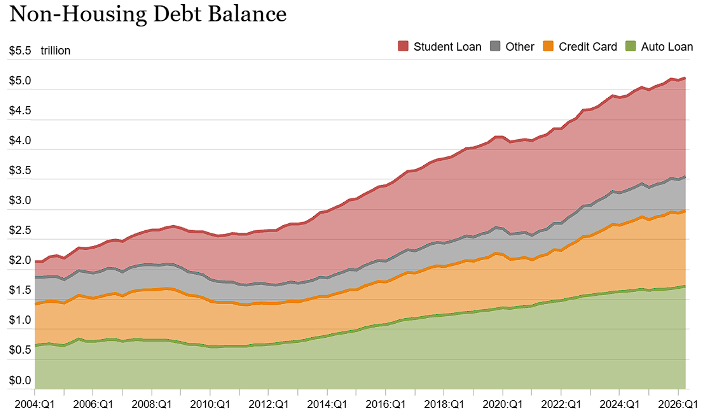
Non-housing debt in the US. (Source: newyorkfed.org)
While Dutch households’ private debt consists mainly of mortgages, Americans also have substantial debts beyond their mortgages. Student loans, in particular, are rising sharply. Typically, people borrow more when interest rates are low and confidence in the economy is high. Strikingly, consumer confidence in the US has been falling continuously since 2022. Taking on debt certainly does not have to be a bad thing. When confidence in the economy increases, people are more likely to take on long-term commitments such as a mortgage. On the other hand, it is a bad sign when loans are taken out to supplement income.
The latter appears more likely to be the case. Credit card arrears have risen sharply since 2022, offering a telling glimpse into Americans’ finances.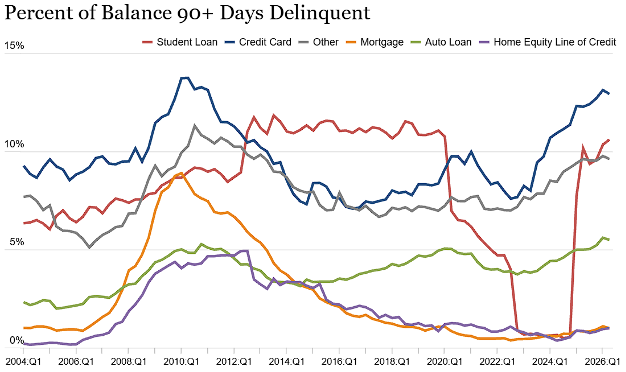
Overdue payments in the US
Although attention today is primarily focused on government debt, high levels of private household debt also pose a risk to the economy. Rising interest rates can increase monthly payments, while heavily indebted households are more vulnerable to economic setbacks. High debt levels are not necessarily problematic, but debt that does not contribute to future income and productivity is a cause for concern. In particular, the rising number of overdue payments provides insight into the financial pressure households are experiencing.