English
EN


Chinese gold imports are at their highest level since 2017, at 1,141 tonnes. By August, the country had already imported more gold than in the whole of 2025. Combined with robust ETF inflows, this gold demand is supporting a strong gold price that is withstanding the headwinds from higher interest rates. Analysts say it is remarkable that gold remains so strong despite the Fed’s rate hike and higher interest-rate expectations. What is driving this?
Yes, Chinese gold imports have risen sharply since 2020. After a decline in 2025 as a result of high gold prices, Chinese demand for gold is now surging to a new record. The explanation? Lower gold prices and a strong yuan are providing significant support for gold, which is popular among Chinese investors. Both Chinese investors and the Chinese central bank (PBoC) are major buyers. In August alone, Chinese gold ETFs added 44 tonnes of gold, 18% more than the previous year, while in the same month the PBoC bought the most gold since 2023.
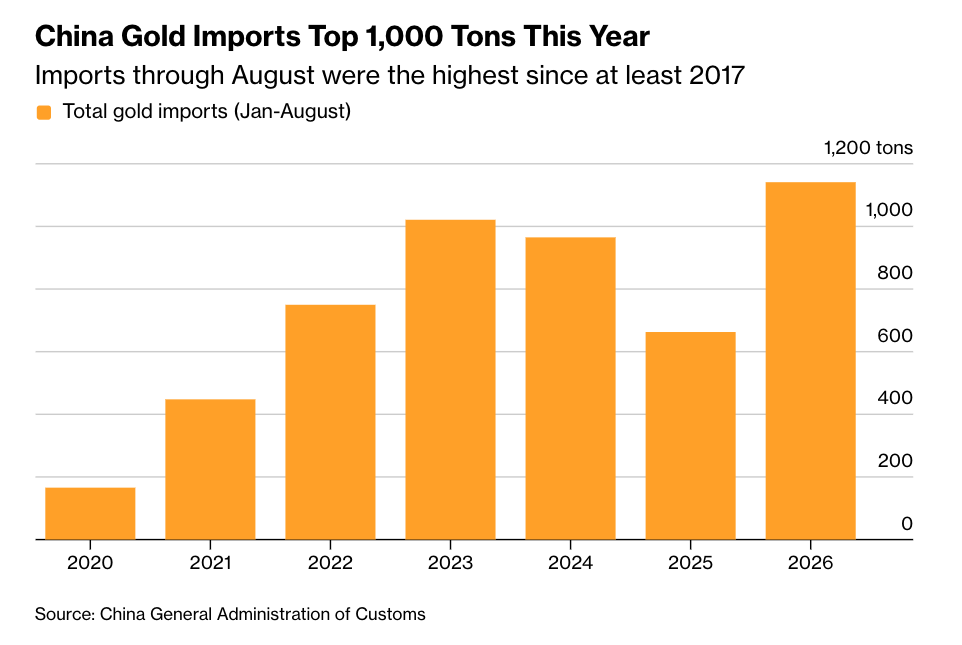 Gold imports in tonnes from January to August. (Source: Bloomberg).
Gold continues to face headwinds from higher interest-rate expectations and higher oil prices. Last week, the Fed, the US central bank, raised its policy rate. Several analysts and journalists subsequently questioned aloud how the Fed can fight inflation by slowing the economy when that inflation is being driven by entirely different factors. US inflation is being driven by three things: high oil prices, Trump’s import tariffs and the enormous investments in AI. Trump certainly does not want to put the brakes on the latter.
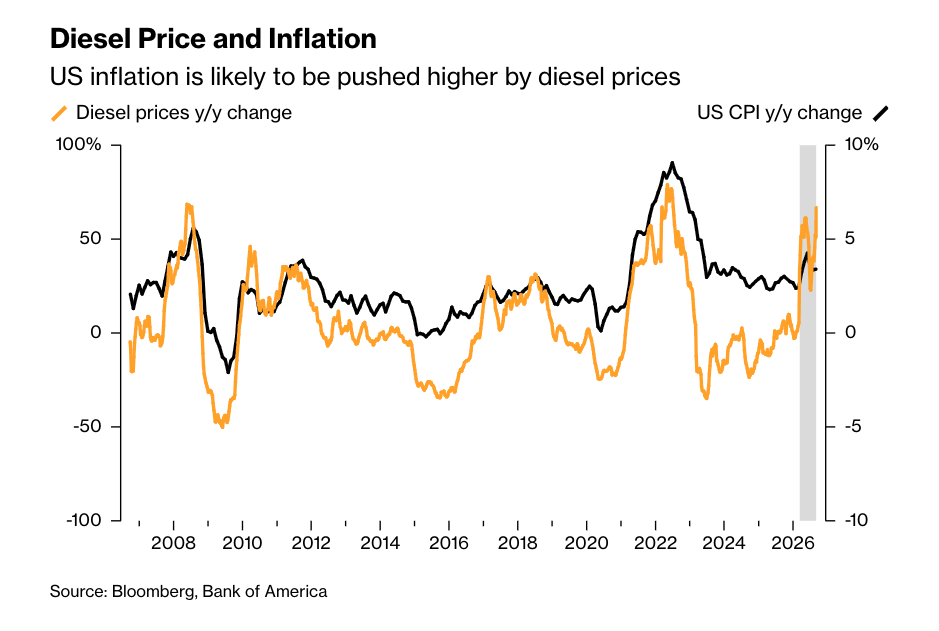 Higher diesel prices (year-on-year percentage change) shown by the yellow line and US inflation (CPI) (year-on-year percentage change). (Source: Bloomberg).
Last week, we saw the remarkable call from the CEOs of Anthropic (Claude) and OpenAI (ChatGPT) to slow AI development in order to contain the risks of AI. In his speech to the United Nations General Assembly, however, Trump made clear that he had no intention of limiting the growth of a development that is bigger than the Industrial Revolution.
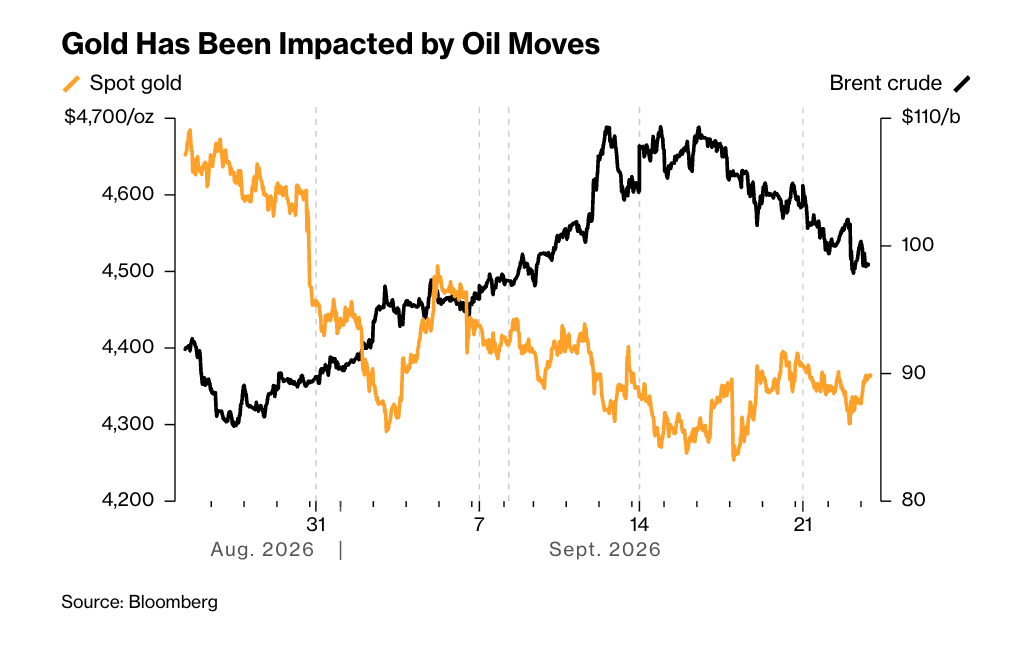 Gold price shown by the yellow line in dollars per troy ounce (31.1 grams). Brent crude oil price shown by the black line. (Source: Bloomberg).
In stark contrast to the purpose of the United Nations, Trump issued new threats against Iran in his speech to the UN: “Will there be a deal with Iran that gives the country the opportunity to rebuild itself and become stronger than ever, perhaps even grow into one of the most important countries in the Middle East or the world, or will I destroy the Islamic Republic, and quickly?” Trump said.
Ongoing tensions in the Middle East are keeping oil prices high and increasing the likelihood of another rate hike. This is widely seen as a headwind for gold. Despite Trump’s strong rhetoric on 22 September, a day later there was once again news of possible renewed negotiations between the US and Iran. For now, gold and oil appear to be moving in opposite directions.
Gold is “holding up remarkably well” following the rate hike and the hawkish outlook, Ryan McKay, an analyst at TD Securities, wrote in a note. “Although a cycle of rate hikes is already priced into the market, the outlook for precious metals remains very favourable across the board,” McKay said. According to him, short-term weakness is “increasingly being viewed as a buying opportunity”.
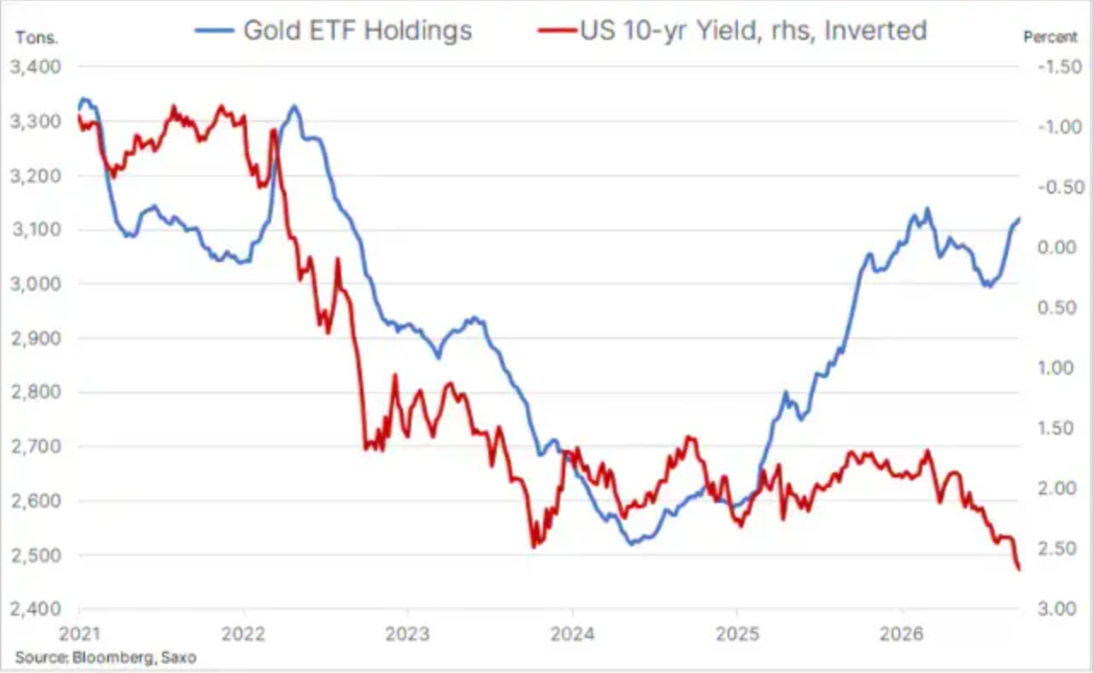 Gold ETFs (in tonnes), shown by the blue line, are increasing while the US 10-year yield rises (note that the red line shows the inverted percentage, so a falling red line represents a higher yield). (Source: Kitco).
According to Saxo Bank analyst Ole Hansen, something else remarkable is happening. Historically, the gold price falls when real yields on US 10-year Treasuries rise. That relationship, however, appears to have broken down. “The real yield on US 10-year Treasuries reached 2.63% on Friday, its highest level in more than twenty years. That is 76 basis points higher than at the beginning of the year, while total assets in gold-backed ETFs [actually] continued to recover,” Hansen wrote in a recent analysis.
The fact that not only the gold price, but also gold ETFs, no longer appear to be sensitive to higher 10-year yields is an important signal. It means that investors continue to see compelling reasons to invest in gold.
“One possible explanation is growing concern about the sustainability of public finances and rising national debt,” Hansen said. “Investors may no longer view higher bond yields as an attractive alternative to gold, but instead as a signal of increasing fiscal risks, higher financing costs for governments and potential pressure on financial stability. Seen in that light, gold may actually become more attractive as an investment outside the traditional financial system.”
These are some of the key dates to watch in the coming period: