9.3
8.064 reviews

English
EN


The financial markets started the week with some volatility. Investors are concerned about the speed at which central banks are raising interest rates, the British government's support program and Italy's change of political course. Geopolitical tensions are also flaring up again and there are more and more signs of a new recession. In this article, we will discuss the most important news facts.
The British government unveiled new plans to support the economy on Friday. With £45 billion in tax cuts and £60 billion to cap energy prices for households, the government is trying to restore citizens' purchasing power. But the support programme was not well received. The financial markets doubt the effectiveness of a number of measures, such as lowering taxes on the highest incomes and allowing bonuses in the banking sector. According to Prime Minister Liz Truss, these tax breaks should trickle down to the rest of the economy, but that theory does not convince most Britons.
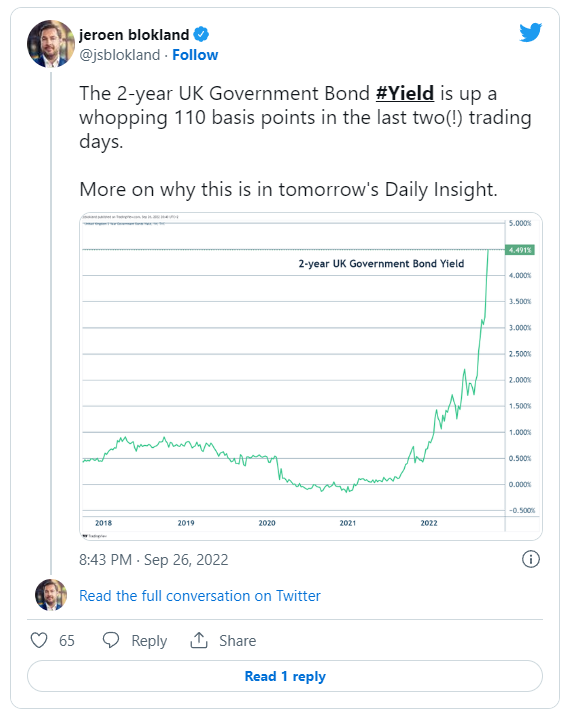
In addition, investors are questioning public finances. Never before has the government come up with such a large fiscal support programme, while the British economy is not exactly in a strong position. The market is doubting the government's creditworthiness, as the British pound tumbled down 4% in a day to its lowest level since 1985. At the same time, Treasury yields skyrocketed. For example, the 2-year yield rose by more than a percentage point to 4.49% in two trading days. By comparison, in 2021, the same bond still had an interest rate of 0%.
The depreciation of the currency makes it more expensive for the British to import goods, which will further fuel price inflation. The rise in interest rates also has an impact on the economy. Due to the extreme movement in interest rates, a number of financial service providers have decided to temporarily No mortgages to offer more. Due to the uncertainty in the market, it has become much more expensive to fix interest rates for a longer period of time. The interest rate is determined by the interest rate on short-term government bonds, which has risen unprecedentedly in recent days. Due to high interest rates, mortgages have already become less attractive. In the United Kingdom, there are almost no providers that provide a mortgage loan for less than 5%. From a historical perspective, that's not an extreme interest rate, but at current house prices, affordability is significant Deteriorated. This does not bode well for the economy, because housing costs are rising and house prices are very likely to fall due to high interest rates. As a result, the wealth of many British households is decreasing.
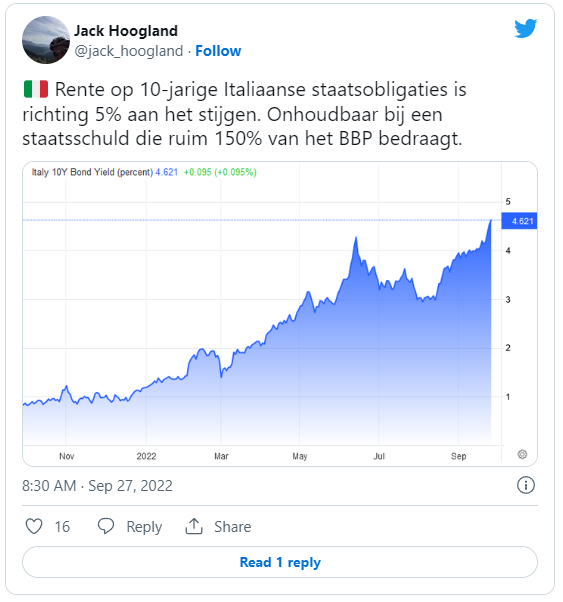
Last weekend, Giorgia Meloni of Italy's national-conservative Brothers of Italy party won a landslide victory in the elections. Together with two other right-wing parties, she can now form a right-wing government, which will take a more conservative course. During the election campaign, Meloni was very critical of political decision-making in Brussels. This creates uncertainty in the financial markets. Italy can claim many billions of euros from the European corona recovery fund. If the country does not receive this money, it could have consequences for public finances.
This is reflected in the financial markets in the form of rising interest rates. The Italian 10-year yield rose to 4.5%, higher than the previous peak last summer. Then the ECB intervened by announcing a new support programme, the Transmission Protection Instrument (TPI). This program enables the central bank to buy government bonds of countries that are facing sharp interest rate rises. The criterion for this support programme is that there are 'unfounded' interest rate increases, an arbitrary and not very transparent criterion. The market continues to test the ECB by shorting Italian government bonds, as we wrote earlier in This article.
Moreover, high interest rates do not pose an acute threat to Italian public finances. Over the past two years, the government has made maximum use of the low interest rates by issuing many more loans with long maturities. As a result, the average interest burden on the total government debt is much lower than the current market interest rate of 4.5%. Interest rates need to remain at this high level for a longer period of time before they have a real impact on public finances. The high interest rates do make it more expensive for the new government to incur a lot of new debt.
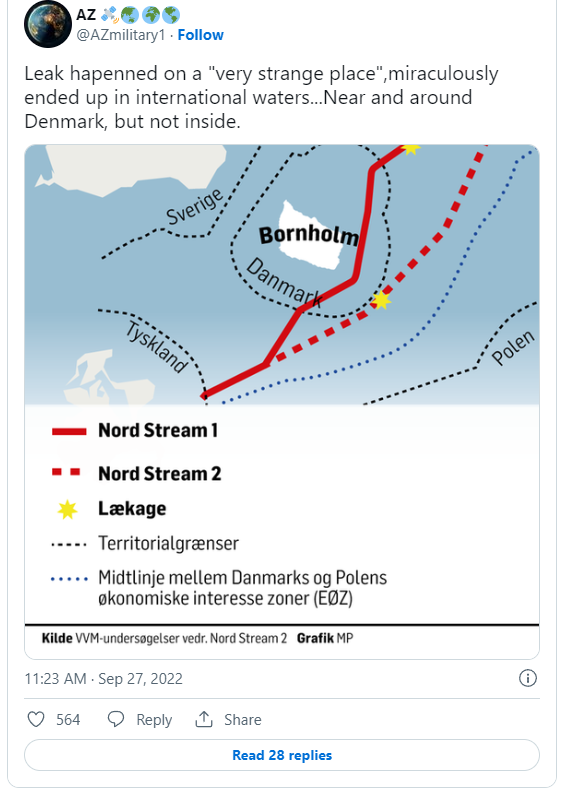
One message that has the potential to have far-reaching implications for the energy market is the damage on both Nord Stream gas pipelines. Leaks have been found in three different places, causing gas to escape from the pipeline and the pressure to drop. The cause has yet to be investigated, but repairing the pipeline will not be easy. This is bad news for European energy security, because Russia can supply a lot of gas to Europe via this route. Various sources speak of sabotage, because it is technically very unlikely that a leak will occur in several places at the same time. The Nord Stream has been in operation since 2012, the Nord Stream 2 was completed but never put into operation.
As a result of this incident, the Gas price by about ten percent to €192 per MWh. The consequences are currently difficult to foresee. An interruption in the supply of gas could jeopardise Europe's energy supply next winter. It will also further exacerbate the geopolitical relations between Russia, Europe and the United States.
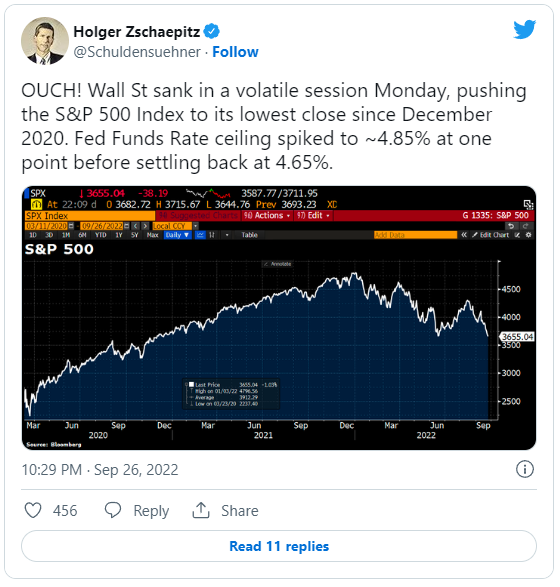
The combination of high inflation, increasing geopolitical turmoil and interest rate hikes by central banks are like a toxic cocktail for the economy and the stock market. According to research firm Ned Davis Research, the probability of a global recession is currently 98%, almost certainly. The last time we saw such a high percentage was during the credit crisis in 2008 and the corona crisis in 2020. And that's reflected in the stock market, because it's heading for the Worst year since 2008. From its peak earlier this year, the US S&P 500 index has already fallen 23%, to its lowest level since December 2020.
The S&P 500 index has been below the 200-day moving average for 110 days now, the longest streak since 2008. And there seems to be no improvement in sight for the time being, because rising interest rates are making equities less attractive compared to bonds. In addition, it is very likely that corporate profits will fall in the event of a recession.
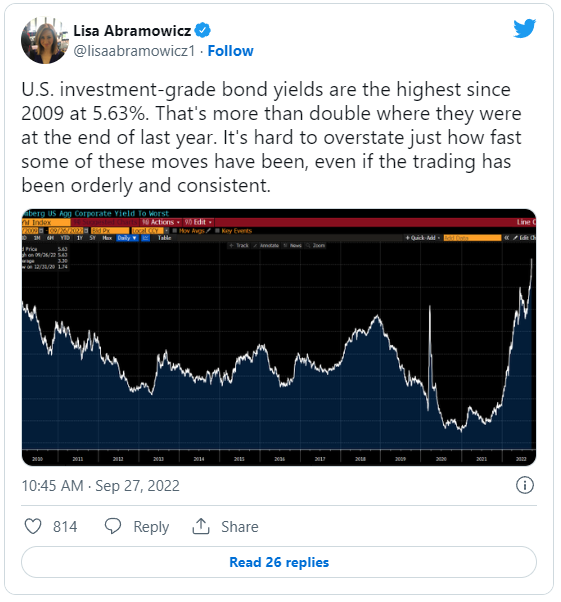
Investors are also demanding an ever-increasing interest rate for corporate bonds. Even the interest rate on high-quality Investment grade Bonds are skyrocketing and are currently at 5.63%, the highest level since 2009. Compared to the end of last year, companies are now paying twice as much interest. The deterioration in financing conditions is therefore also affecting companies. New investments are becoming less attractive and rolling over existing loans is becoming increasingly expensive. It is also becoming less attractive for large listed companies to borrow money and use it to buy back their own shares, a financial ploy that has given a strong boost to share prices in recent years.
As we wrote earlier in This article we are actually already in an economic crisis. Central banks are determined to raise interest rates further and reduce their balance sheets, which will slow down the economy even further. Due to the energy crisis, the purchasing power of many households has already deteriorated, causing purchasing power to decrease. This is already having an effect on the valuations of shares, bonds and real estate, but could also ultimately lead to more bankruptcies and therefore higher unemployment. The coming period therefore requires a defensive investment strategy, in which gold plays an important role as a Hedge against currency risk and political risk.
 Have a look at us YouTube channel
On behalf of Holland Gold, Paul Buitink and Joris Beemsterboer interview various economists and experts in the field of macroeconomics. The aim of the podcast is to provide the viewer with a better picture and guidance in an increasingly rapidly changing macroeconomic and monetary landscape. Click here to subscribe.


